
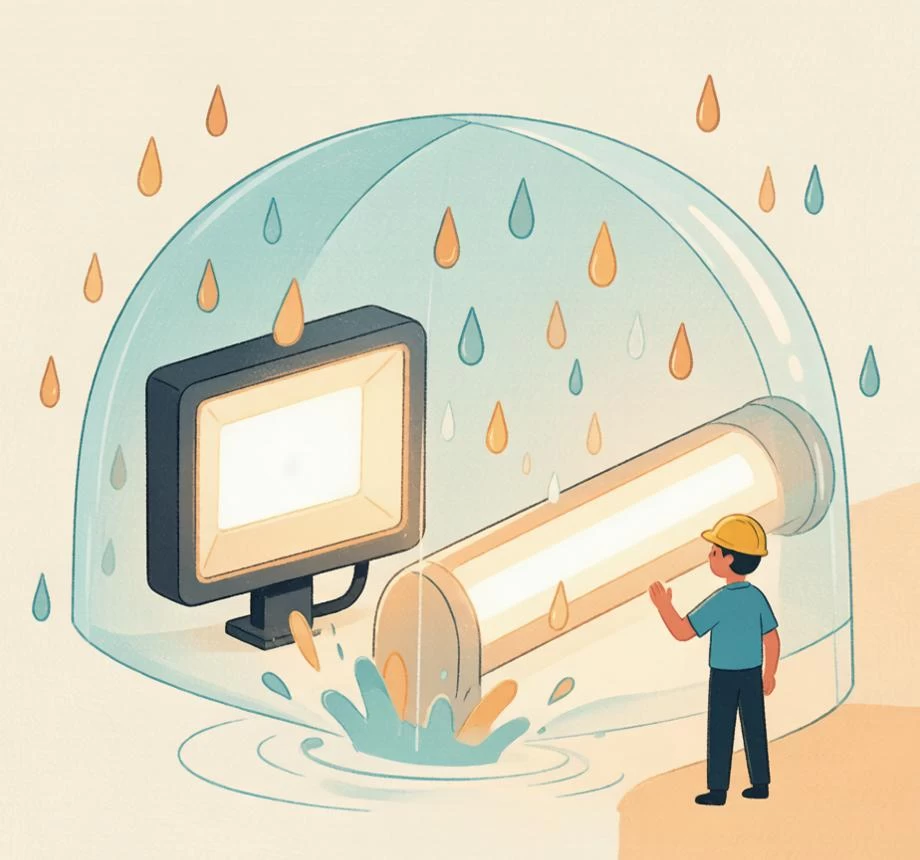
What an IP Rating Actually Tells You
Most lighting buyers see "IP65" on a datasheet and assume it means "waterproof." That shorthand works in casual conversation but fails exactly when it matters — on an outdoor wall pack, a tunnel luminaire, or a high-bay in a wet factory.
IP stands for Ingress Protection. The rating is two digits that describe two separate things: the first digit rates protection against solid objects and dust, the second against water. They are not one combined "weatherproof" score; they are two independent measurements.
An IP65 fixture is 6 for dust and 5 for water. If a supplier tells you "IP65, fully waterproof," they have collapsed two different ideas into one — and that collapse is where specification mistakes begin.
The First Digit: Solid Object and Dust Protection (0–6)
The first digit runs from 0 to 6. The values buyers actually use sit at the top of the scale:
- IP5X — dust-protected: limited dust ingress, but not enough to interfere with operation.
- IP6X — dust-tight: no dust ingress at all, verified under a vacuum test.
For a tunnel or an industrial environment with airborne particles, IP6X matters more than most people realize. Dust that settles on LEDs and drivers acts as an insulating blanket, raising temperature and accelerating lumen depreciation. A fixture that is IP65 but only "dust-protected" on paper will behave differently from one that is fully dust-tight.
The Second Digit: Water Protection (0–9)
The second digit is the one buyers focus on, and the one most often misread. The critical values:
- IPX5 — protected against water jets from a 6.3 mm nozzle at low pressure, from any direction.
- IPX6 — protected against powerful water jets from a 12.5 mm nozzle at high pressure.
- IPX7 — protected against temporary immersion in up to 1 meter of water for 30 minutes.
- IPX8 — protected against continuous immersion, with depth and duration specified by the manufacturer.
The mistake to avoid: the digits do not stack upward automatically. A fixture rated IPX7 (immersion) is not automatically IPX6 (powerful jets). Immersion and jet tests are different stresses, and a product can pass one while failing the other. This matters in practice because many outdoor fixtures face high-pressure cleaning or driving rain, not submersion.
IP65 vs IP66 vs IP67: Where They Actually Differ
This is the comparison that decides most outdoor and tunnel specifications:
Rating | What it survives | Typical use |
IP65 | Dust-tight + low-pressure water jets | Outdoor wall packs, parking lot lights, general exterior |
IP66 | Dust-tight + powerful high-pressure jets | Tunnels, washdown areas, coastal or storm-exposed sites |
IP67 | Dust-tight + temporary immersion | Flood-prone areas, submerged wells, special duty |
The practical difference between IP65 and IP66 is water pressure. If the fixture will be hit by driving rain at speed, by tunnel washing equipment, or by a pressure washer during maintenance, specify IP66. If it only faces normal rain and occasional splashes, IP65 is usually sufficient — and often cheaper, because the higher seal rating adds gasket and housing cost.
Don't Confuse IP with the IK Impact Rating
IP measures dust and water. It says nothing about physical abuse. A separate rating, IK, measures resistance to mechanical impact, from IK00 to IK10.
Outdoor and tunnel fixtures are frequently specified as "IP66 + IK08" or "IP66 + IK10." The IP part keeps water out; the IK part means the housing survives a knock or an act of vandalism. When you buy a fixture for a public space, ask for both numbers — a "weatherproof" light with no IK rating will crack the first time a vehicle or a branch hits it.
Why Moisture Is a Lighting Killer
Water does not just stop a fixture; it accelerates every failure mode at once:
- Driver short circuits — moisture bridges the circuit and kills the power supply instantly.
- Electrolytic capacitor failure — humidity plus heat dries out capacitors, and the driver dies.
- Corrosion — terminals and PCB traces corrode, raising resistance and heat.
- Accelerated lumen depreciation — moisture on the LED package degrades the phosphor and optics faster.
There is also a subtler enemy: thermal breathing. As a fixture heats up and cools down each day, air inside expands and contracts, drawing moist air in through any seal that is not perfect. Over months, that cycle pumps water vapor into the housing. This is why a good outdoor fixture needs not just a tight seal but a breathing valve (a vent that lets pressure equalize while blocking water) — and why cheap fixtures with a plain O-ring often fail after one or two seasons.
How to Pick the Right Rating by Application
The rule of thumb: match the rating to the worst condition the fixture will actually face, not to the most extreme number available.
Application | Typical requirement |
Office, retail, residential interior | IP20 |
Warehouse, factory floor (dry) | IP54–IP65 |
Outdoor wall pack, parking lot | IP65 |
Tunnel, metro, coastal, washdown | IP65–IP66 |
Solar street light, exposed poles | IP66 |
Submerged or special duty | IP67–IP68 |
Two notes. First, higher is not always better: a sealed IP66 housing traps heat, so the driver and LEDs must be sized and thermally managed for the extra enclosure. Second, an IP rating is only as good as its testing — always ask for the certificate, not just the printed number.
The Bottom Line
IP ratings are simple to read and easy to get wrong. The buyer who survives a wet tunnel or a stormy coastal season is the one who specified two digits, checked the certificate, separated IP from IK, and remembered that a sealed fixture also has to breathe and cool.
At Solarix Lighting, our outdoor, tunnel, and solar street-light fixtures are engineered and third-party tested to IP65 and IP66 with fully potted drivers and breathing-valve housings, so the protection on the label is the protection in the field. Tell us the location, exposure, and cleaning method for your project, and we will specify the exact IP and IK ratings that keep your lighting running through the worst weather it will face.