Why a Case Study Matters More Than a Catalog
A datasheet tells you what a luminaire is supposed to do. A project case study tells you what it actually did — for years, under real conditions, in a building that could not afford to go dark.
For B2B buyers the difference is decisive. You are not buying one fixture. You are committing to thousands of units across a station, a tunnel or a terminal, where a single early failure means expensive access, downtime and a damaged reputation with your own client.
The problem is that most case studies are marketing first and evidence second. This guide shows you how to separate the two, so you can judge a supplier on what they proved, not what they promised.
What a Credible Case Study Should Tell You
Before you believe any project reference, check whether it answers these five questions.
1. Where and how long did it operate?
A light that works for six months in a clean showroom proves very little. Ask for the real environment — dust, vibration, humidity, temperature swings — and the total operating hours. A metro tunnel fixture that has run 24/7 for three years carries far more weight than a demonstration install.
2. What lighting performance was actually measured?
Look for numbers, not adjectives. A credible case reports lux levels on the working plane, color rendering (CRI, and ideally R9), color consistency (SDCM) and illuminance uniformity. "Bright and comfortable" is not a specification — it is an opinion.
3. What was the failure and maintenance record?
Ask how many fixtures were installed and how many failed in the first one to three years. A supplier who quotes a driver MTBF of 50,000 hours but cannot share field failure rates is already telling you something useful.
4. Who can verify it?
A real project has a name, a location and a client. Ask whether you can speak to the installer or facility manager, or at least receive dated documentation. An anonymous "major European airport" claim is worth almost nothing.
5. What happened after handover?
Good projects produce repeat orders. Ask whether the client expanded the contract, ordered again, or extended the same scheme to a second site. Repeat business is the only testimonial that costs the client real money.
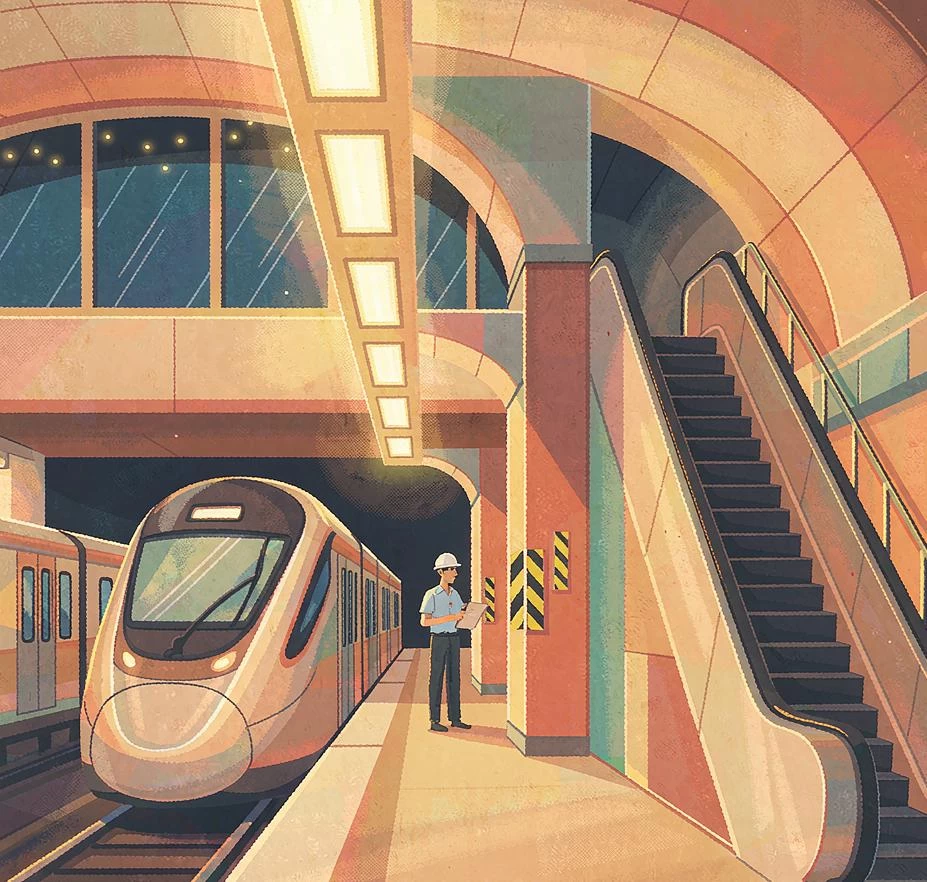
Reading a Rail Transit Case Study
Rail and metro are the toughest test an LED luminaire can face. When you review a metro station or tunnel reference, look for these specifics.
Vibration and mechanical integrity. Trains create constant low-frequency vibration. Ask whether the mounting, lens and internal wiring were designed and tested for vibration resistance, and whether any units loosened or rattled over the operating years.
24/7 operation and lumen maintenance. Tunnel lighting often runs continuously. Ask for the L70 lifetime at the actual ambient temperature — not at the idealized 25°C printed in catalogs. Inside a tunnel, trapped heat can cut real lifetime significantly.
Emergency and control integration. Station lighting usually ties into emergency circuits and a DALI or wireless control network. A strong case will mention dimming, scene control and how the luminaires behaved during a simulated power loss.
Glare and platform uniformity. UGR limits and uniform vertical illuminance along platform edges matter for both passenger comfort and CCTV recognition. A credible metro case cites these measured values.
Reading an Airport or Transit Hub Case
Airports add scale, high ceilings and strict glare control. When you evaluate an airport terminal or railway station reference, check these points.
High mounting heights demand precise optics that place light where people are, instead of scattering it into a void. Ask for the beam angle and the spacing-to-height ratio actually used on site.
Glare control. Terminals are full of reflective floors and glass. A UGR below 19 in circulation areas is a meaningful target, and the case should say whether it was verified.
Maintenance access. Replacing a fixture 12 metres up is expensive. Ask whether the reference mentions tool-free access, long-life drivers or planned maintenance intervals.
Large-batch consistency. A single terminal can use tens of thousands of panels. Ask how the supplier guaranteed visual consistency — for example SDCM ≤ 3 — across every delivered batch.
Five Questions to Ask Any Supplier
Before you shortlist anyone, send these five questions about every case study they present:
- Can you name the project and put me in touch with the client or installer?
- What was the operating environment and the total installed quantity?
- What lux, CRI, UGR and uniformity values were measured after installation?
- What was the first-three-year failure rate, and how were failures handled?
- Was the contract repeated or extended?
A supplier who answers all five clearly is worth your time. A supplier who dodges them is already showing you how they will behave after handover.
About Solarix Lighting: Guangzhou Solarix Lighting Technology Co., Ltd. engineers reliable LED lighting for commercial, rail transit, tunnel, airport and municipal projects. From high-CRI panel lights to vibration-rated rail fixtures, we back every quote with verifiable project data. Planning a station, tunnel or terminal upgrade? Contact us to review our case documentation.