
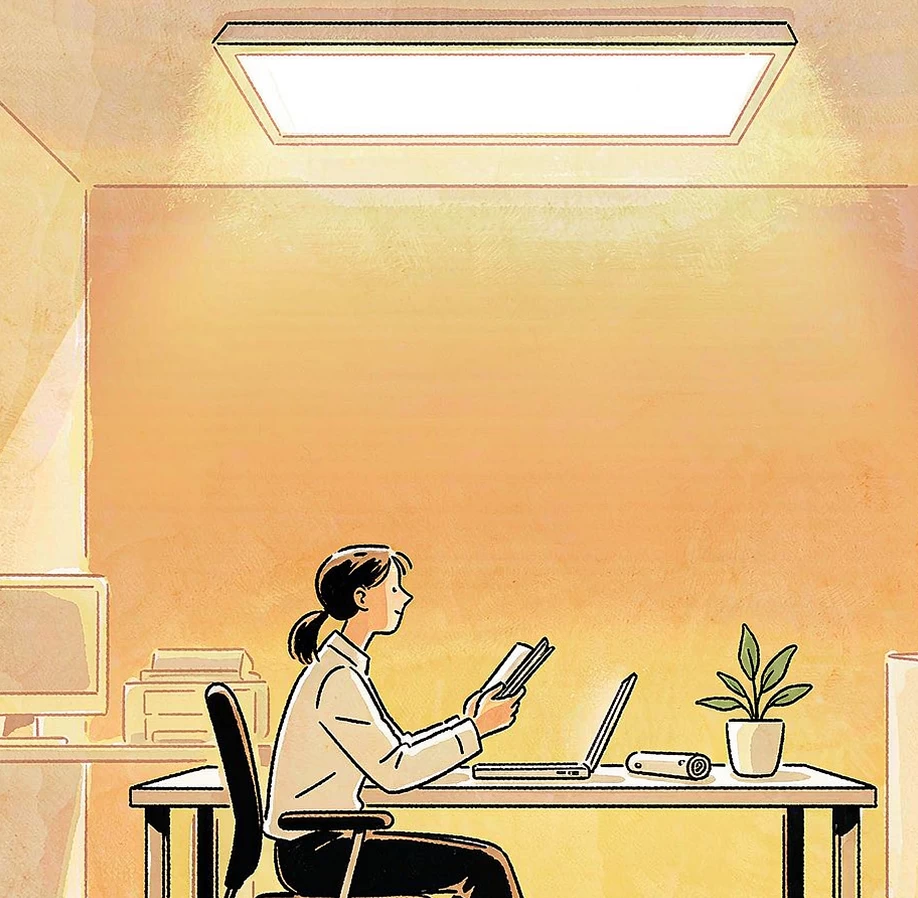
Why Buyers Should Care About Glare, Not Just Brightness
Most lighting procurement starts with lumens and wattage. But two fixtures with identical output can feel completely different once installed — one comfortable to work under, the other harsh and tiring. The difference is usually glare, and the number that measures it is UGR.
Glare is the discomfort or loss of visibility caused by a light source that is too bright relative to its background. In an office or classroom, glare is the reason staff complain of headaches and eye strain even when the room looks "bright enough." For a B2B buyer, UGR is one of the cheapest ways to avoid a finished project that the client rejects.
What UGR Actually Measures
UGR stands for Unified Glare Rating, defined in the international standard CIE 117 and used in the European workplace lighting standard EN 12464-1. It is a single number that combines several factors into one discomfort score:
- Luminance of the luminaire — how bright the visible light-emitting surface is, not just how many lumens it puts out.
- Background luminance — how bright the surrounding room is.
- Solid angle of the source — how large the light surface appears from the observer's position.
- Position factor — where the fixture sits in the viewer's field of vision.
The result runs on a scale where a lower number means less glare. In practice, commercial spaces live between roughly 10 and 30:
- UGR < 10: imperceptible glare — museum or high-end detail work.
- UGR 10–16: comfortable for demanding tasks such as classrooms and drawing offices.
- UGR 16–19: acceptable for general office and reading work.
- UGR 19–22: tolerable for circulation areas and some industrial tasks.
- UGR > 22: noticeable glare, generally uncomfortable for long periods.
The Numbers That Matter by Space
When you write a specification, cite the target UGR for the space, not just "low glare." Common benchmarks under EN 12464-1:
Space | Typical UGR limit |
Offices, general work | ≤ 19 |
Classrooms, drawing, precision tasks | ≤ 16 |
Hospital wards and treatment rooms | ≤ 19 |
Retail and reception areas | ≤ 22 |
Industrial workshops and corridors | ≤ 25 |
The tighter the task, the lower the UGR you should require. A classroom at UGR 19 is legal in some regions but visually demanding for children reading for hours; UGR 16 or better is the standard most education projects now specify.
Why Two Fixtures With the Same Lumens Feel Different
This is the concept that trips up most first-time buyers. Lumens measure total light output; UGR measures how uncomfortably that light reaches the eye. A bare 40 W LED tube and a large 40 W panel can emit the same lumens, yet the tube has a small, intensely bright surface while the panel spreads the same light over a much larger, dimmer surface.
The panel scores a far lower UGR because its luminance — the light per unit area — is low. That is why "panel light" and "low glare" so often go together in office and classroom specifications.
How Manufacturers Control Glare
Suppliers reduce UGR through three main levers:
- Optics: micro-prismatic or opal diffusers that spread light and soften the peak brightness of each LED chip.
- Recess and shielding: sinking the light source deeper into the housing so it is hidden from normal viewing angles.
- Surface area: larger luminous panels with lower luminance per square centimeter.
A well-engineered panel can reach UGR < 19, and many education-grade panels hit UGR < 16. When a datasheet lists a UGR value, check the reference room it was measured in — UGR is not a fixed property of the fixture alone. The standard calculation assumes a reference room with defined dimensions, mounting height, and surface reflectance, so always ask the supplier for the test conditions.
The Bottom Line
Glare is the difference between a room that is merely lit and a room people can actually work in. Specifying UGR — not just lumens — is the fastest way to deliver a commercial or education lighting project your client approves on the first walkthrough.
At Solarix Lighting, our low-glare LED panels are engineered with micro-prismatic optics and high-transmission diffusers to hit UGR < 19 for offices and UGR < 16 for classrooms, and we can supply the test reports to back the numbers. Tell us your space, mounting height, and target UGR, and we will help you specify a fixture that is bright where it counts and comfortable where it matters.