
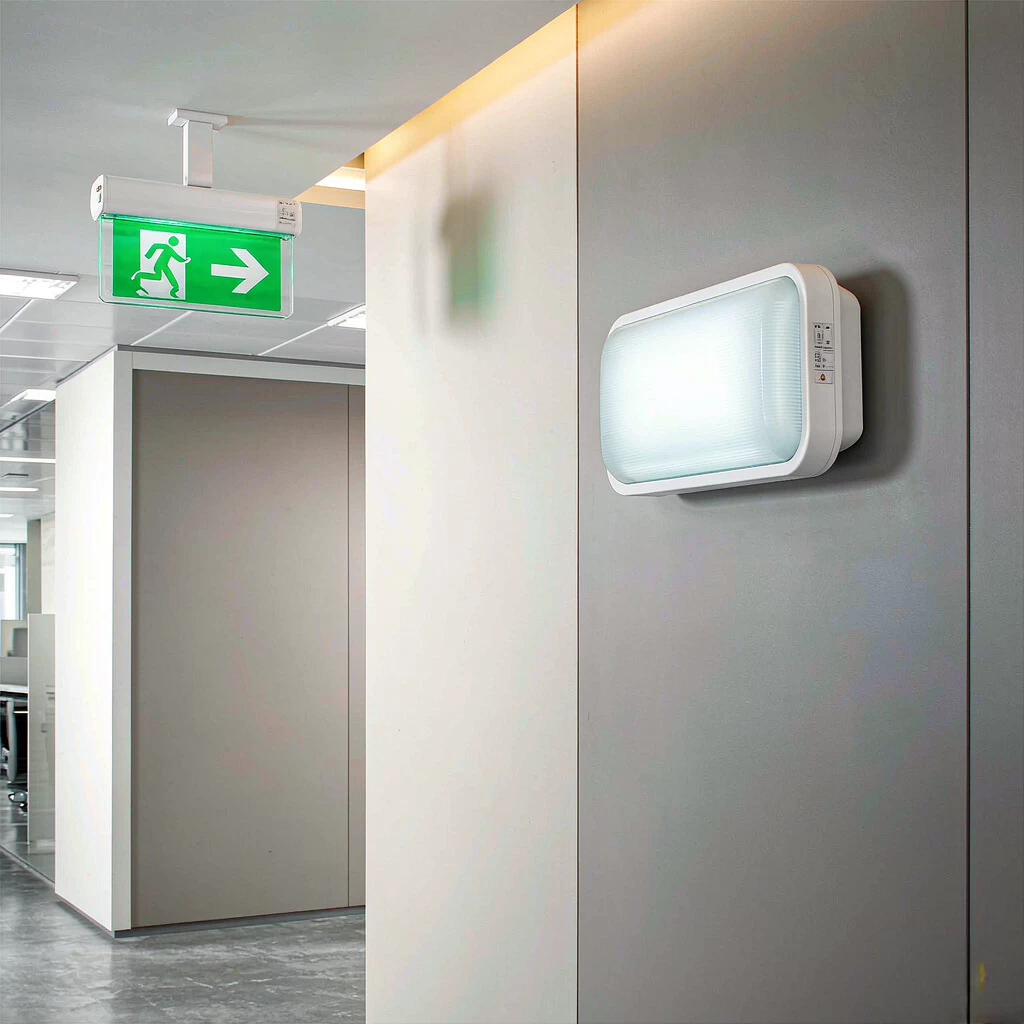
Emergency lighting is not an upsell. In most commercial, industrial and transit buildings it is a legal requirement. When the main power fails, emergency luminaires must switch on within seconds and hold enough light for people to evacuate safely. If they don't, the cost is not a dim corridor — it is a failed inspection, an insurance dispute or, in the worst case, a liability that no contractor wants to own.
This guide explains the types, the key parameters and the certifications you should verify before you buy, so you can specify emergency lighting with confidence and avoid the two most common procurement mistakes: buying on price alone and trusting a supplier's word without a test report.
Emergency Lighting Is a Compliance Requirement, Not an Option
Three standards shape most international projects:
- North America: NFPA 101 (Life Safety Code) and UL 924 for equipment.
- Europe: EN 1838 for application and EN 60598-2-22 for luminaires.
- China: GB 17945 for fire emergency lighting and evacuation indication.
What matters for a buyer is that these standards define measurable minimums: how bright the escape route must be, how long the light must last, and how quickly it must turn on. An inspector does not ask whether the luminaire "looks bright"; he measures illuminance with a meter and checks the rated duration. That is why a generic product without a compliance test report is a project risk, even if the price is attractive.
The Four Types of Emergency Luminaires You Need to Know
Emergency lighting is not one product. A complete system usually mixes four types, each with a different job.
Exit Signs
Exit signs mark the route to safety. They use a running-man pictogram (or "EXIT" text in North America) and must remain visible for the full rated duration. Modern LED exit signs run at a few watts, so battery backup is cheap and runtime is long. Verify the viewing distance rating and the pictogram standard required in the target market.
Escape-Route Luminaires
These light the corridor or stairway itself so people can see the floor and obstacles. EN 1838 requires at least 1 lux on the centre line of an escape route (0.5 lux in some cases), with a uniformity ratio no worse than 40:1. In practice this means luminaires must be spaced and aimed correctly — a point many low-cost suppliers ignore.
High-Risk Task Area Luminaires
In plant rooms, switchgear rooms or areas with moving machinery, people need enough light to shut down equipment safely before leaving. Requirements here are stricter — often 10% of normal operating illuminance or more — and the light must appear within 0.5 seconds. This is where a cheap driver or a slow-starting power supply fails.
Anti-Panic / Open-Area Luminaires
Large open areas such as shopping halls, lobbies and warehouses need low-level illumination so people do not panic. The goal is visibility of the space and exit directions, typically 0.5 lux at floor level. These are often combined with normal luminaires in a maintained or non-maintained configuration.
Key Parameters to Verify Before You Buy
Rated Duration
Most projects specify 1 hour or 3 hours. The 3-hour rating is common in Europe; 90 minutes is a typical North American requirement. Confirm the duration is measured at the end of the battery life, not when the battery is new, because batteries degrade.
Battery Chemistry and Lifespan
Three chemistries dominate: nickel-cadmium (NiCd), nickel-metal hydride (NiMH) and lithium iron phosphate (LiFePO4). NiCd is proven and tolerant of high temperatures but has environmental restrictions in some markets. LiFePO4 offers longer cycle life and lower weight, and is becoming the default for new designs. Ask for the rated battery life — often 4 to 5 years — and whether the battery is replaceable on site, because that determines the total cost of ownership.
Self-Test and Central Monitoring
IEC 62034 defines automatic test systems for emergency lighting. A self-test luminaire checks its own lamp and battery at intervals and reports a fault with a visible indicator. Central monitoring goes further: DALI or wireless systems collect status from every luminaire and alert the facility manager. For large buildings this turns a monthly manual walk-through into an automatic report. If your project is large, specify self-test or monitored units from day one.
Illuminance, Uniformity and Start Time
Write the numbers into the specification: minimum lux on the escape route, uniformity ratio, and switch-on time. A compliant luminaire should reach full emergency output in a few seconds. These are the figures an inspector will measure, so they should be in the supplier's datasheet, not just a claim.
Certifications and Test Reports That Matter
A datasheet that says "CE" is not enough. Ask for the specific standard:
- UL 924 for the North American market.
- EN 60598-2-22 and, where relevant, EN 1838 for Europe.
- GB 17945 for projects in China.
- IEC 62034 for automatic test systems.
Request the actual test report or certificate number and verify it against the issuing body's database. A legitimate manufacturer can provide this in days. A supplier that hesitates is usually reselling an untested product.
A Practical Procurement Checklist
Before you place an order, confirm:
- The exact standard required by the project (region and building type).
- Rated duration (1 h, 90 min or 3 h) and battery life.
- Escape-route illuminance and uniformity figures in the datasheet.
- Battery chemistry and whether it is field-replaceable.
- Self-test or central-monitoring support if the building is large.
- A copy of the test report or certificate, not just a logo on the label.
- Lead time, warranty and after-sales support for replacement parts.
Conclusion: Specify Emergency Lighting Like a Contractor, Not a Shopper
Emergency lighting is judged by compliance and reliability, not by how it looks in a catalogue. The buyers who avoid problems are the ones who lock the measurable parameters — duration, lux, uniformity, battery type and certification — into their specification before comparing prices. Once those numbers are fixed, price comparison becomes fair and safe.
At Solarix Lighting, we engineer LED emergency and evacuation luminaires for commercial, industrial and rail-transit applications, with the compliance documentation and field-replaceable battery options that project buyers actually ask for. If you are specifying an emergency lighting system and want a supplier that can back up its datasheet with test reports, talk to our team — we will help you match the right luminaires to your standard and budget.