Why Surge Is the Hidden Line Item in Your Maintenance Budget
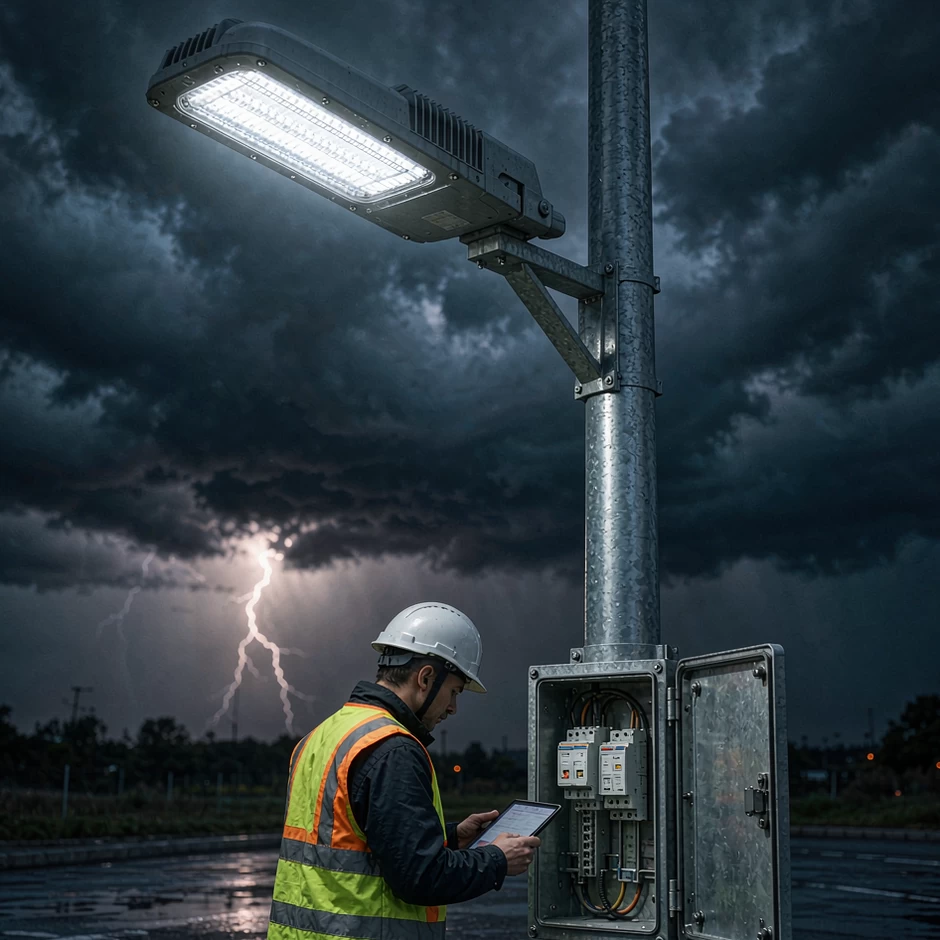
On top of the steady 50 or 60 Hz sine wave ride short, violent spikes. Some come from lightning striking the ground or a structure nearby. Others come from switching: a large motor starting, a capacitor bank stepping, a transformer being energised. The first is rare and enormous; the second small and constant.
Both find the weakest point in the fixture: the driver input stage — rectifier bridge, PFC switch and input capacitors on a board with millimetre-scale clearances.
Once a varistor inside the driver has absorbed a few dozen events it degrades. The fixture fails three months later, in clear weather, and everyone blames the driver brand. Surge protection belongs in the specification, not in the warranty claim.
How ANSI C136.2-2023 Grades Surge Immunity
For roadway and area lighting in North America, the governing document is ANSI C136.2-2023, "Dielectric Withstand and Electrical Transient Immunity Requirements". It covers luminaires and control devices up to 600 V and grades transient immunity into three levels: withstand voltage over discharge current.
| Exposure level | Surge rating | Typical application |
|---|---|---|
| Typical | 6 kV / 3 kA | Urban local streets, buried feeders, low lightning density |
| Enhanced | 10 kV / 5 kA | Arterial roads, coastal corridors, moderate storm exposure |
| Extreme | 20 kV / 10 kA | High masts, open plains, desert sites, unstable grids |
Read the pair as voltage over current, tested with a 1.2/50 µs open-circuit voltage wave paired with an 8/20 µs short-circuit current wave. "Withstand voltage" alone is half a specification.
Two rules follow. The standard tests the luminaire and the surge protective device together, so an SPD module datasheet alone does not prove the luminaire passes. And it does not evaluate bare components — those sit under UL 1449 in North America and IEC 61643-11 internationally.
Matching the Level to the Site, Not to the Price List
Choosing the highest level everywhere wastes money; choosing the lowest everywhere wastes fixtures.
Use the electrical environment. A quiet residential street with buried feeders sits at Typical. An arterial road along a coastline, or a corridor with repeated storm records, belongs at Enhanced. A high mast on an open plain, or a site on an unstable grid with documented switching transients, justifies Extreme.
A second, cheaper decision sits on top: where the protection physically lives.
Built-in protection is a surge module or surge-rated driver mounted inside the luminaire at the factory, tested with the fixture and covered by the fixture warranty. On new projects this is usually right, because SPD-to-driver coordination is already verified.
Field-installed modules are Type 4CA components added at the pole base. They suit retrofits, and let a crew replace a sacrificed protector without touching the fixture. Many municipalities specify built-in protection at the chosen level and keep field modules as spares.
Wide input voltage range is a third, quieter layer. A driver rated AC 85–265 V rides out slow grid swells and sags that fast clamping devices never address, because those last seconds or minutes rather than microseconds.
Differential Mode vs Common Mode: The Two Numbers Behind One Rating
Most datasheets print a single number. Better ones print two, and the difference decides whether your fixtures survive.
Differential mode (DM) is the transient between line and neutral. It appears across the driver's AC input terminals and threatens the rectifier bridge, the PFC MOSFET and the input capacitors. Outdoors, most DM events come from switching — inductive loads sharing the feeder, capacitor bank operations, load shedding.
Common mode (CM) is the transient between the live conductors and protective earth. It appears when lightning strikes ground near the installation and raises local earth potential relative to the remote earth of the power line. CM events can break down insulation between the AC input and the earthed housing — a reliability and a safety failure.
Industry thresholds are well established. Indoor commercial drivers typically carry around 1 kV DM / 2 kV CM. Outdoor IP65 and IP67 drivers commonly carry 4 kV DM / 4 kV CM. Premium street and floodlight drivers reach 6 kV DM and 6 or 10 kV CM.
Lighting-specific minimums sit in IEC 61547, with the test method in IEC 61000-4-5. That method defines five levels — 0.5, 1, 2, 4 and 6 kV — plus an "X" level the product standard may set anywhere. Most claims above 6 kV are X levels, which is why they must be read with the waveform, the current and the mode.
The Three-Element Acceptance Check
A complete surge specification has three elements: withstand voltage in kV, discharge current in kA, and mode (differential, common, or both). Drop any one and the number becomes unusable. A quote claiming "10 kV surge protection" with no current figure and no mode cannot be compared against the Enhanced level of ANSI C136.2-2023.
Build the check into your RFQ as four clauses:
- State the required exposure level and name the standard with its year edition.
- Require the surge test report with the SPD installed in the luminaire, not the module datasheet alone.
- Require DM and CM figures separately, both in kV, with the test level and waveform stated.
- Require the driver make and model to be named and locked, so a substitution cannot silently change the input stage.
Then add the site-specific clause. In lightning-prone regions, an external Type 2 SPD in the pole base is worth specifying regardless of the luminaire rating: it absorbs the big events, so the driver only ever sees a residual clamp.
One caution: a "6 kV" rating means the device survived ten positive and ten negative pulses at that level, under the specified coupling network, at a stated ambient temperature. It does not mean the fixture survives a direct lightning strike — that is a question of earthing, bonding and, where appropriate, an air termination system.
Where Solarix Lighting Fits
Solarix Lighting (Guangzhou Xuyuan Lighting Technology Co., Ltd.) builds outdoor and transit lighting for projects that cannot afford to replace fixtures every storm season. On North American roadway, tunnel, car park and industrial programmes we quote surge-rated driver platforms with DM and CM figures stated separately, plus an external SPD option for exposed corridors. Surge is a specification line for us, not an accessory — which is why our RFQ templates ask for test reports with the protector installed.
Our project background is rail transit — more than twenty metro projects, Baiyun Railway Station, Baiyun Airport Terminal 3 and municipal road lighting programmes — where electrical environment quality is verified, not assumed. That is why we can tell you before tender which exposure level a corridor really needs.
Writing a roadway or industrial lighting specification and want the surge clauses checked before tender? Send us the electrical environment — feeder type, lightning exposure, pole height, driver preference — and we will return the surge level, the DM/CM breakdown and the driver platform itemised.