
Why "same Kelvin" is not "same color"
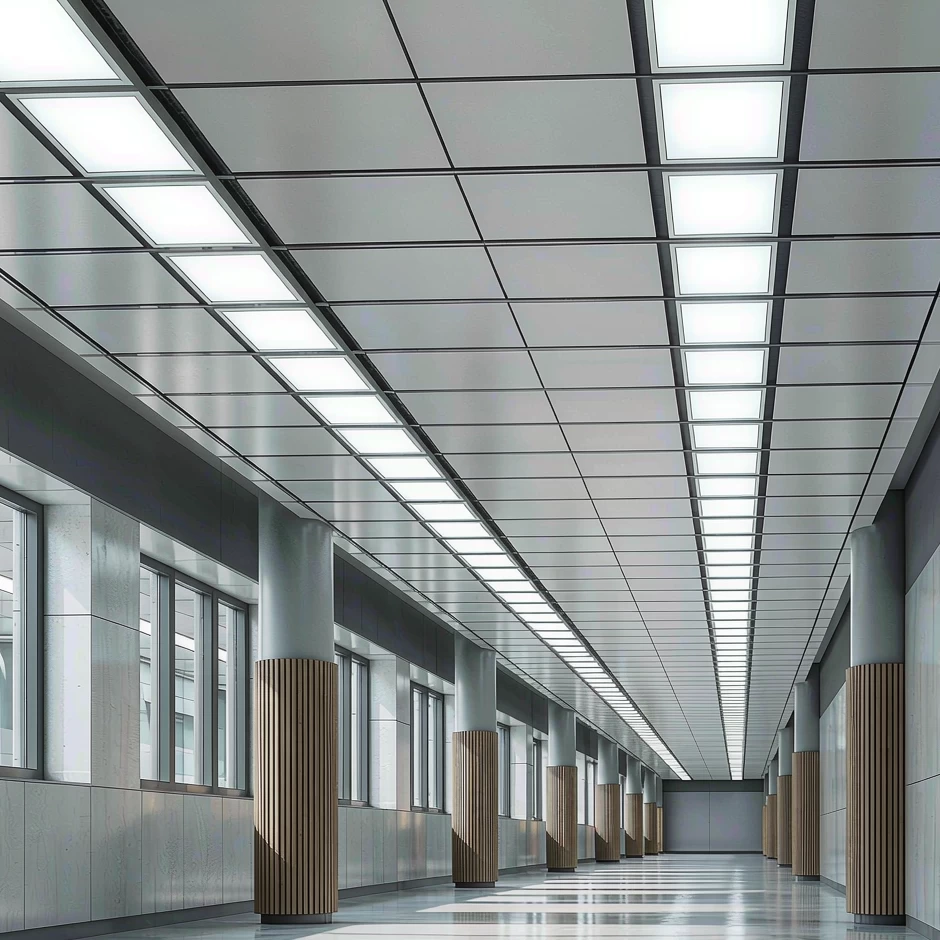
Open two boxes of 4000K panel lights from different lots and mount them on the same ceiling. It is common to see one panel look slightly warm, the next slightly green, and a third faintly pink. The label says the same CCT, but the eye still catches the difference. On a metro platform, in an open office, or across a retail rollout, that mismatch reads as poor quality even when every fixture is "within spec."
The cause is simple: every LED chip is made slightly differently. The phosphor mix, die temperature, and package tolerance all shift the exact chromaticity. Without tight sorting, a 4000K bin can still span a visibly different range of white.
What SDCM actually measures
SDCM stands for Standard Deviation of Color Matching. One SDCM step equals one MacAdam ellipse — a region on the CIE color diagram inside which most people cannot tell two whites apart. ANSI C78.377, the standard most North American buyers reference, defines popular bins as 4-step and premium bins as 2-step or 3-step.
So when a datasheet says "4 SDCM," it promises the light falls within four MacAdam steps of the target point. That is tighter than "4000K ± 200K," but it is not perfect. A 4-step bin can still contain a visible spread between fixtures, especially on a large flat ceiling where the eye compares them directly.
MacAdam ellipse, in plain terms
Imagine drawing small oval zones around the target white point on a color map. Each oval is one just-noticeable step. Move outside the oval and the average person sees a tint shift. SDCM counts how many of those ovals sit between your fixture's actual color and the target.
Two takeaways for specifiers
- A lower SDCM number means tighter matching. ≤3 SDCM is a sensible requirement for offices, schools, and transit spaces; ≤2 SDCM for color-critical areas like galleries or broadcast.
- SDCM describes distance from the target, not the tint direction. A fixture can be "within 3 steps" yet sit slightly green or pink relative to neighbors. That is why single-bin, single-batch supply matters more than the number alone.
CCT, Duv, and the tint you can't see on the box
CCT (Correlated Color Temperature) is a single number that approximates the color of a black-body radiator. But two lights with the same CCT can have different Duv — the distance above or below the Planckian locus. Positive Duv looks pink or rosy; negative looks green. Specifying only "4000K" says nothing about Duv, so the green-versus-pink problem slips through.
Good procurement asks for both: a CCT target and a Duv window (for example −0.003 to +0.003). LM-79 photometric reports list CCT and Duv, so request one per batch.
High CRI does not mean "matches the next one"
A common assumption is that a high-CRI panel will automatically match its neighbor. It will not. CRI and R9 measure how faithfully a light renders colors; SDCM measures how close two lights are to each other. A 95-CRI panel and an 80-CRI panel can share the same CCT, and two 95-CRI panels from different bins can still look different. Treat color rendition and color consistency as two separate specs.
Why batches drift, and how to stop it
Even fixtures from the same SDCM bin can drift between production runs made months apart. Phosphor batches, driver tuning, and assembly lots all shift over time. For a 5,000 m² office or a 20-station rail line, that means the fixtures shipped in March may not match the ones shipped in September.
Three controls that stop drift
- Single-bin requirement — all fixtures must come from one MacAdam bin, not just "≤3 SDCM" loosely.
- Same production lot — request one continuous lot for the whole project, or at least one lot per building zone.
- Batch color report — ask for an LM-79 chromaticity reading per shipment so you can verify before installation.
RFQ clauses that actually prevent complaints
When you write the request for quotation, turn the above into numbered requirements.
A clause set to paste into your RFQ
- Chromaticity: CCT per IES TM-30 / ANSI C78.377, SDCM ≤ 3 (≤2 for color-critical areas).
- Duv window: −0.003 to +0.003.
- Supply: single bin, single production lot for the entire order; mixed lots rejected.
- Documentation: LM-79 report with CCT, Duv, and SDCM for each batch.
- Sample approval: supplier ships 3–5 sample fixtures for on-site viewing before full delivery.
- No brand or series mixing on the same ceiling plane.
A real fix from the field
A transit concourse we supported had been fitted with 4-step-bin panels from two deliveries. Passengers and staff noticed faint stripes of warmer and cooler light along the platform. The remedy was not brighter fixtures — it was re-specifying the remaining phases to a single 3-step bin, one lot, with a Duv window, and a sample wall-check before rollout. The visible stripes disappeared.
Summary
Color consistency is not a luxury spec; on large ceilings it is the difference between "professional install" and "cheap retrofit." Specify SDCM, Duv, single-bin and single-lot supply in writing, and verify with batch reports and a sample check before you commit the whole order.
At Solarix Lighting we bin and sort panel and luminaire families at the fixture level, offer ≤3 SDCM options for offices, schools, and transit projects, and ship rail and commercial rollouts from a single matched lot so the white you approve is the white you get across the whole site.