
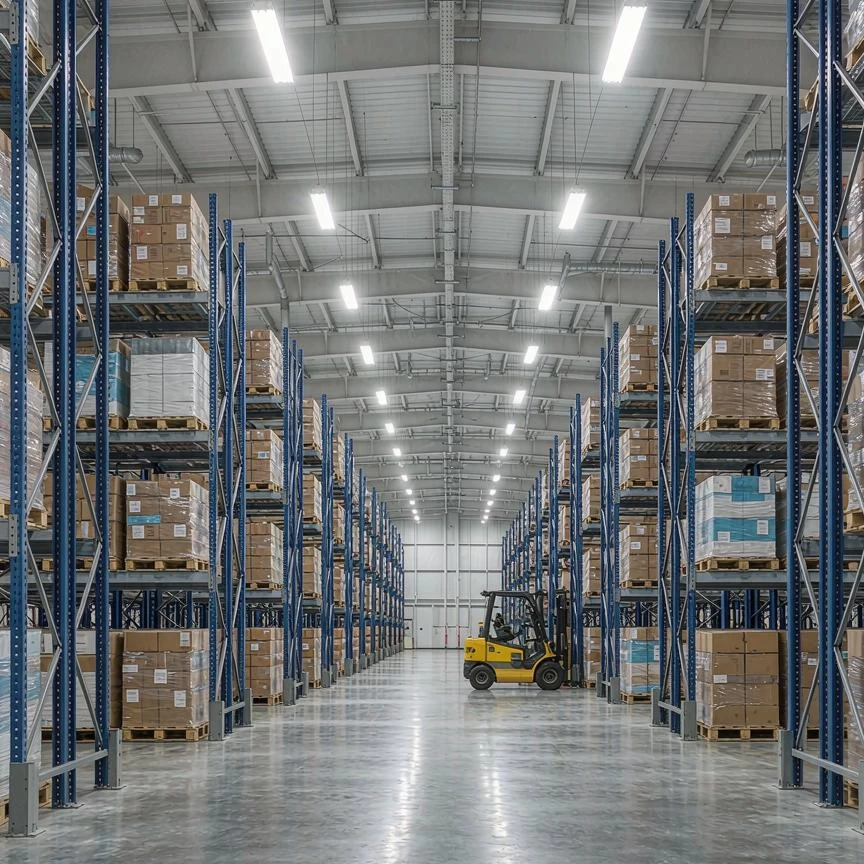
Industrial lighting is not like office lighting. The ceilings are high, the working hours are long, and the cost of getting it wrong — in energy, productivity, and maintenance — compounds for years. Yet most RFQs still lead with a wattage number, which tells you almost nothing about whether a high bay fixture will actually light the floor below it.
This guide covers the seven decisions that matter when specifying LED high bay lights for warehouses, factories, and logistics facilities.
1. Start with mounting height, not wattage
The first number to write down is how high the fixture will be mounted, because that determines everything else.
- 4–6 m (13–20 ft): low bay range. A wide-beam fixture with 100–140 lm/W is usually enough.
- 6–12 m (20–40 ft): the classic high bay zone. You need optics designed to push light down without creating a bright spot directly under the fixture.
- Above 12 m (40 ft): a narrow-beam or lensed optic is required; otherwise most of the light spreads sideways and never reaches the floor.
Wattage is a poor proxy for light. Two 150 W high bay fixtures can differ by 30% in delivered lumens. Compare lumen output (lm) and efficacy (lm/W) instead, and always ask for the delivered or "system" lumens, not bare LED chip lumens.
2. Set a target illuminance for each zone
Different work needs different light. A single uniform lux number for an entire warehouse is usually wrong and wasteful.
- Storage aisles and low-traffic corridors: 100–150 lux
- General handling and rack picking: 200–300 lux
- Order picking, packing, and labeling: 300–500 lux
- Precision assembly and inspection: 500–750 lux
Reference the relevant standard for your region (EN 12464-1 in Europe, IES recommendations in North America) and specify uniformity, not just average lux. A 300 lux average with a uniformity ratio below 0.4 means bright islands and dark gaps — exactly what you are trying to avoid.
3. Match beam angle and spacing to the layout
High bay optics come in wide, medium, and narrow distributions. The rule of thumb is simple: higher mounting height needs a narrower beam to get light down to the work plane.
- Wide beam (110–120°): low ceilings, wide aisles, and areas where fixtures are spaced far apart.
- Medium beam (90°): general warehouse lighting between 6–10 m.
- Narrow beam (30–60°): high ceilings above 10 m, and tall racking where light must reach the floor between aisles.
Then check the spacing-to-mounting-height ratio (SHR). If your fixtures are mounted at 8 m and spaced 12 m apart, the SHR is 1.5 — most medium-beam high bays are designed for an SHR around 1.0–1.5. Beyond that, expect dark patches. A quick DIALux or RELUX layout simulation costs nothing at the quoting stage and prevents a very expensive mistake after installation.
4. Choose IP and IK ratings for the actual environment
The enclosure rating is decided by what is in the air.
- Clean, dry warehouse: IP20 or IP40 is adequate.
- Dusty production, food processing, or humid areas: IP54 or IP65 with a sealed driver.
- Washdown or outdoor-loading docks: IP65 minimum, and confirm the gasket material.
Also check the IK (impact) rating if forklifts or tall racking operate nearby, and consider a polycarbonate or tempered-glass lens that will not yellow over time. In high-temperature environments — foundries, kilns, rooftop mezzanines — verify the driver's maximum ambient temperature (often 45–55 °C) and derate the fixture if needed, because heat is the single biggest killer of LED lifetime.
5. Pick color temperature and CRI for the task
- 4000K neutral white is the default for warehouses and logistics: bright, alert, and consistent.
- 5000K is common in manufacturing where workers need maximum visual acuity and the space feels like daylight.
- Avoid warm 3000K for industrial task lighting unless it is a specific design requirement.
For zones where color matters — QC inspection, textile sorting, electrical wiring with color-coded cables — specify CRI 90 rather than the default CRI 80, and ask for R9 (deep red) values. The cost premium is small compared to the cost of a misread label.
6. Add controls to cut energy further
Lighting is often the largest electrical load in a warehouse, so controls usually pay for themselves faster than the fixture upgrade itself.
- Motion/daylight sensors in low-traffic aisles: dim to 10–20% when empty.
- DALI or 0–10V dimming wired to a BMS for scheduling and zoning.
- Confirm the driver's dimming range and compatibility with your control protocol before ordering — retrofitting controls later is far more expensive than specifying them now.
A realistic plan is sensors on 20–30% of fixtures (the low-traffic areas) rather than every fixture, which keeps the upfront cost down while capturing most of the savings.
7. Verify lifetime and maintenance claims
A high bay fixture is hard to reach, so reliability matters more than a low unit price.
- Ask for LM-80 test data and a TM-21 projection, and state the L70 lifetime you actually need (50,000 hours is a common, defensible target).
- Confirm the driver brand and its rated lifetime — the electrolytic capacitors in the driver usually fail before the LEDs.
- Check how the fixture is replaced: a quick-release or plug-and-play design cuts the cost of every future relamp.
Conclusion
High bay lighting is a specification problem, not a product problem. The difference between a good and a poor industrial lighting project is rarely the LED chip — it is whether mounting height, illuminance targets, optics, spacing, enclosure rating, and controls were thought through before the order was placed.
At Solarix Lighting, we help B2B buyers and contractors specify industrial and commercial LED lighting backed by real project experience — from metro stations and airport terminals to municipal roads. If you are planning a warehouse or factory lighting project, tell us your ceiling height and target illuminance, and we will return a layout and specification you can actually bid on.