Why Rail Transit Lighting Is Not "Just Commercial Lighting"
Three things set rail lighting apart: duty cycle, environment, and safety.
Stations operate 18–20 hours a day with only a short nightly maintenance window. Luminaires in tunnels and trackside are exposed to continuous vibration and dust. And emergency performance is a life-safety matter, not an optional add-on. Any fixture that works fine in a shop but cannot handle these three factors will fail early and expensively.
Photometric Requirements That Drive the Design
Illuminance and Uniformity
These are the practical baselines most metro authorities work from:
- Platform: 150–200 lux average, uniformity ≥ 0.4
- Concourse / ticket hall: 150–300 lux, with higher levels at ticket and service counters
- Stairs and escalators: ≥ 150 lux, with strong vertical illumination on the step risers
- Running tunnel: ~100 lux, with a graduated transition zone to protect train operators' dark adaptation
Exact figures follow your governing standard — EN 12464-1 for interiors, EN 13201 for tunnel and outdoor sections, or regional equivalents such as GB 50034. Confirm which standard the client is bound to before finalizing any lux target.
Glare Control (UGR)
High glare causes visual discomfort for passengers and can momentarily blind train operators. For platform and concourse zones, target UGR ≤ 19–22 depending on the area. Choose luminaires with deep shielding, quality diffusers, or batwing optics that push light sideways onto the platform surface rather than up into the eye.
Color Rendering and CCT
Ra ≥ 80 is the practical baseline for public areas. 4000K is the most common CCT for stations — it reads bright and clean without the clinical coldness of 6500K. Tunnels and trackside often shift to 5000K for maximum visibility.
Environment and Reliability — Where Cheap Fixtures Fail
Vibration Resistance
Trains produce continuous low-frequency vibration. LED boards, connectors and drivers must be mechanically secured and built from components rated for vibration. This is the single biggest reason a rail-approved luminaire is not the same as a general commercial panel.
Ingress Protection and Impact
Tunnel and open-air sections need IP65 or higher; covered platforms can use IP54. Add an IK08–IK10 impact rating wherever public access or stray objects are a risk. Dust and humidity slowly degrade optics and electronics, so real sealing quality matters as much as the number printed on the datasheet.
Fire Safety and Smoke
Rail projects increasingly demand low-smoke zero-halogen (LSZH) wiring and housings that meet EN 45545 (railway), or the older DIN 5510 / BS 6853. In a tunnel, smoke — not flame — is the real killer, so material selection is a compliance issue, not a nice-to-have.
Electrical Design and Control
Drivers Built for Continuous Duty
Specify constant-current drivers with surge protection (IEC 61000-4-5), a wide input range for unstable rail power, and a rated life of 50,000 hours at real operating temperature. A driver that fails early wipes out the energy savings you promised the client.
Emergency Lighting
Escape routes need at least 5 lux (1 lux in open areas) for the full rated duration when mains fails. Use maintained or non-maintained emergency modules with self-test, and confirm battery life and remote monitoring meet the project's fire code.
DALI and Controls
DALI dimming lets operators schedule lighting around peak hours, integrate daylight in atriums, and monitor fixture status remotely — cutting both energy use and fault-finding time. If budget is tight, prioritize DALI on the platform and concourse first.
Typical Application Scenarios
Platform and Platform Edge
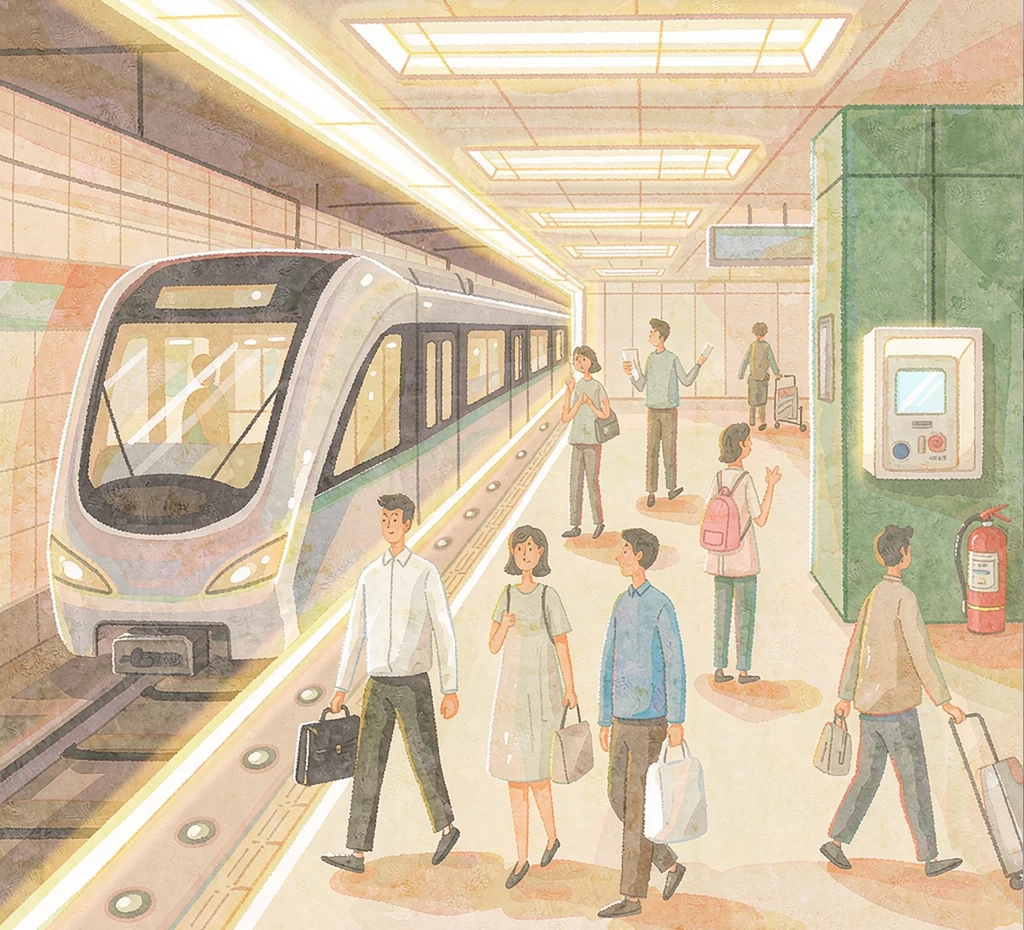
The highest-risk zone. Combine uniform general lighting with higher vertical illuminance at the platform edge, and consider a contrasting edge band to mark the gap for passengers and CCTV systems.
Concourse and Transfer Corridors
Prioritize glare control and wayfinding. Ceiling-mounted panels or linear fixtures with wide, even distribution keep large public spaces legible and reduce passenger stress during transfers.
Tunnel and Transition Zones
Running tunnels favor linear or compact fixtures with high IP and vibration ratings, arranged for fast replacement during the night maintenance window. The transition zone — tunnel mouth to open air — should step lux gradually so train operators' eyes can adjust.
Rail transit lighting rewards buyers who specify precisely and penalizes those who treat it as a commodity. The specification that survives is the one that accounts for 24/7 duty, vibration, ingress, fire safety and emergency performance — not just a lumen number. Solarix Lighting supplies LED rail transit and commercial luminaires backed by 20+ metro projects and transport-hub experience. Share your governing standard and site conditions with our engineers, and we will help you match the right fixture, driver and optics to the project.