An LED street light buying guide has to answer a harder question than "which luminaire is cheapest". On a road project you are specifying an asset that will sit on a pole for ten to fifteen years, exposed to weather and grid transients, and audited against a lighting standard the contractor must prove compliance with before handover. Get the specification wrong and the cost shows up later — in re-aiming, in pole changes, in warranty claims, and in a road section that fails its acceptance test.
This LED street light buying guide is written for B2B buyers — municipal procurement officers, EPC contractors, road developers and lighting distributors — who need to specify, compare and source road luminaires without guessing. It follows the order a real tender runs in: road class, photometrics, optics, construction, electrical package, certification, RFQ and total cost.
Step 1 — Start With the Road Class, Not the Catalogue
The most common buying mistake is choosing a wattage before defining the road. Wattage is a consequence of the road class, the pole geometry and the optic — never the starting point.
Road classification sets every target that follows
Most projects outside North America work to the EN 13201 series, which assigns an M class (M1 to M6) to roads carrying motorised traffic, a C class to conflict areas such as junctions, and a P class to pedestrian and low-speed areas. M1 carries the highest luminance requirement; M5 and M6 sit at the low end for local residential streets. In North America the common reference is the IES RP-8 practice, which is illuminance-based and organised by road and pedestrian conflict area instead. Confirm which standard the acceptance test will use before you write the specification — a layout designed to EN 13201 luminance criteria will not automatically pass an RP-8 check.
The four photometric numbers in every tender
| Metric | What it describes | Why a buyer cares |
|---|---|---|
| Lavg or Eavg | Average road surface luminance (cd/m²) or illuminance (lx) | The headline compliance number |
| U0 | Overall uniformity, minimum divided by average | Low U0 gives the "zebra" road that reads as badly lit |
| Ul | Longitudinal uniformity along the driving lane | Poor Ul is what drivers perceive as dangerous striping |
| TI | Threshold increment, disability glare from the luminaires | High TI reduces obstacle visibility; a safety criterion, not comfort |
Two more choices belong here. Correlated colour temperature: 4000K is the common municipal default, while 3000K is increasingly requested near housing and in dark-sky or ecological zones. And colour rendering — Ra above 70 is typical for roads, because higher CRI buys little at road light levels. Our colour temperature application guide explains the trade-off.
Step 2 — Read the Photometric File Before You Read the Price
Two quotes can list the same wattage and lumen figure yet light the road completely differently. The difference is in the file, not the datasheet headline.
Delivered lumens, not chip lumens
LED package lumens are measured at the die, before the optic, the glass and thermal losses. Delivered lumens — measured on the complete luminaire — are commonly 10–25% lower. If a supplier will not state delivered lumens, you are comparing two different things.
IES distribution types decide where the light lands
- Type I — narrow, along the road; wide median walkways.
- Type II — wider lateral spread for wide roads with kerb-side mounting.
- Type III — the most common road distribution; throws forward and sideways from the kerb.
- Type IV — forward-heavy semicircular throw for perimeter and area mounting.
- Type V — circular and symmetric; junctions, plazas and car parks rather than running road.
Choosing the wrong Type is the fastest way to fail a uniformity test. A Type III optic on a narrow residential street can hit the average and still miss U0, because too much light spills beyond the kerb.
Ask for IES/LDT files and a calculation
Serious municipal tenders require photometric files (IES or LDT) and a lighting calculation run in DIALux, Relux or AGi32 as part of the bid. It is the only way to verify pole height, spacing, overhang and tilt before anything is manufactured. For the arithmetic behind output, area and quantity, see Lumens vs Lux vs Watts.
Step 3 — Construction: What Survives Year Five
Road luminaires fail outdoors for the same reasons they fail in tunnels and industrial yards: water, impact, heat and vibration.
Ingress and impact ratings that matter
IP66 is the practical baseline for the optical and gear compartment, and what most municipal specifications now write in. IK08 or IK09 impact resistance is worth requiring on low-mounted or vandalism-prone sections. Our IP rating guide for outdoor, tunnel and industrial lighting breaks down what each digit covers.
Thermal design and lumen maintenance
Heat is what ages an LED. Ask for three documents rather than a headline "50,000 hours" claim: LM-79 (photometric measurement of the complete luminaire), LM-80 (lumen maintenance of the LED packages) and TM-21 (the projection that turns LM-80 data into an L70 or L80 lifetime). A lifetime stated without its test basis is marketing — how to verify L70 and lumen maintenance claims walks through the check. Also confirm the maintenance factor your designer used: municipal layouts are normally calculated on a maintained value, with dirt and depreciation already priced in.
Step 4 — Electrical Package, Surge Protection and Controls
Input voltage, power factor and harmonics
A wide-voltage driver covering AC100–277V, 50/60Hz suits most international grids; North American projects on 347V or 480V distribution need a driver explicitly rated for it. Require power factor above 0.95 and total harmonic distortion within your utility's limit — many reject large lighting loads above 20% THD. Drivers are the component most likely to end a luminaire's life, so the LED driver selection guide is worth reading before you lock the spec.
Surge protection for exposed networks
Road luminaires are the longest, most exposed conductors on the network, and transients destroy drivers. 10 kV protection is the common minimum; 20 kV is frequently specified for storm regions, coastal roads and elevated expressways. Confirm whether the protector is field-replaceable — a non-serviceable SPD turns one surge into a full luminaire replacement and a bucket-truck callout.
Dimming, photocells and smart-ready interfaces
Even if you are not deploying controls today, specify the interface now. A 0-10V or DALI driver input plus a Zhaga or NEMA socket lets you add photocells, sensors or a management node later without touching the luminaire. Retrofitting control onto a non-socketed road fitting is the most expensive upgrade in street lighting.
Step 5 — Certification and Market Access
Certification is a market-entry question, and the requirement changes by destination:
- European Union — CE marking under the LVD, EMC and RoHS directives; ENEC or CB reports are commonly requested for public tenders.
- North America — a UL or ETL safety listing, DLC listing where utility rebates apply, and FCC compliance for the driver.
- Japan — PSE certification for the luminaire.
- Middle East and parts of Asia — often a national conformity mark layered on top of a CB report.
Ask for the certificate number and issuing body, then verify it — reports issued for a different model in the same series are a frequent problem in road tenders. Our documented compliance covers CE, CCC, PSE and RoHS; for North American projects, treat UL/ETL and DLC listing as a specific line item to request and verify for the exact model you buy.
Step 6 — Build an RFQ That Makes Bids Comparable
A strong RFQ forces every bidder to answer the same questions, so the price gap you see reflects real value rather than a different reading of the scope.
| Specification line | What to require |
|---|---|
| Road class and standard | EN 13201 M/C/P class or IES RP-8 category, and which one the acceptance test uses |
| Photometry | Delivered lumens, efficacy in lm/W, IES distribution type, IES/LDT file supplied |
| Compliance metrics | Lavg/Eavg, U0, Ul, TI, plus the lighting calculation |
| Construction | Housing material, IP rating, IK rating, tool-free access, operating temperature range |
| Optical | CCT, CRI, lens material, tilt and overhang adjustment, pole-mount diameter |
| Electrical | Input voltage range, PF, THD, surge rating and replaceability, driver brand |
| Lifetime evidence | LM-79, LM-80 and TM-21 documents; stated L/B value at a stated hour figure |
| Certification | Certificate numbers and issuing bodies for the destination market |
| Controls | Dimming protocol, Zhaga/NEMA socket, photocell or node provision |
| Commercial | Warranty term and claim process, spare parts availability, spare driver supply, export packaging |
Send the table with the enquiry, pre-filled with your target values. Bidders who return it incomplete are telling you something useful before you have paid for anything.
Step 7 — Total Cost, Warranty and Spare Parts
Unit price is rarely where road projects are won or lost. Model the whole life: luminaire cost, pole and civil work, installation and traffic management, energy over the service life, and the cost of a truck roll to reach a failed unit. A luminaire costing 15% more that halves the failure rate or allows tool-free driver replacement from a boom usually wins that comparison.
On warranty, read three things: the term (five years is the common municipal expectation), whether labour and access are covered or only the part, and how a claim is evidenced. Ask how long spare drivers, optics and PCBs stay available — a road network is a twenty-year asset. Our retrofit ROI guide covers the payback arithmetic, and how to read a lighting project case study shows how to check a supplier's reference project against yours.
Five Mistakes That Cost Road Buyers Money
- Specifying wattage instead of road class. You get the wattage you asked for and the wrong light on the road.
- Comparing chip lumens. Normalise to delivered lumens and efficacy (lm/W).
- Ignoring the IES distribution type. The same lumens in the wrong Type fails uniformity.
- Accepting a lifetime claim with no LM-80/TM-21 backing. Ask for the report, not the number.
- Judging on unit price alone. Access cost, spare parts and failure rate dominate the ten-year number.
Frequently Asked Questions
How many watts does a street light need?
It depends on road class, pole height and spacing rather than on the fixture. As a rough orientation, residential streets often land between 30W and 60W, secondary urban roads around 80W to 150W, and main arterials at 200W to 300W — but the correct answer comes from a lighting calculation against the road class, and higher-efficacy optics can meet the same target at lower wattage.
What is the difference between IP65 and IP66 for a street light?
IP65 is protected against low-pressure water jets; IP66 against powerful jets. For luminaires exposed to driven rain, pressure washing and coastal conditions, IP66 is the safer baseline. The IK rating is a separate mechanical-impact scale and should be specified alongside it.
Do I need a Zhaga or NEMA socket if I am not installing controls now?
In most cases, yes. The socket costs very little at purchase and is the only practical way to add photocells, sensing or a network node later. Without it, upgrading means replacing the luminaire or opening the housing in the field.
What warranty should a municipal LED street light carry?
Five years is the common expectation, sometimes with an extension option. Compare what is covered — parts only, parts plus labour, or parts plus access equipment. A long warranty with a slow claim process is worth less than a shorter one with a clear replacement procedure.
3000K or 4000K for a road project?
4000K is the municipal default and generally delivers slightly higher efficacy. 3000K is increasingly required in residential zones, near ecologically sensitive areas and under dark-sky ordinances. Check the local ordinance first, because this is often set by regulation.
Next Step
Start by fixing the road class and the acceptance standard, then send suppliers the RFQ table above with your own targets filled in. It turns a vague enquiry into comparable answers within one round.
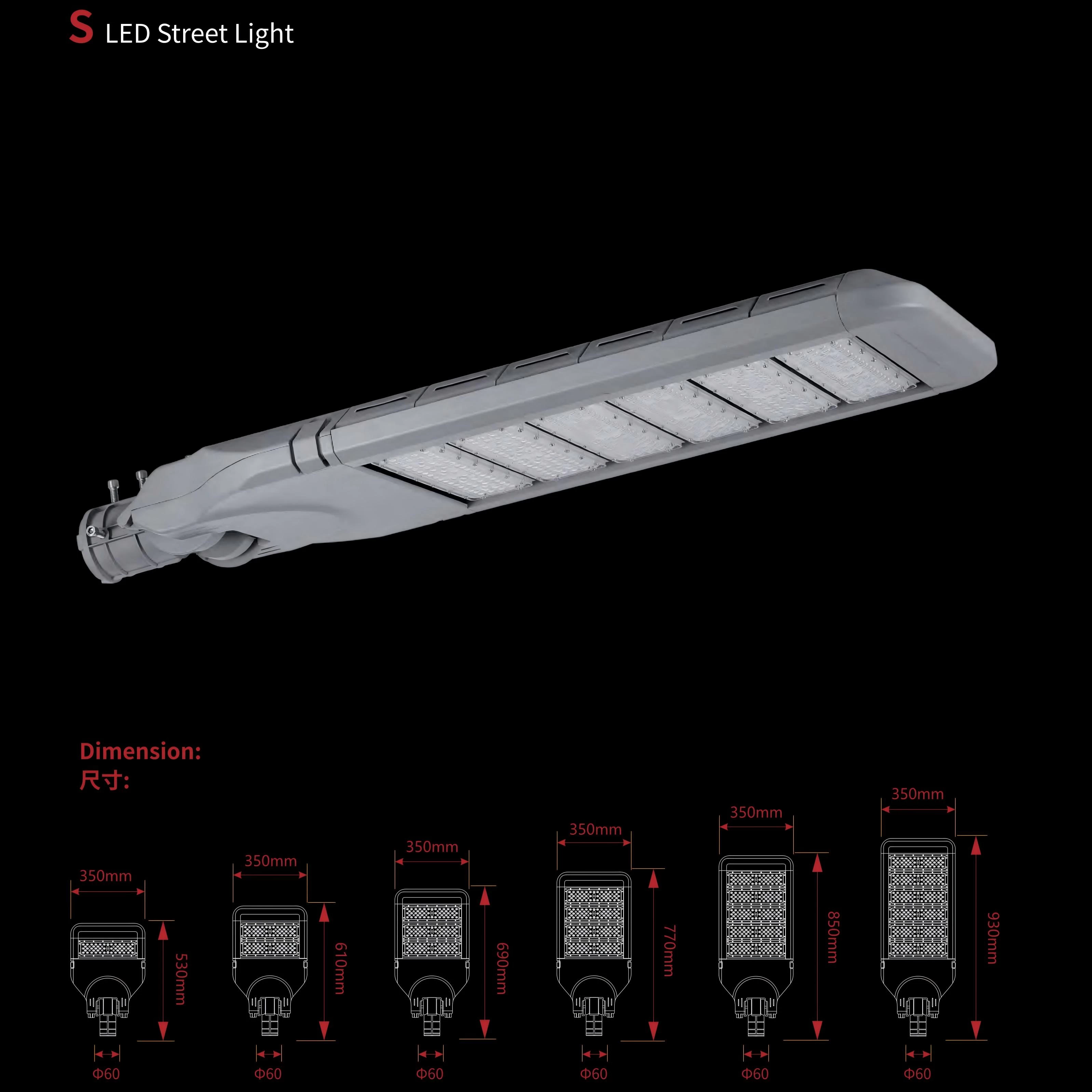
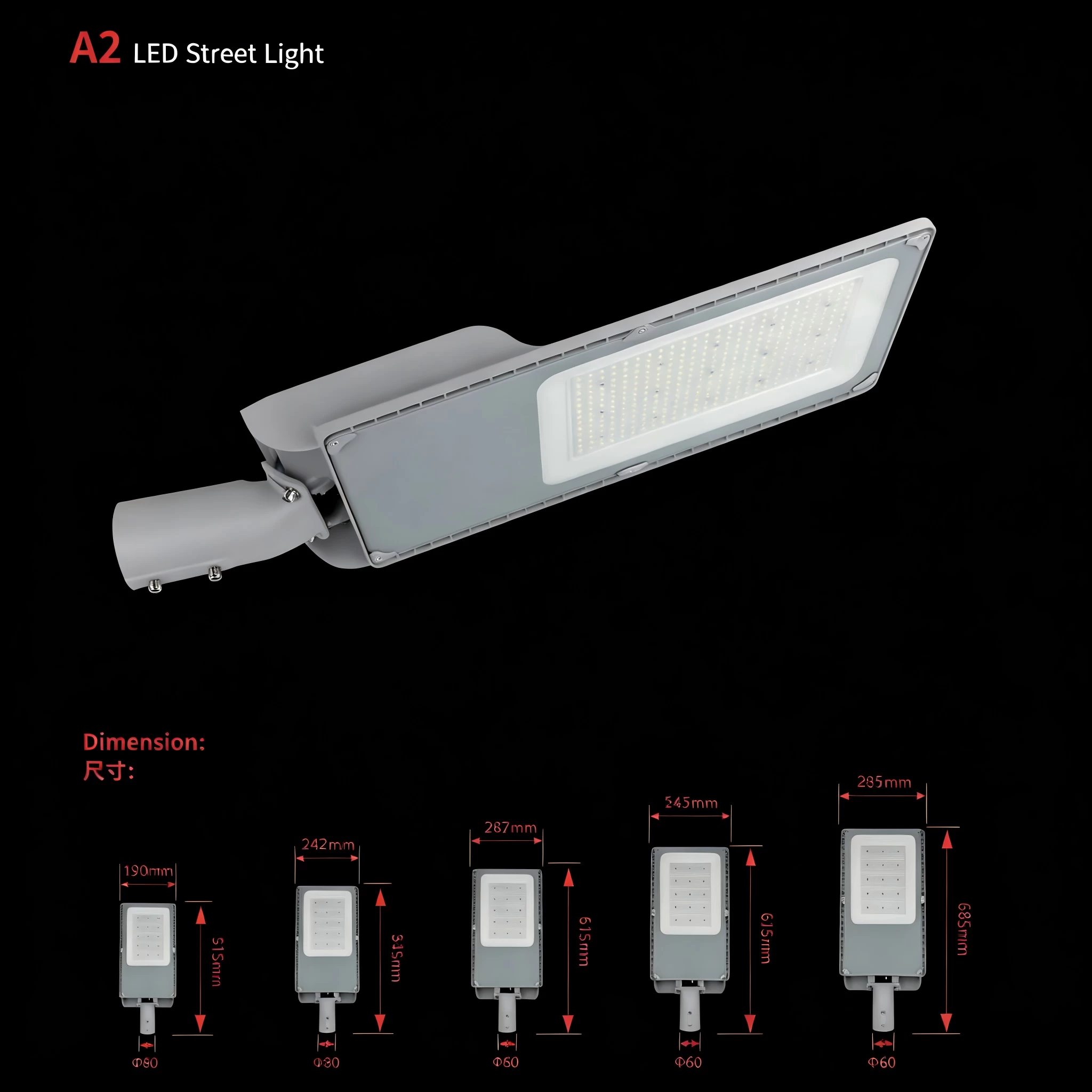
If you are shortlisting hardware, our outdoor lighting range covers municipal road luminaires from compact 40W residential units to modular 300W arterial fixtures, including the S Series modular street light (50W–300W) and the A2 Series economical street light (50W–200W). Off-grid or rural sections are a different calculation — see how to choose a split solar LED street light. Send us your road class, pole layout and destination market, and we will return a photometric proposal and a line-by-line specification you can put straight into a tender.