
1. One structural difference, and everything follows from it
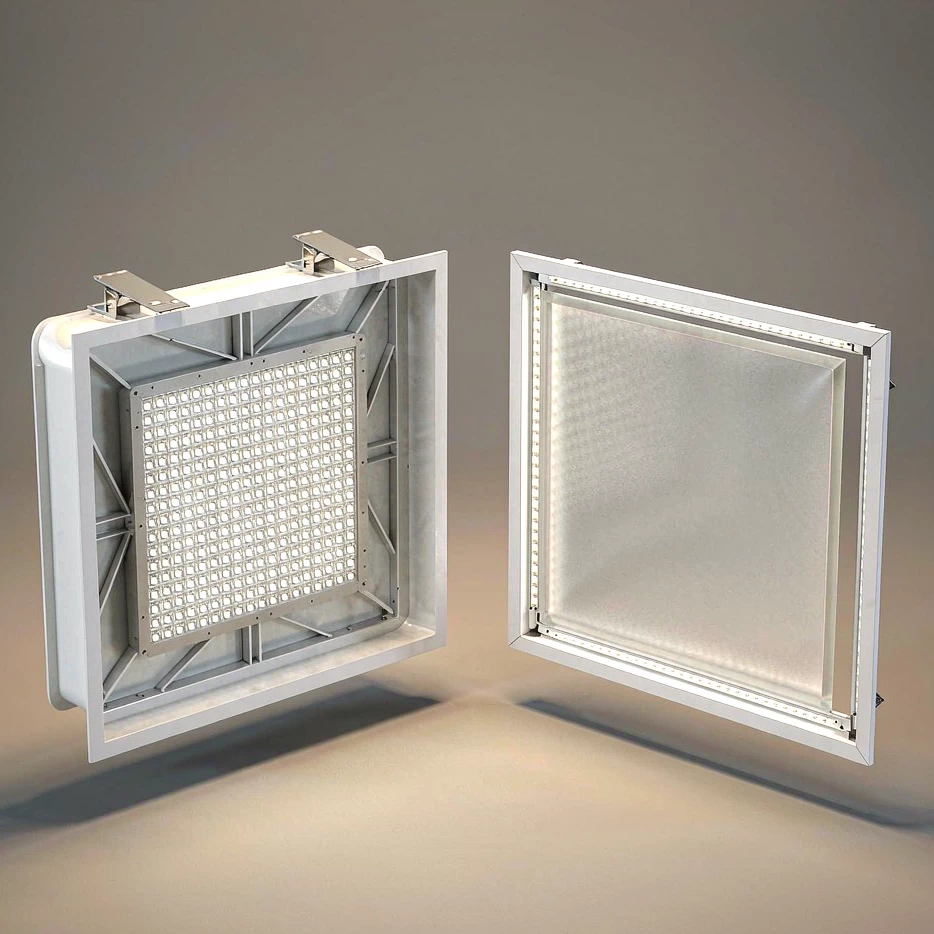
An edge-lit panel mounts LED strips along the inner frame, firing sideways into an acrylic light guide plate. Dot patterns on the plate scatter that light downward through a diffuser. It is the same optical stack as an LCD backlight, which is why the panel can be 9–15 mm thin.
A backlit panel places a full LED array across the back plate, shining straight down through a diffuser and, on better models, a micro-prismatic lens. No LGP. The housing gets thicker — typically 25–35 mm — but the light path is one bounce instead of dozens, and the entire back plate works as a heat sink.
Edge-lit buys thinness. Backlit buys optical efficiency and thermal headroom.
| Element | Edge-lit | Backlit |
|---|---|---|
| Light path | LEDs → LGP → diffuser | LEDs → diffuser / lens |
| LED count (600×600) | ~40–80, on the frame | ~120–200, across the back plate |
| Typical thickness | 9–15 mm | 25–35 mm |
| Heat sink | Narrow frame only | Full back plate |
2. Efficacy: check the DLC V6.0 threshold before you compare prices
Light lost inside a light guide plate is light you already paid for. Real published specifications for mainstream 600×600 backlit panels cluster around 100–125 lm/W system efficacy, with premium versions at 130–150 lm/W. Comparable edge-lit panels generally sit at 90–110 lm/W. Treat the widely quoted "40% gap" as marketing: at equal LED and driver quality, the honest difference is 10–25%. What matters is not the percentage but whether your fixture clears the threshold the project is judged against.
Under DLC SSL V6.0 — released November 2025, accepting applications from 5 January 2026, with V5.1 listings removed from the Qualified Products List on 15 December 2026 — every category's minimum rose:
| Primary use | Standard | Premium |
|---|---|---|
| Troffer (2×2, 1×4, 2×4) | 120 lm/W | 135 lm/W |
| Linear ambient | 125 lm/W | 140 lm/W |
| Low bay | 130 lm/W | 145 lm/W |
| High bay | 135 lm/W | 150 lm/W |
A 40 W / 4000 lm panel — 100 lm/W, extremely common in the market — now sits 20 lm/W below the V6.0 troffer Standard line. It will still light the room. It will not qualify for the roughly 700 North American utility rebate programmes that gate on the QPL. V6.0 also retains glare requirements for troffers and adds efficacy allowances for better colour rendering and glare control, so a high-CRI, low-UGR backlit panel can clear the bar more easily. Ask for the DLC product ID, not the word "listed", and verify it yourself.
3. Yellowing: the failure mode that arrives in year two
A light guide plate sits immediately next to the LED strip, bathed in blue light and radiant heat. PMMA degrades by photo-oxidation: UV and heat break the polymer chains, oxygen forms chromophores, and the plate turns yellow. The process is irreversible — transmission drops, output dims, colour temperature drifts warm, and the whole fixture has to come down.
| LGP material | Transparency | Yellowing behaviour |
|---|---|---|
| PS (polystyrene) | ~88% | Visible yellowing in 12–18 months near the strip |
| MS (methacrylate-styrene) | ~91% | Usually stable 3–4 years |
| Virgin optical PMMA | >93% | Typically 10+ years, no visible yellowing |
| Recycled PMMA | Variable | Unpredictable; impurities catalyse oxidation |
Two details separate a durable edge-lit panel from a disposable one. Laser-dotted plates outlast silk-screen printed ones, because the ink itself yellows under heat. And the gap between strip and plate matters: strips pressed hard against the plate cook it from the outside in, which is why failing panels yellow at the four edges first. Backlit panels remove this failure mode entirely — no LGP, nothing to yellow.
On a 40-hour-per-week office with a five-year maintenance plan, this is the strongest argument for backlit. Pair it with verified L70 lumen maintenance data rather than a "50,000 hours" headline and the comparison becomes quantitative.
4. Glare and uniformity: UGR is an optic, not a lumen number
Uniformity is where edge-lit historically won and where backlit has now caught up. Both routinely achieve U0 ≥ 0.8 when LED pitch and diffuser are engineered properly; hot spots on a backlit panel are a manufacturing quality issue, not a technology limit.
Glare is where specifications fail. EN 12464-1 caps Unified Glare Rating by task:| Space | Maintained illuminance | Max UGR | Min CRI |
| --- | --- | --- | --- |
|---|---|---|---|
| Technical drawing / CAD | 750 lx | 16 | 80 |
| Classroom | 300–500 lx | 19 | 80 |
| Retail sales floor | 300 lx | 22 | 80 |
| Corridors / circulation | 100 lx | 25–28 | 40–80 |
The UGR scale is non-linear: 22 to 19 roughly halves perceived discomfort glare. Neither technology delivers UGR<19 automatically — it comes from the micro-prismatic diffuser and shielding geometry, and it must be reported for your room dimensions, not printed as a generic badge. Backlit construction makes low-UGR optics easier, because the optics sit directly over the LED array instead of behind a plate that is already scattering light. Read the plain-language UGR guide before accepting a supplier's number.
5. Heat, LED count and lifetime
Edge-lit panels concentrate 40–80 packages on a narrow frame, so heat flux density is high and the only conduction path is the frame extrusion. Backlit panels spread 120–200 packages over the full back plate, each running at lower current and lower junction temperature. Lower junction temperature is what actually buys lifetime: it slows lumen depreciation and protects the driver, usually the first component to fail. In practice, backlit panels are commonly rated L70 ≥ 50,000 h against 30,000–40,000 h for budget edge-lit equivalents, with LM-80 and TM-21 reports behind the claim.
6. When edge-lit is still the right choice
Thinness is a real engineering constraint, not a marketing adjective. Choose edge-lit when plenum depth is genuinely limited — shallow T-bar ceilings, surface-mount over concrete, retrofit frames where a 30 mm body will not fit. Choose it too when the fixture is a visible design element in lobbies and high-end retail, or when operating hours are short enough that the panel never accumulates the exposure dose that causes yellowing. If you go edge-lit, specify virgin PMMA, laser dotting, a defined strip-to-plate gap and an aluminium frame thick enough to move heat.
7. Compare total cost, not unit price
A cheaper edge-lit panel may need more fixtures to reach 500 lx, and a lower-efficacy panel misses the DLC threshold that pays for the project. Compare quotes across six lines:
| Cost line | Depends on |
|---|---|
| Fixture count | Lumens per fixture at the specified lux target |
| Installation labour | Fixture count × mounting type |
| Energy | System watts × operating hours × tariff |
| Rebate eligibility | DLC product ID and V6.0 status |
| Replacement cycle | LGP yellowing risk and L70 rating |
| Maintenance access | Ceiling height and room occupancy |
On a school or hospital running 10–14 hours a day, the replacement cycle dominates. On a spec office fit-out with a five-year lease, fixture count and rebate eligibility dominate instead. Our LED retrofit payback guide works through the arithmetic.
8. The RFQ fields that make quotes comparable
- Construction: backlit or edge-lit, stated explicitly.
- Photometry: lumens, system watts, lm/W, beam angle, IES or LDT file.
- Optics: UGR value with test geometry, diffuser type, uniformity U0.
- Materials: LGP material and dotting method (laser / printed) if edge-lit; diffuser material either way.
- Colour: CCT, CRI and R9, SDCM binning tolerance.
- Electrical: voltage range, PF, THD, driver brand, dimming protocol, flicker percentage.
- Lifetime: L70/B50 hours with LM-80 and TM-21 reports, plus written warranty terms.
- Compliance: DLC product ID (V6.0 status), CE / CB / ETL, plus verifiable certificate numbers.
If a supplier will not commit to items 2, 4 and 7 in writing, that silence is itself the answer. More detail on locking this down is in our China sourcing checklist.
Conclusion
Specify backlit unless the ceiling physically will not accept the depth. It removes the light guide plate and its yellowing failure mode, spreads heat across the whole back plate, and makes low-UGR optics easier to achieve — benefits that show up in year three, not on day one. Reserve edge-lit for genuinely shallow plenums and design-led spaces, and pay for virgin PMMA and laser dotting when you do.
Solarix Lighting manufactures both, because both have a place on real projects. Our LED Backlit Panel Light (36 W / 50 W, low UGR, recessed) is the specification-grade option for offices, classrooms and healthcare, where long operating hours and colour stability decide lifecycle cost; our LED Edge-Lit Panel Light (36 W / 50 W, low UGR) covers shallow T-bar ceilings, surface-mount retrofits and design-led interiors. Both are available with high-CRI, flicker-free drivers for healthy full-spectrum lighting, with DALI, 0-10 V and sensor options. We supply LM-79 photometric files, LM-80/TM-21 lifetime reports and UGR data for your room geometry, with samples so your designer can verify before you commit. Send us your ceiling type, target lux and operating hours and we will quote against a complete specification.