
Author: Solarix Lighting
Abstract
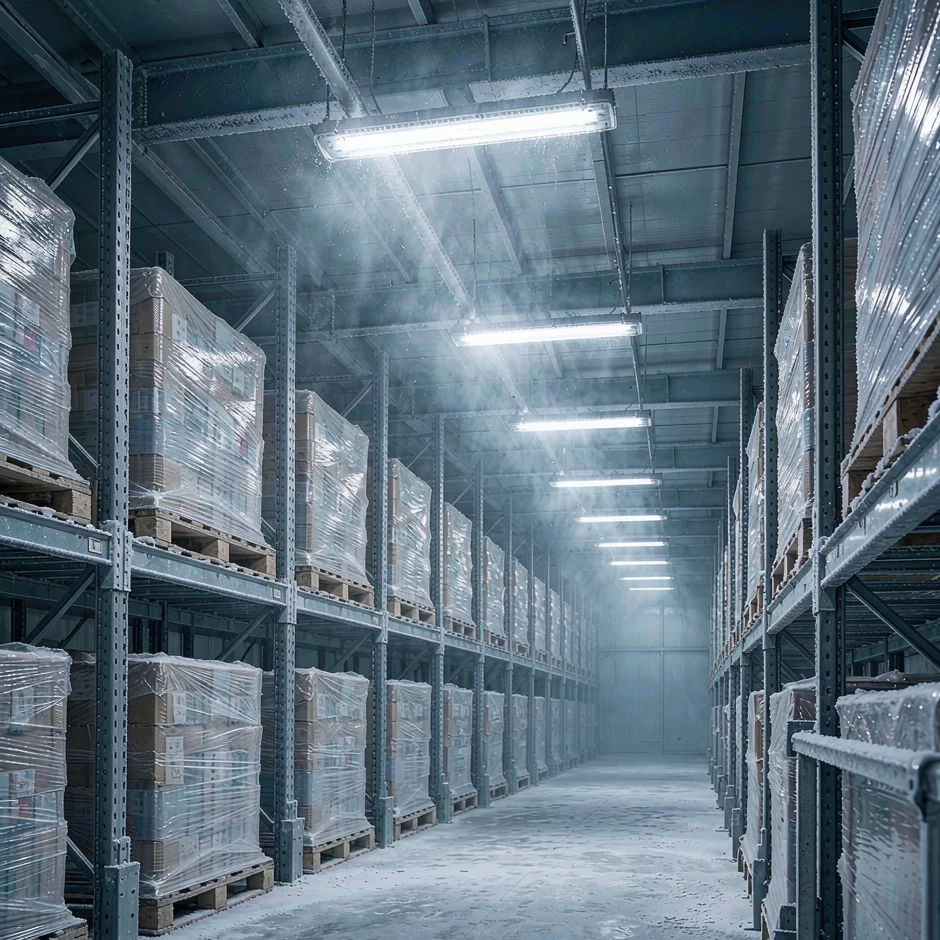
Cold rooms are one of the few environments where LED chips actually perform better than at room temperature — and one of the fastest places to destroy a badly specified luminaire. Almost every premature failure in a freezer comes from the same three places: a driver whose lowest rated ambient temperature is higher than the room, moisture pulled into the housing by daily door cycles and defrost, and a fixture that meets the IP number on the datasheet but not the hygiene rules of a food plant. This guide is written for contractors, specifiers and procurement teams sourcing sealed LED fixtures for chill rooms, freezers, blast freezers and food processing areas. It covers what cold really does to LEDs and drivers, how to match fixture construction to each temperature zone, why condensation matters more than temperature, what IP69K and NSF certification do and do not cover, the illuminance levels referenced in FDA Food Code 6-303.11, emergency lighting inside a freezer, and a seven-item checklist you can paste straight into your next RFQ.
The LED chip loves the cold. The driver does not.
Most buying decisions for cold storage start from the wrong assumption: that sub-zero temperatures shorten LED life. In practice the opposite is true for the light source.
What actually happens at −25 °C
An LED is a semiconductor. Run it cold and its junction temperature drops, which usually means slightly higher forward voltage, slightly higher light output for the same drive current, and a longer predicted life than the same chip at 25 °C ambient. LED chips are not the parts that fail in a freezer.
The driver is. Inside almost every LED driver sits at least one aluminium electrolytic capacitor, and that component behaves badly in the cold:
- Its equivalent series resistance (ESR) rises sharply as temperature falls, so it can no longer smooth the rectified ripple. The visible symptoms are flicker at low dimming levels, unstable output in the first minutes after switch-on, and premature capacitor wear.
- Cold electrolyte also slows the chemistry that keeps the capacitor functional, which is why many general-purpose drivers carry a minimum rated ambient (Ta min) of only −20 °C or −25 °C.
- A blast freezer or spiral freezer running at −35 °C to −40 °C is below the rating of those drivers. The fixture lights in the factory test, then in the field it either will not start after a cold soak, or it starts and fails within a season.
This is the single most useful line in any cold storage specification: ask for the driver datasheet, not the fixture brochure. Confirm the driver's own minimum ambient rating, the capacitor series used, and the rated lifetime at the actual case temperature (Tc) the driver will see in your housing. A "−40 °C" claim printed on a luminaire cut sheet very often refers to the aluminium body, not to the electronics inside it.
The cold-start clause worth writing into the RFQ
Ask suppliers to state, in writing:
Fixture shall start and operate at full rated output after an 8-hour soak at the minimum specified room temperature, with test report or type-test evidence provided.
That one sentence moves the conversation from marketing language to documented behaviour.
Pick the zone first, then the fixture
A single "cold storage light" rarely covers a whole facility. A distribution centre typically has four or five distinct environments, and specifying all of them to the highest level wastes money while specifying all of them to the lowest level guarantees callbacks.
| Zone | Typical air temperature | Minimum ingress | Driver rating to ask for | Notes |
|---|---|---|---|---|
| Chill / produce cooler | 0 °C to +10 °C | IP65 | Ta min −20 °C | Low condensation risk if seals are intact |
| Cold store | −1 °C to −18 °C | IP65, IP66 preferred | Ta min −30 °C | Door cycles drive moisture ingress |
| Freezer | −18 °C to −25 °C | IP66 | Ta min −40 °C | Silicone gaskets, low-temperature cable |
| Blast / spiral freezer | −30 °C to −40 °C | IP66 + potted driver | Ta min −40 °C with cold-start report | Severe thermal shock, fast air movement |
| Washdown / processing | Ambient to +80 °C water | IP69K | Standard ambient rating | NSF listing usually required |
Use this table as a starting point and then adjust it to the room's real profile: the defrost peak, the door-open frequency, and whether the area is hosed down.
Condensation, not temperature, kills most cold-room fixtures
If you have ever replaced a batch of "failed drivers" in a freezer and found rust or water droplets inside the housing, you have met the real failure mode.
Every time a freezer door opens, warm humid air enters. When the door closes and the room is pulled back down, the air inside the fixture contracts and creates a slight negative pressure — the luminaire breathes. Over hundreds of cycles a day, that pumping action pulls moisture past any weak point: a compression-set gasket, a loose cable gland, a micro-gap in a lens seal. Water then sits inside, corrodes the driver, and the fixture dies months later. It looks like a random electronics failure and gets blamed on product quality.
Four construction details stop it:
- Silicone gaskets, not foam. Silicone stays flexible at −40 °C and tolerates caustic cleaning agents; foam gaskets harden, shrink and pull away from the housing.
- A one-piece continuous gasket with a proper compression stop. Gaskets that rely on installer torque alone will be inconsistent across a 200-fixture project.
- A hydrophobic breather vent. A small membrane plug equalises pressure between the inside of the housing and the room, so the fixture stops pumping moist air through its seals. It is a cheap component that solves the most expensive problem.
- Cable glands rated for the temperature and tightened to a stated torque. Silicone or low-temperature-rated cable is also worth specifying: standard PVC jackets stiffen and crack in sustained cold, and the crack usually starts at the strain relief.
In blast freezers and high-humidity seafood rooms, a fully potted driver compartment is worth the extra cost — it removes the air volume that can hold moisture in the first place.
Read the IP rating, then read past it
Ingress protection is necessary but widely over-trusted. A quick refresher:
- IP65 — dust-tight, protected against low-pressure water jets. Acceptable for chill rooms and dry cold stores.
- IP66 — dust-tight, protected against powerful water jets. The sensible default for freezer rooms.
- IP67 — dust-tight, protected against temporary immersion. Relevant where floors flood.
- IP69K — dust-tight, protected against high-pressure, high-temperature (around 80 °C) water sprayed from multiple angles. This is the rating for sanitation washdown, and it comes from the vehicle/equipment washdown test method rather than ordinary outdoor luminaire testing.
What the IP code does not cover: thermal shock from a defrost cycle, chemical attack from cleaning agents, gasket ageing, condensing humidity, cable entries, or UV exposure. Two fixtures can both print "IP66" on the box and behave completely differently after two years.
So when you compare bids, ask for the IP test report number, the gasket material and hardness, the IK impact rating, and confirmation that the rating covers the complete luminaire including the cable entry — not just the housing.
When food is in the room, hygiene rules apply
If the room is part of a food plant, lighting stops being only an electrical decision.
NSF/ANSI 2 certification is the reference point in North America. It classifies fixtures by zone — food zone (directly above open product), splash zone, and non-food zone — and checks hygienic design: smooth cleanable surfaces, no crevices that trap product or moisture, non-porous materials, sealed construction, and shatter-resistant optics. A luminaire with a strong IP rating but no NSF listing can still be rejected at inspection in an open-product area.
Related practical points:
- No glass. Lenses should be polycarbonate or PMMA. If a fixture can shed fragments into product, it does not belong above a line.
- Watch the lens chemistry. PC is the default and works well in most applications, but it can craze — develop fine surface cracks — under repeated exposure to sodium hydroxide, peracetic acid or chlorine-based sanitisers. Once crazed it harbours bacteria and can shed particles. PMMA resists those chemicals better and is worth specifying in meat, dairy, seafood and beverage plants with aggressive sanitation protocols.
- Stainless steel hardware. Clips, brackets and fasteners in 304 or 316, not zinc-plated steel, which rusts and stains the ceiling.
- Illuminance. FDA Food Code 6-303.11 sets minimum intensities that many US jurisdictions adopt directly: at least 110 lux (10 foot-candles) at 75 cm above the floor in walk-in refrigeration units and dry storage, and in other areas during cleaning; at least 220 lux (20 foot-candles) at handwashing, warewashing and utensil storage areas and inside reach-in refrigerators; and at least 540 lux (50 foot-candles) at surfaces where employees work with knives, slicers, grinders or saws. In practice, QA and third-party audit schemes (BRC, SQF, FSSC 22000) usually push inspection and sorting zones well above the floor — commonly designed to 500–1,000 lux. Always design against the plant's HACCP plan and the auditor's requirement, not against the legal minimum alone.
- Colour quality. CRI 80 is the practical floor; CRI 90 makes a visible difference when staff are judging meat colour, produce freshness or label legibility. 4000 K to 5000 K keeps alertness high and reads cleanly against stainless steel and white packaging.
Layout and controls that survive the room
Cold rooms punish optimistic lighting calculations. Three adjustments matter:
Use a realistic maintenance factor. Frost film on a cold lens, dust, and the difficulty of cleaning a ceiling at −25 °C all reduce output over time. Designing at a maintenance factor of 0.7–0.8 rather than 0.9 keeps the room compliant at year three instead of only at handover.
Light the pallet faces, not just the floor. Order pickers read barcodes and labels vertically. A layout that only meets horizontal illuminance often leaves the aisle face under-lit. Ask your supplier for the IES or LDT photometric file and have the layout checked in Dialux or AGi32 before ordering, with vertical calculation points on the racking.
Every watt you remove saves more than a watt. Lighting heat inside a refrigerated envelope has to be removed by the refrigeration plant, so a dimming or occupancy strategy that looks modest on the lighting bill also cuts compressor load. In high-bay freezers, microwave (HF) sensors are usually the better choice over PIR because they can be mounted inside a sealed housing and detect movement through the lens; set a short time delay and a background level around 10–30 % rather than switching to zero, so staff never walk into a dark freezer.
Emergency lighting needs its own decision. Many emergency battery packs will not charge below 0 °C, and the stated 90-minute duration is measured at room temperature. In a freezer, either mount the battery pack outside the cold envelope and run the luminaire as a remote-fed emergency fitting, or specify a heated battery compartment with a published minimum ambient. Confirm which option the quotation actually includes — this is a common gap that only surfaces at inspection.
Seven things to put in the RFQ
Paste this into your next enquiry and the bids you get back will finally be comparable:
- Room profile — minimum and maximum air temperature, defrost peak, washdown water temperature and pressure, hours of operation.
- Driver data — brand and model, minimum rated ambient (Ta min), cold-start test evidence at the room's minimum temperature, capacitor series and rated hours at the expected Tc.
- Ingress and mechanics — IP and IK rating with test report number, gasket material, breather vent yes/no, cable gland specification.
- Optics and photometry — beam angle, IES/LDT file supplied with the quote, CRI, CCT, and UGR data if the room has seated workstations.
- Compliance — NSF/ANSI 2 listing for food and splash zones, ETL or UL listing for wet locations, DLC listing if the project is chasing utility rebates.
- Warranty in writing — duration, whether it holds at the room's actual temperature, who pays for access equipment and labour, and spare-part lead time.
- Documentation pack — photometric files, IP/IK reports, LM-80 and TM-21 lifetime data, and installation instructions with torque values for glands and brackets.
Bottom line
Cold storage is not a harder version of a warehouse — it is a different specification. Get four things right and the installation will outlast its warranty: a driver rated below the room's lowest temperature, a housing sealed with silicone and pressure-equalised with a breather vent, an ingress and hygiene rating matched to the actual zone, and photometric files verified in software before you buy rather than after the fixtures are on site.
Solarix Lighting supplies sealed LED fixtures and full project documentation for cold chain, food processing and industrial applications across our Commercial & Indoor, Outdoor and Industrial ranges. For freezers, chill rooms and washdown areas we provide the photometric IES/LDT files, driver datasheets with minimum ambient ratings and low-temperature test evidence alongside the quotation, so your design team can verify the layout before the order is placed. Send us your room dimensions, temperature profile and target lux levels and we will come back with a fixture schedule, a Dialux-ready layout and a specification you can put straight into a tender.