
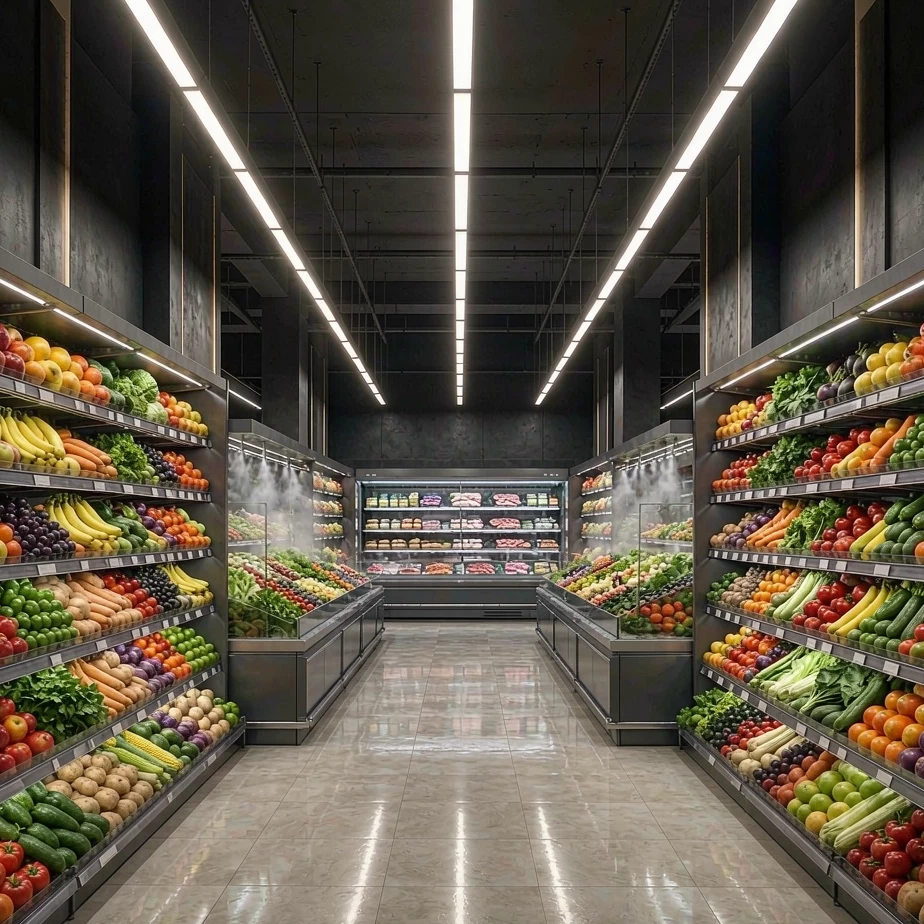
1. Retail Lighting Is Judged on Shelves, Not Floors
Most office lighting is measured on the desk. Retail lighting has to be measured on the merchandise. A shopper decides whether produce looks fresh, whether a garment colour is true and whether a package is readable while standing in the aisle — and all of that happens on vertical and near-vertical surfaces roughly 0.3–1.8 m above the floor.
That is why the most important number in a supermarket photometric report is not the average illuminance on the floor but the vertical illuminance on the shelf face. As a working range, specifiers aim for around 200–350 lx vertical at the shelf front, with uniformity on the shelf face at U0 ≥ 0.60. A store that reaches 500 lx on the floor but only 80 lx on the shelf face will look dim exactly where the money is spent.
Three practical consequences follow. Continuous linear rows aligned with the aisles do more work than scattered downlights. Asymmetric optics that throw light onto the shelf face beat symmetric distributions. And the acceptance measurement grid should include vertical planes, not just the floor — the same principle we apply in the site commissioning checklist.
2. Start From the Standards, Not the Catalogue
In North America, the reference document is ANSI/IES RP-2-20, Recommended Practice: Lighting Retail Spaces — the 2020 revision of RP-2-17. It gives horizontal and vertical illuminance recommendations and uniformity criteria, plus specific annexes for fresh foods and live produce (Annex C) and for fading, bleaching and shelf life (Annex B). RP-2-20 is guidance rather than law, but it is the document most US retail lighting contracts and utility rebate reviews are written against.
In Europe, EN 12464-1 (Light and lighting — Lighting of work places — Part 1: Indoor) sets the commonly cited minima for retail: 300 lx maintained in the general sales area and 500 lx at checkout and counter areas.
Neither document tells you the colour temperature of the meat counter. That is where the zoned specification below does the real work.
3. Zone-by-Zone Targets That Change the Purchase Order
A supermarket is at least five different lighting projects under one roof. The table below summarizes widely used design targets aligned with EN 12464-1 and IES RP-2-20 practice.
| Zone | Maintained illuminance | Typical CCT | Colour rendering | Glare |
|---|---|---|---|---|
| General aisles and sales floor | 300–500 lx horizontal; 200–350 lx vertical at shelf face | 3500–4000 K | Ra ≥ 80 | UGR ≤ 22 |
| Checkout / POS | 500 lx at counter, U0 ≥ 0.70 | 4000 K | Ra ≥ 80 | UGR ≤ 19 |
| Fresh produce | 500–750 lx | 3000–4000 K | Ra ≥ 90, R9 ≥ 50 | UGR ≤ 19 |
| Meat counter | 500–750 lx | 2700–3000 K | Ra ≥ 90, R9 ≥ 50 | UGR ≤ 19 |
| Seafood on ice | 500–750 lx | 5000–6000 K | Ra ≥ 90 | UGR ≤ 19 |
| Bakery and deli | 400–600 lx | 2700–3000 K | Ra ≥ 90 | UGR ≤ 19 |
| Frozen / refrigerated aisle | 300–500 lx | 4000–5000 K | Ra ≥ 80 | UGR ≤ 22 |
| Feature display / endcap | ≥150% of adjacent aisle (750–1000 lx) | Match the zone | Ra ≥ 80–90 | Per zone |
| Fitting room (apparel) | 300–500 lx | 3000–3500 K | Ra ≥ 90 | UGR ≤ 19 |
| Back-of-house / stockroom | 200–300 lx | 4000–5000 K | Ra ≥ 70–80 | Not critical |
Two notes on the table. First, the contrast rule: feature displays should read at roughly 1.5× or more of the adjacent aisle light level. Uniform brightness flattens the merchandising hierarchy, and "everything highlighted" means nothing is highlighted. Second, the frozen aisle usually inherits cabinet-integrated lighting — verify case lighting performance separately from the ceiling system, and see our cold storage lighting guide for the low-temperature constraints involved.
4. Colour Is a Sales Specification: Ra, R9 and TM-30
General CRI (Ra) averages eight pastel test samples and does not include saturated red. For fresh food, R9 — the special colour rendering index for red — is the number that decides whether beef looks fresh or brown. A source can post Ra 90 and still render R9 at 20; the meat counter will look wrong even though the datasheet says "high CRI".
Specify Ra ≥ 90 with R9 ≥ 50 for all fresh-food zones, and require those values on the LM-80 or third-party test report, not on the catalogue page. For a more complete picture, ask for TM-30 Rf/Rg data: an Rg slightly above 100 with a high Rf generally makes produce look more vivid without distorting skin tones at the checkout. We explain the full metric set — CRI, R9, TM-30 and flicker — in our colour quality guide.
5. Fading, Heat and Perishables
Compared with halogen and metal halide, LED emits negligible UV and far less infrared, which is why RP-2-20 dedicates an annex to fading and shelf life — and why LED retrofits protect light-sensitive merchandise such as packaged goods, florals, leather and printed packaging. Two cautions remain. First, high-blue-content LEDs can still fade sensitive goods under long exposure, so request the spectral power distribution if the merchandise mix includes sensitive materials. Second, heat is still heat: fixtures mounted too close to open chilled cases add refrigeration load and dry out exposed product, so keep radiant output off open food and coordinate fixture placement with the refrigeration engineer.
6. Glare, Cameras and Dark Ceilings
UGR ≤ 19 at the checkout is a working-conditions issue, not a luxury. Cashiers spend full shifts under the ceiling plane, and glossy floors double every bright source in view. In task zones choose micro-prismatic or deep-recessed optics over bare opal diffusers — the mechanics behind the UGR rating we explain elsewhere.
Cameras add a second constraint. Security CCTV and self-checkout cameras can turn visible flicker into rolling bands on recordings. Specify percent flicker below 5% across the dimming range, and request flicker test reports at 10%, 50% and 100% output wherever cameras view the sales floor.
7. Controls: Why Retail Almost Always Justifies DALI-2
Retail layouts change with planograms, so a control system that can be reprogrammed instead of rewired pays for itself. DALI-2 (IEC 62386) supports up to 64 addresses per bus and makes scenes — trading hours at full output, promotional endcap boost, overnight security at 20%, cleaning-mode task lighting — switchable by schedule or from the building management system. Add daylight-based dimming on perimeter rows near the shopfront glazing, and occupancy control in back-of-house areas. Emergency and exit circuits stay on their own supply and are verified during commissioning.
8. What to Write Into the RFQ
A short list that filters suppliers fast:
- Maintained illuminance targets, horizontal and vertical, with the maintenance factor stated — not initial lumens.
- IES/LDT photometric files for each SKU plus an LM-79 report, so the layout can be run before ordering (see our guide to reading IES/LDT files).
- Colour evidence: Ra, R9 and TM-30 data from test reports, with the SPD available on request.
- UGR tables calculated for the actual room reflectances, not a generic claim.
- Percent flicker at 10%, 50% and 100% output.
- IP rating for wet and dusty zones — produce misting, bakery flour, wash-down areas: IP54 minimum, IP65 preferred.
- Driver brand and MTBF, surge protection level, and the L70/TM-21 lifetime basis behind the warranty.
- A photometric layout with a vertical calculation grid plus a commissioning and acceptance method — measure what you specified.
Conclusion: Light the Merchandise, Then the Store
Retail LED projects are judged at the shelf face, the meat counter and the checkout, in that order. Specify vertical illuminance and colour first, glare and flicker second, controls third — and put every number into the RFQ. When the same discipline is applied to fixture counting, the lumens, lux and watts method turns the zoned targets above into an order quantity.
Solarix Lighting manufactures low-UGR LED panel lights, commercial downlights and continuous linear systems for retail and supermarket projects worldwide, with IES/LDT files, high-CRI and R9-enhanced options, and engineering support from layout to delivery. Send us your store plan, and our team will return a zoned lighting design you can put in front of your client.