
1. Start with a spec, not a price request
"Please quote a 600×600 LED panel" can legitimately return eight different products, from 1,800 lm to 4,500 lm, with driver lifetimes differing threefold. Suppliers cannot guess your intent, so they fill every blank with the lowest-cost option that still fits the words — and most disappointing first shipments trace back to exactly that.
The RFQ fields that actually change the quote
| Field | Example | What it changes |
|---|---|---|
| Luminous flux & efficacy | 4,000 lm, ≥110 lm/W | LED count, bin, driver cost |
| CCT & tolerance | 4000K, ±150K, SDCM ≤3 | Binning cost |
| CRI / R9 | Ra ≥80 with R9 >0, or Ra ≥90 (what R9 does) | Phosphor cost |
| UGR | <19 for offices | Diffuser / lens design |
| IP / IK | IP65, IK08 | Sealing, housing, glass |
| Driver | Named brand, PF ≥0.95, THD ≤15%, flicker % | The largest hidden cost item |
| Dimming | DALI-2, 0-10V, or on/off | Driver model |
| Lifetime claim | L80B10 @ 50,000 h at Ta 35 °C | LED drive current (de-rating) |
| Certifications | CE / CB / UL / ETL / DLC / PSE | Testing cost and MOQ |
| Input voltage | 120–277 V or 220–240 V | Driver topology |
| Surge protection | 2 kV / 4 kV / 10 kV | SPD component |
| Warranty | 5 years, whole luminaire | Warranty reserve in the price |
The commonly missing field: Ta
A "50,000-hour" claim measured at 25 °C on a bench is not the same product as one in a closed ceiling void where the driver sees 50–55 °C. State the ambient temperature your fixture actually runs at, and ask the supplier to confirm the lifetime claim at that Ta. Without a temperature attached, a lifetime number is marketing.
2. Ask for test data, not marketing numbers
ANSI/IES LM-79-19 (the current version) defines absolute photometry of the complete luminaire: the whole product is measured with its own driver and optics, not calculated from an LED data sheet. A proper report gives total lumens, efficacy, CCT, CRI and R9, Duv, input watts, power factor, THD and intensity distribution. Check that the model number matches your SKU including the driver, that the values are measured rather than "typical", and that an accredited laboratory issued the report.
LM-80 tests the LED package or module for at least 6,000 hours, and TM-21 projects that data forward, capped at six times the tested duration. The projection only means something if you know the LED's real operating temperature inside your luminaire — which is what an in-situ temperature measurement test (ISTMT) provides. We covered the L70 / LM-80 / TM-21 chain here.
The .ies (or .ldt) file is what your designer loads into DIALux, AGi32 or Relux to check lux levels and uniformity. Ask before you order: without one, your designer is guessing, and the tender's lighting targets may not be met on site.
3. Golden sample: freeze the exact configuration
Approve one physical sample, then lock it down. Photograph the internals before sealing: the LED board (quantity, brand, model), the driver label (brand, model, output current, PF, THD), aluminium thickness and gaskets. Attach that photo set plus a short bill of materials to the purchase order, with a line reading "Driver: [brand] [model]; no substitution without written approval."
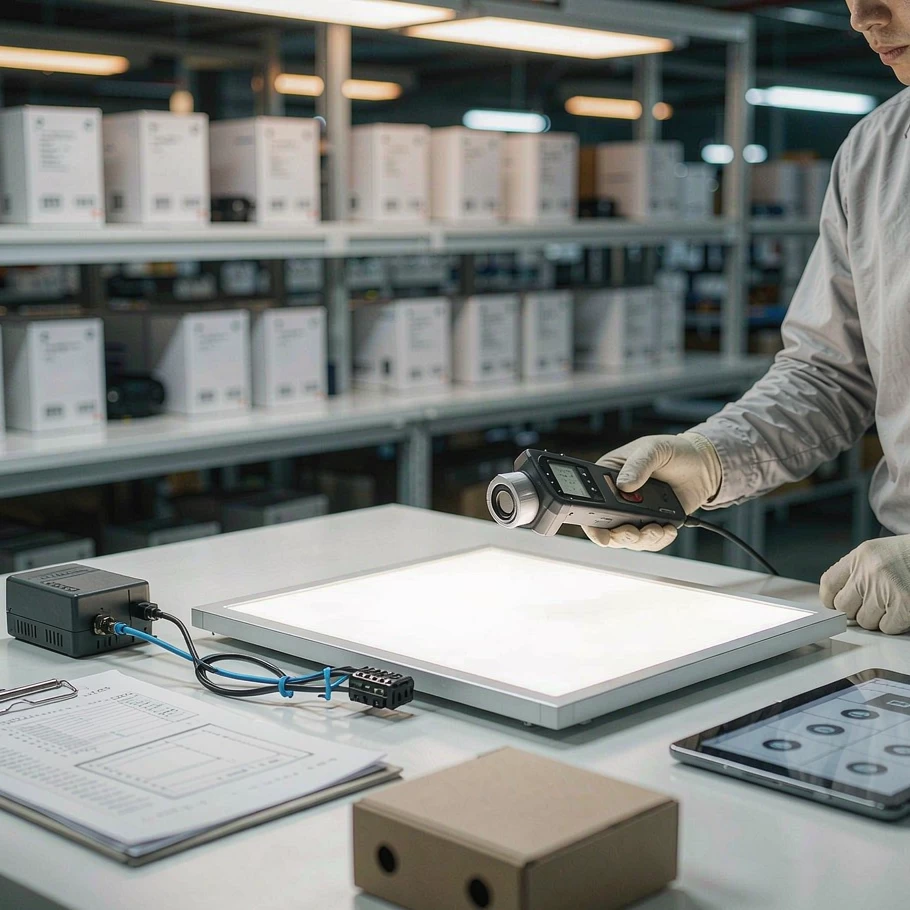
Measure the sample yourself and keep the record: input watts, CCT, CRI on a handheld meter, and a relative lux reading in a fixed set-up. That becomes your reference for every inbound batch. Drift happens in three places: a cheaper driver with the same output current but a lower surge rating; LEDs one bin looser (SDCM 5 instead of 3, visible as colour difference across a ceiling); and a thinner housing or heat sink.
4. Factory audit: four places worth your time
You do not need a full social compliance audit to judge whether a lighting factory can hold a spec. Look at four things.
Assembly and SMT. How many lines, is SMT in-house, and is there basic ESD control?
Burn-in. Every unit should be powered at elevated temperature before packing — commonly 4 to 24 hours. Ask what they actually do, and ask to see the log. A factory without burn-in ships you early-life failures.
Test equipment. An integrating sphere, a goniophotometer, an IP spray and dust chamber, a Hi-Pot tester and a surge generator. A factory with only a lux meter is not verifying output.
Traceability. Months later, can they pull the LED batch and driver batch for a given serial number? If you cannot travel, ask for a live video walk-through with a random carton powered and measured on camera.
5. Pre-shipment inspection: AQL is the floor, not the finish line
The standard reference is ANSI/ASQ Z1.4 (identical to ISO 2859-1) at General Inspection Level II: AQL 0 for critical defects, 2.5 for major, 4.0 for minor. A 1,000-unit lot means 80 samples — accept up to 5 major defects and reject at 6. Critical defects such as exposed live parts, a missing earth or a failed Hi-Pot are zero tolerance.
A default AQL sheet checks what the eye can see. It does not check lumens, CCT consistency, power factor, THD or flicker — exactly the parameters separating a compliant luminaire from a cheap one. Write them into an inspection criteria (IC) sheet: input watts within ±10% of the approved sample; lumen output no more than 5% below spec; CCT within the agreed MacAdam step range; CRI at or above spec with PF and THD inside limits (see our load calculation guide); Hi-Pot on every sampled unit, with the whole sample burned in for 2–4 hours; and a carton drop test plus label check.
Book the inspection at roughly 80% packed, typically 3–5 days before the vessel, and add a during-production inspection at 30–50% for a first order. Write the remedy into the PO: a failing lot is rejected, and the supplier bears the cost of re-inspection, rework or replacement.
6. Certificates: verify, don't file
A PDF certificate is not evidence. Check the certificate number in the issuing body's own directory — UL Product iQ for UL and ETL listings, Intertek's directory, the DLC Qualified Products List for rebate eligibility. Then confirm three matches: the certificate holder is the legal entity shipping your goods, the model number is your SKU, and the standard scope fits the product (UL 1598 for luminaires, UL 8750 for LED drivers and equipment).
For CE, the marking is only a manufacturer's self-declaration. Ask for the reports behind it: EN 60598-1 for luminaire safety, EN 62471 for photobiological safety, EN 55015 and EN 61547 for EMC, and EN 61000-3-2 for harmonics.
7. Commercial terms that quietly decide your margin
- Incoterms. EXW, FOB, CIF and DDP move risk differently. FOB is common for container loads; DDP looks convenient but bundles duty, clearance and forwarder margin into a number that is hard to compare.
- MOQ and lead time. Is the minimum per SKU or per order, and is a mixed container acceptable? Define the lead-time clock in the purchase order — from deposit, drawing approval, or sample sign-off.
- Payment. A 30/70 T/T split is common, with an L/C for larger orders. Avoid full prepayment on a first order with an unproven supplier.
- Warranty wording. "5 years" can mean the whole luminaire or only the LED board. Ask who pays labour, access equipment and return freight, and whether a failure-rate trigger obliges the supplier to act.
- Spares. A station, tunnel or airport project cannot wait 30 days for a replacement. Order 1–2% spare fixtures, or a driver-only kit, with the main shipment.
Final word
Run it in order: RFQ with Ta, LM-79 and LM-80 / TM-21 with ISTMT plus the .ies file, a sealed golden sample with its BOM on the PO, agreed AQL levels and IC sheet, then the 80%-packed inspection and certificate checks before the balance payment. None of this needs a large procurement department — just writing down what "correct" means before the money moves, and checking the same five things on every order.
Solarix Lighting (广州旭远照明科技有限公司) manufactures commercial, industrial, rail transit and outdoor LED luminaires for B2B distributors, contractors and project owners. We supply LM-79 photometric reports and .ies / .ldt files for your lighting design, seal a golden sample record with every project order, and support inspection against your own IC sheet. Our portfolio includes 20+ metro projects, Baiyun Airport T3, Baiyun Railway Station and municipal road lighting, with CE, CCC, PSE and RoHS certification in place. Send us your spec — or just the room dimensions and target lux level — and we will return a compliant quotation with the test files attached.