
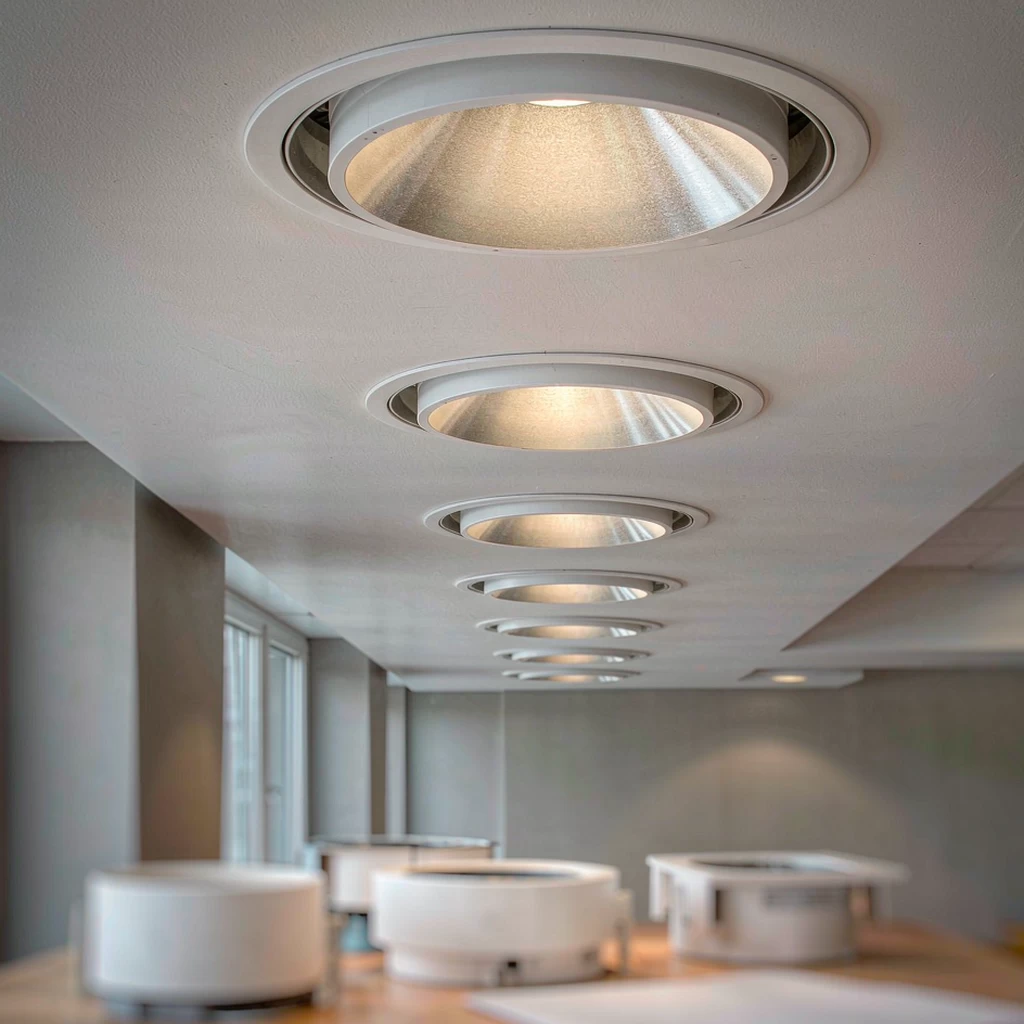
LED downlights are one of the most frequently ordered fixture categories in commercial construction, and also one of the easiest to get wrong. Two fixtures with the same wattage can behave completely differently once installed: one delivers a comfortable, uniform ceiling plane, while the other produces glare complaints, dark spots and costly rework. This LED downlight buying guide is written for B2B buyers — procurement managers, contractors, distributors and project developers — who need to specify and source downlights for offices, retail spaces, hotels and transport hubs. It covers the decisions that matter most and ends with a practical pre-order checklist.
Why Downlights Remain the Default in Commercial Ceilings
Downlights survive every lighting trend for good reasons: clean ceiling lines, compatibility with fire-rated and acoustic ceilings, and even distribution when spaced correctly. Their popularity has a downside for procurement, though — the market is crowded, quality ranges from excellent to disposable, and prices can differ fivefold for fixtures that look identical in a product photo. The way to buy well is to define your requirements precisely, then evaluate suppliers against them.
Know Your Mounting Types First
Before comparing datasheets, confirm which mounting type your ceiling construction requires. Mixing types across one project is a common cause of installation delays and change orders.
Recessed Downlights
Recessed fixtures sit flush with the ceiling and are the standard choice for suspended and drywall ceilings in offices, showrooms and corridors. Check the cut-out diameter and the available plenum depth against the ceiling build-up — an ultra-thin recessed model can solve clearance problems in shallow ceilings where a deep reflector will not fit. For example, an ultra-thin recessed COB LED downlight is often specified precisely for its low profile rather than its raw output.
Surface-Mounted Downlights
Surface-mounted models fix directly onto the ceiling and avoid ceiling-cutting entirely. They are the pragmatic answer for concrete slab ceilings, renovation projects where opening the ceiling is too expensive, and spaces where access for maintenance is difficult. A surface-mounted round downlight designed for lobbies, airports and metro stations is a typical example of this category used at scale in public buildings.
Cylinder and Adjustable Fixtures
When light needs to be aimed — at merchandise, artwork, signage or reception desks — cylinders and adjustable recessed fixtures take over from fixed downlights. A anti-glare cylinder COB downlight gives retail and hospitality projects a combination of directional control and visual comfort. For tighter layouts, a square surface-mount downlight with single or double heads covers spots where one fixture is not enough and two would be wasteful.
If your project mixes general and accent lighting, it is worth reading our comparison of LED downlights vs LED panel lights to decide which category should carry which task.
The Specifications That Actually Matter
A downlight datasheet contains dozens of numbers. In practice, five groups decide whether the fixture will perform in your building.
Wattage, Lumens and Efficacy
Where circuit capacity is tight, look beyond watts and lumens to power factor, harmonic distortion and inrush current: these figures decide how many fixtures a breaker can carry, and our LED lighting load calculation guide walks through the arithmetic.
Never judge a fixture by wattage alone. Two 15 W downlights can differ by 30% or more in delivered lumens. Ask for lumens and efficacy (lm/W), and ask whether the lumen figure is measured on the complete luminaire or on the bare LED module — the difference matters. If you are unsure how lumens translate into fixture quantities for a given room, our plain-language guide to lumens, lux and watts covers the calculation step by step.
Glare Control and UGR
Glare is the number one post-occupancy complaint in office and education projects. Look for deep recessed light sources, matte reflectors and a stated UGR value. A fixture marketed as "anti-glare" without a UGR figure has given you a marketing claim, not a specification. Our guide What Is UGR? explains how the rating is calculated and which values are commonly requested in tenders.
Color Temperature and Color Rendering
Corridor and circulation areas usually call for neutral-to-warm tones, while task areas often specify cooler light. Match the color temperature to the application rather than to habit — the trade-offs are set out in our 3000K vs 4000K vs 6000K guide. For color-critical environments such as retail displays, showrooms and healthcare spaces, ask for CRI and R9 values, not just a headline CRI; our article on color quality metrics explains why R9 reveals what CRI alone hides. Also request SDCM (binning tolerance) data so fixtures installed in the same ceiling do not show visible color differences.
Lifetime and the Driver Question
Lifetime claims deserve the same skepticism as glare claims. Ask for the L-value (for example, the hours at which the fixture reaches L70) and, just as importantly, the rated life of the driver — in many commercial downlights, the driver fails first. Driver brand and model should be disclosed on the datasheet, not kept as a supplier secret. Our deep-dive on L70 and lumen maintenance shows which test data to request before you commit to a volume order.
Flicker
Flicker is invisible in a showroom but obvious on a smartphone camera and, for some occupants, felt as eye strain over a working day. Ask for flicker percentage and index data, especially for dimmed fixtures.
Matching the Fixture to the Space
The right downlight depends on what the room does. As a rule of thumb for planning discussions with your design team:
- Offices and meeting rooms: recessed fixtures with good UGR control, consistent color temperature, and dimming where presentation screens are used.
- Retail and hospitality: a combination of fixed recessed downlights for ambient light and adjustable cylinders for accenting merchandise and feature walls.
- Corridors, stairwells and back-of-house: simple, reliable fixtures at moderate output, where maintenance access is the main cost driver.
- Transport hubs, airports and stations: robust surface-mounted fixtures with high ingress protection, specified for long maintenance cycles.
Most commercial projects combine several of these zones under one ceiling, which is one more reason to buy downlights as a family from a supplier whose range covers recessed, surface and cylinder types — this keeps color temperature, appearance and spare-part logistics consistent. Our LED downlight collection and broader commercial indoor lighting range are organized around this logic.
Certifications and Market Compliance
Certification requirements vary by destination market and are the importer's responsibility — not something to discover at customs. Confirm which marks the fixtures carry and which documents (test reports, declarations of conformity) are provided, and treat any claim as unverified until the certificate with a matching model number is in your hands.
How to Evaluate a Downlight Supplier
For B2B buyers, the supplier matters as much as the fixture. A short evaluation before a volume order protects you from the most expensive mistakes:
- Samples first: order production-line samples, not showroom pieces, and light them in a real room next to the competing fixtures.
- Photometric files: ask for IES/LDT files so your designer can run real calculations instead of guessing; reputable suppliers provide them without being asked twice.
- Driver transparency: confirm driver brand, model and warranty terms in writing.
- Consistency data: request binning/SDCM policy for the production batch you will actually receive.
- Warranty terms: get the warranty duration, what it covers, and the replacement process in writing before the contract is signed.
- Packaging: downlights travel badly if packed loose; confirm individual boxing and drop-test practices for container shipments.
For a broader view of how suppliers document their projects, see our guide to reading an LED lighting case study critically.
The full RFQ-to-inspection sequence behind the checks above is set out step by step in our guide to sourcing LED lighting from China.
Think in Total Cost, Not Unit Price
The cheapest downlight in a tender is rarely the cheapest in the building: driver replacements, callback visits, color inconsistencies and premature lumen depreciation all cost labor, and labor is the expensive part. Model cost of ownership over the warranty period when comparing offers. Our walkthrough on calculating lighting retrofit payback gives you the framework, and the same math applies to new-build procurement.
Quick Pre-Order Checklist
- Cut-out diameter, mounting type and plenum depth confirmed against the ceiling build-up
- Target illuminance and UGR requirement agreed with the designer
- Luminaire lumens (not module lumens) and efficacy stated on the datasheet
- CCT, CRI, R9 and SDCM binning policy documented
- Driver brand, model and rated life disclosed
- L70 lifetime data and flicker metrics provided
- Market-required certifications verified against actual certificates
- IES/LDT files received and calculations run
- Warranty terms and replacement process in writing
- Sample approved on site before the volume order is released
Frequently Asked Questions
What wattage LED downlight do I need for a commercial office?
There is no universal answer, because the required output depends on ceiling height, spacing, target lux and fixture efficacy. A high-efficacy fixture at lower wattage can outperform a higher-wattage fixture of poor quality. Define the target illuminance with your designer, request photometric files, and let the calculation determine wattage.
Are recessed or surface-mounted downlights better?
Neither is universally better. Recessed fixtures give the cleanest ceiling appearance and best glare control; surface-mounted fixtures are faster to install, need no ceiling cut-outs, and suit concrete slabs and renovation budgets. The ceiling construction usually makes the decision for you.
How long should a commercial LED downlight last?
Suppliers express lifetime as an L-value with hours — the point at which output falls to 70% of initial. Compare fixtures on documented L70 data rather than phrases like "50,000-hour life", and remember that driver quality frequently determines real service life.
Can I mix downlights from different suppliers in one project?
You can, but color consistency is the risk. Different manufacturers bin LEDs differently, and mixed batches can show visible color differences across one ceiling. If you must mix sources, buy all fixtures for each visually continuous area from one batch and one supplier.
What should I check before accepting a downlight sample?
Light it in a real room at its intended mounting height. Check glare at working angles, color consistency against the adjacent fixtures, dimming behavior across the full range, and flicker on a smartphone camera. A sample that looks perfect in a showroom can still fail these four checks.
Conclusion: Specify First, Then Source
A successful downlight purchase is mostly a specification exercise. Buyers who define mounting type, glare control, color quality, driver transparency and warranty terms before requesting quotes get better fixtures — and better prices, because suppliers compete on documented performance instead of vague claims. Use the checklist in your next RFQ and shortlist suppliers who can answer every line without hesitation.
Looking for a downlight partner for commercial, retail or public-transport projects? Explore the Solarix Lighting downlight range or contact our team with your specification — we will be glad to review your requirements and recommend fixtures that match your project, market and budget.