
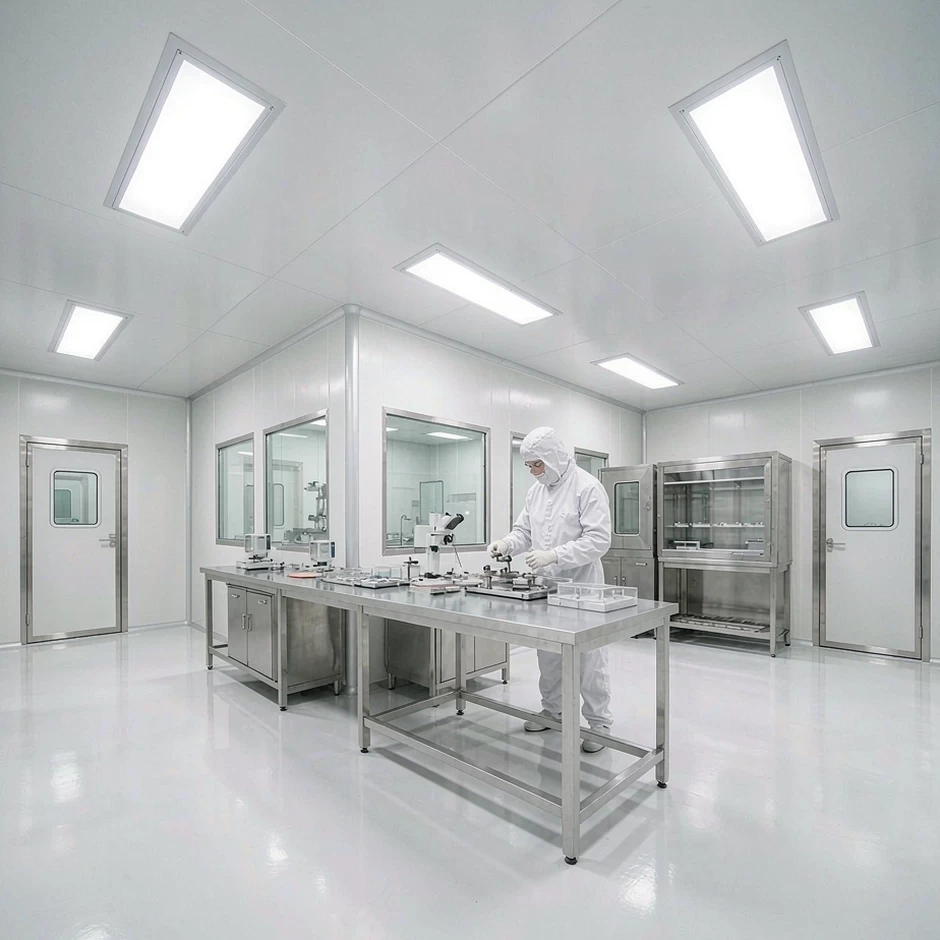
1. A Cleanroom Luminaire Is Not Just a "Sealed Panel Light"
Many procurement teams treat cleanroom lighting as a standard office panel with an IP65 label. That shortcut causes most of the failures we see in the field. A true cleanroom luminaire is designed around three simultaneous duties: it must not emit particles, it must not leak air between the room and the ceiling void, and it must survive the room's cleaning and decontamination chemistry for the life of the installation. A conventional office panel meets none of these duties deliberately — it just happens to look similar.
The distinction matters commercially, too. In pharmaceutical and electronics projects, lighting is part of the qualified environment: swapping a luminaire for a non-equivalent unit can trigger requalification. Specify correctly the first time.
2. Start From the Room Class, Not the Catalog
ISO 14644-1 classifies air cleanliness by particle concentration. The limits most projects work with:
| ISO Class | Max particles ≥0.5 µm per m³ | Typical applications |
|---|---|---|
| ISO 5 | 3,520 | Aseptic filling zones, semiconductor lithography (laminar flow) |
| ISO 6 | 35,200 | Compounding, sensitive electronics assembly |
| ISO 7 | 352,000 | Pharma production backgrounds, medical device assembly |
| ISO 8 | 3,520,000 | Gowning, packaging, support and staging areas |
In pharmaceutical plants, the EU GMP Annex 1 grades A–D overlay these classes: Grade A corresponds to ISO 5 conditions, Grade B to ISO 7 at rest, and Grades C/D roughly map to ISO 7–8 depending on the state of the room.
Two practical consequences. First, the lower the class, the more demanding the sealing, material and installation requirements — an ISO 8 packaging room and an ISO 5 filling zone should not receive the same fixture specification. Second, the class itself does not dictate lux levels; the task performed inside the room does.
3. How Much Light: Illuminance, Glare and CRI
Illuminance targets should come from the visual task, following EN 12464-1. Values widely used as reference points in clean-environment projects:
| Task / area | Maintained illuminance | UGR limit | U0 | CRI (Ra) |
|---|---|---|---|---|
| General cleanroom work, labs | 500 lx | 19–22 | 0.60 | 80 |
| Pharmaceutical production | 500 lx | 22 | 0.60 | 80 |
| Electronics manufacture | 500–750 lx | 19–22 | 0.60 | 80 |
| Visual / QC inspection | 750–1,000 lx | 19 | 0.60–0.70 | 90 |
| Colour inspection | 1,000 lx | 19 | 0.70 | 90, 4000–6500K |
| Gowning, airlocks, corridors | 200–300 lx | 22–25 | 0.40 | 80 |
Three points worth defending in a design review. One: "maintained" means the level after lumen depreciation and dirt — new installations must start above it, which is why sealing and cleanability also protect your lux budget. Two: operators spend full shifts under the ceiling plane, so glare matters; our UGR guide explains the metric. Three: inspection tasks need Ra ≥ 90 and a controlled spectrum — see our high-CRI color quality guide.
4. Sealing and Mounting: IP on Both Faces, and a Service Strategy
The front face should carry at least IP65 per IEC 60529 — full dust protection and resistance to washdown. But the front is only half the fixture. The rear cavity sits over the ceiling void, and any leakage path lets unfiltered air bypass your HEPA filtration. Well-specified cleanroom luminaires are sealed and rated on both faces, with sealed cable entries.
Mounting and service access deserve equal attention:
- Flush or sealed grid integration. EU GMP Annex 1 requires smooth, impervious, unbroken surfaces and tells designers to avoid hard-to-clean recesses. Luminaires should sit flush with the ceiling system, perimeter gasket evenly compressed — no ledges, no exposed fixings on the room side.
- Rear access where containment matters. In BSL and containment laboratories, rear-serviced luminaires let technicians replace drivers from the ceiling void without breaking the room seal.
- Bottom access where downtime matters. Room-side access avoids scaffolding and gowning procedures for a driver swap.
Our IP rating guide explains the rating system itself if you need the basics.
5. Materials That Survive the Cleaning Regime
This is where cheap fixtures quietly fail. Cleanrooms are cleaned with IPA, quaternary ammonium compounds, diluted bleach, and — in pharma suites — vaporized hydrogen peroxide (VHP) and sporicidal agents. Industry compatibility data shows the pattern clearly:
| Material | Behavior under VHP / aggressive disinfectants |
|---|---|
| Polycarbonate diffuser | Oxidative hazing can begin after roughly 50–80 cycles at higher concentrations |
| PMMA (acrylic) | Maintains clarity well beyond 500 cycles |
| Tempered / borosilicate glass | Stable beyond 500 cycles; preferred for Grade A/B areas |
| Peroxide-cured silicone gasket | Absorbs H₂O₂ and extends aeration time; seal life typically under 100 cycles |
| Platinum-cured silicone gasket | Minimal absorption; seal integrity beyond 300 cycles |
| Powder-coated steel / anodized aluminum | Acceptable with inspection intervals; stainless steel preferred in direct vapor paths |
The specification language is simple: for VHP or sporicidal decontamination, require a tempered-glass diffuser and platinum-cured silicone gaskets, and ask for cycle-test or chemical-compatibility documentation — not a generic "chemical resistant" claim.
For food-adjacent clean zones, NSF P442 (the hygiene protocol for luminaires in food zones, beyond the splash-zone requirements of NSF/ANSI 2) adds requirements such as no flaking coatings, no harborage joints, drainable geometry and captive fasteners. Our cold storage lighting guide covers the food side in depth.
6. Amber Light for Photolithography Areas
Electronics fabs add one unusual requirement. Photoresists used in photolithography are sensitive to ultraviolet and short-wavelength blue light below roughly 500 nm, and ordinary white LEDs emit heavily in exactly that band — so lithography bays use amber ("yellow") lighting instead.
The engineering detail buyers miss: a tinted yellow tube is not a filtered yellow light. Surface-dyed diffusers only change the visible color; they do not physically block the sub-500 nm energy that pre-exposes photoresist. Specify luminaires with a dominant wavelength around 590 nm (amber band, roughly 570–620 nm) and demand the spectral power distribution (SPD) report proving no meaningful emission below 500 nm. Process validation teams will also want per-batch spectral test reports.
7. Flicker, Glare and Machine Vision
Two modern pressure points on cleanroom lighting quality:
- Automated optical inspection (AOI). Machine-vision and serialisation cameras see flicker operators cannot. For vision-equipped lines, specify percent flicker below about 5%, or below 1% with a DC-driven fixture. DC low-voltage architecture (typically 30–42 V with a remote driver) also adds an electrical safety margin in wet or conductive zones.
- Operator glare and fatigue. Full-shift inspection needs UGR < 19 (< 16 for the most demanding tasks) — from diffuser optics and source depth, not raw lumens.
Our flicker-free and low-blue-light guide explains how to verify these claims on a datasheet.
8. Layout Rules: Work With the Airflow, Not Against It
Cleanroom lighting design interacts with the HVAC system. Three rules that avoid expensive rework:
- Do not place luminaires directly under HEPA / fan-filter supply outlets. The fixture blocks and disturbs the supply air jet. Keep fixtures offset from filter faces.
- Keep the layout compatible with unidirectional flow. In ISO 5 zones, flush, low-profile fixtures reduce obstruction; review the lighting plan against the airflow model, not just the lux grid.
- Seal every penetration. Cable entries, driver boxes and trim rings are the usual leak paths; airtight installation and gasket compression belong in the installation specification, and site acceptance measurement should include a sealing check alongside the illuminance grid.
9. The Documentation Pack Your Auditor Will Ask For
In regulated facilities, lighting joins the qualification file (IQ/OQ documentation). Collect from the supplier: CE and RoHS declarations; the IP test report (IEC 60529) for front and rear ratings; photometric files (IES/LDT) and UGR data — see how to read photometric files; lifetime evidence such as LM-80 / TM-21 reports; material and chemical-compatibility statements for diffusers and gaskets; and the SPD report for amber litho fixtures plus flicker data for AOI zones.
A supplier who produces this pack without prompting is also, statistically, a supplier whose fixtures will not surprise you at requalification.
10. Quick RFQ Checklist
- Room class (ISO 5–8) and GMP grade, per zone
- Task illuminance, UGR and CRI targets per zone
- IP rating front and rear; flush, rear-access or bottom-access service
- Cleaning agents and decontamination cycle → diffuser and gasket material
- Amber/590 nm variant and SPD report for lithography areas; flicker target for machine-vision lines
- Full documentation pack listed above
11. Where Solarix Lighting Fits
Solarix Lighting (Guangzhou Xuyuan) manufactures sealed, seamless-frame cleanroom luminaires in two configurations: a 32 W DC 30–42 V built-in-driver model (595×595 mm, 130 lm/W, UGR < 23/< 16, Ra > 80) for compact all-in-one installations with low-voltage safety, and a 36 W AC100-240V external-driver model (1215×165 mm, 110 lm/W, Ra > 80) for remote-driver heat and maintenance access. Both use a fully sealed, wipe-clean smooth frame for hospital, laboratory, pharmaceutical and food workshop environments — see the cleanroom luminaire product page and the external-driver version.
Beyond the standard line, Solarix supports project-level customization — dimensions, drivers, controls and photometric files for your DIALux/AGi32 layout — and brings rail-transit, airport and municipal project experience to controlled-environment work. Send us your zone classifications and task requirements, and our engineers will return a lighting layout and a fixture specification that passes both your lux grid and your audit. From a single sealed luminaire to a full project rollout, Solarix Lighting delivers clean, stable, verifiable light — built for environments where quality problems only show up after it is too late.