A luminaire is a 20-year asset. Its electronics are not.
A luminaire is specified for 15 to 20 years of service; the electronics inside it are not 20-year products. LED drivers are usually the first component to fail, and the connectivity ecosystem around smart lighting changes every three to five years.
Most "dead" LED fixtures are not dead at all. One failed component — a driver, an LED board, a sensor — takes down the whole fitting. If it is potted into the housing, or the fixture cannot be opened without destroying the seals, the buyer replaces the whole luminaire — and pays for a bucket truck to do it.
This guide covers what to make replaceable, the interface standards behind plug-in control nodes, and the RFQ clauses that keep spare parts available a decade after installation.
What actually fails first
Failure rates in LED fixtures follow a known pattern:
- The driver fails first. Electrolytic capacitors age with heat, and drivers sit near hot LED boards. It is the most common point of failure, which is why a replaceable driver is worth more than extra lumens per watt — see why the driver decides how long your light lasts.
- LED boards age slowly. Good boards cross L70 tens of thousands of hours in, so full replacement is rare — but a batch defect or an optics change still argues for a board you can actually order.
- Control nodes churn fastest. Radio standards, IoT platforms and cellular networks are retired on commercial timelines — the 2G and 3G sunsets already stranded thousands of smart-city nodes.
Access cost dominates the arithmetic. Replacing a driver at 8 metres means a platform truck, traffic management and a crew. In most markets that visit costs more than the part — which is why serviceability is designed in, not improvised.
Three levels of replaceability to specify
1. The LED driver
Insist on a separate gear compartment with tool-less entry, plug-in connectors instead of hard-wired leads, and a named-brand driver with its model and serial printed on the label — the same checks we apply in our LED driver selection guide for commercial and rail projects. A programmable-output driver lets one spare cover several wattages. Sealed, potted "all-in-one" designs look cheap on a datasheet and expensive at year six.
2. The LED board or light engine
Look for boards connected through standard holders rather than soldered leads. Zhaga now defines linear socketable LED modules for exactly this purpose: Book 26 for non-SELV applications (launched December 2024) and Book 21 for SELV applications. Standardised holders mean a certified replacement module drops into the same footprint without re-engineering the fixture.
3. The control node
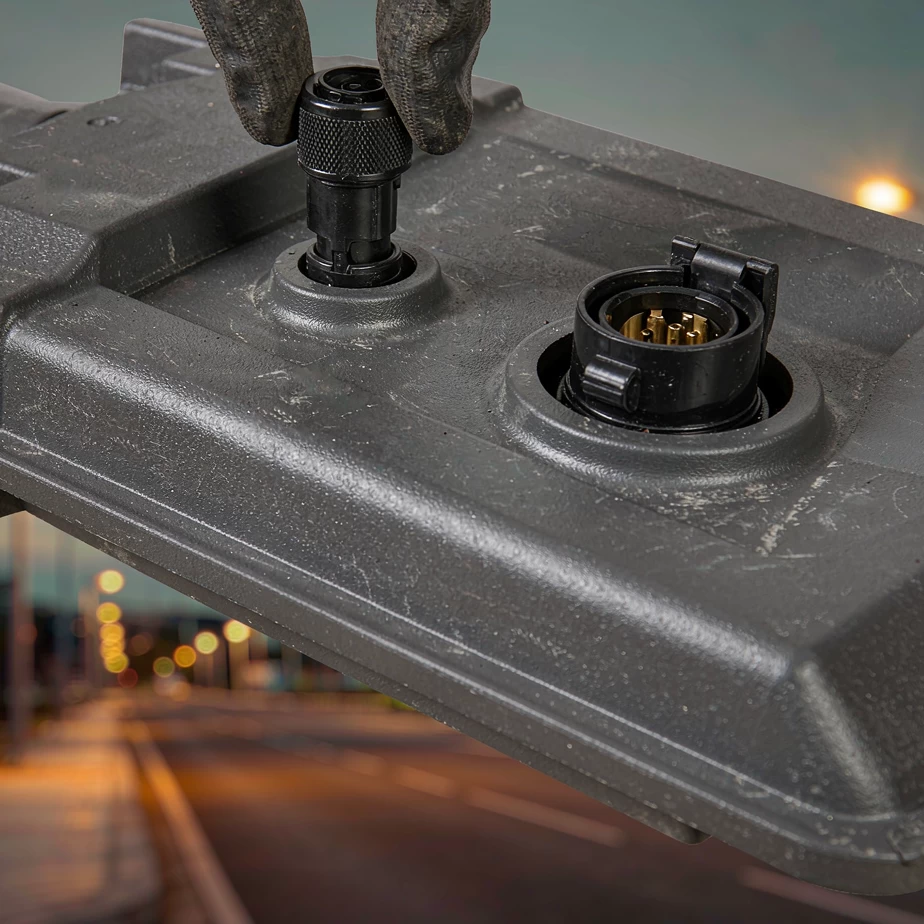
The node — photocell, motion sensor, radio module — is the part you will most often want to change, so it deserves a standardised socket.
Zhaga Book 18 vs NEMA 7-pin: what each standard actually fixes
Both standards solve the same problem — add or replace a control node in the field without rewiring the luminaire — but they come from different ecosystems.
Zhaga Book 18 comes from the Zhaga Consortium, an association of luminaire and component makers. It specifies the mechanical and electrical interface between an outdoor luminaire and a sensing or communication module: a compact socket whose four-pin connection carries 24 V DC power, DALI control and a logic input. A luminaire can ship with a blank cap and take a module years later, and certified nodes from any vendor click into any certified luminaire. Edition 4.0 (October 2025) extends the ecosystem to heritage and decorative luminaires; the indoor counterpart is Book 20.
ANSI C136.41 is the North American 7-pin twist-lock receptacle familiar from NEMA photocontrols. It is backward compatible with 3-pin ANSI C136.10 photocells, carries a 0-10 V dimming pair on violet and grey leads plus a second pair on orange and brown for DALI or a second channel, seals to IP66 with an approved cap, and is rated from -40 to +85 °C.
| Aspect | Zhaga Book 18 (D4i) | ANSI C136.41 (NEMA 7-pin) |
|---|---|---|
| Home market | Europe, global OEM smart platforms | North America, NEMA-market export projects |
| Connector | Compact 4-pin socket, sealed module | Larger 7-pin twist-lock receptacle |
| Control voltage | 24 V DC plus DALI | Mains-side power plus 0-10 V / DALI signal pins |
| Node change | Tool-less click-in, no luminaire entry | Twist-lock swap in seconds |
| Data model | D4i certified (see below) | None standardised at component level |
| Photocell compatibility | Certified Zhaga-D4i nodes | Any ANSI C136.10 3-pin photocell plugs straight in |
Which one should you write into the spec?
Follow the market, not the brochure: North American municipal and utility projects expect C136.41, while European smart-city programmes and global OEM platforms expect Zhaga Book 18. Many export suppliers offer both.
D4i: the data that makes the socket worth having
A socket standardises the fit; D4i standardises the conversation. Zhaga-D4i certification combines the Book 18 socket with a DALI-2 driver profile, and the interoperability promise only holds when both the luminaire and the node carry the certification.
On the driver side, D4i requires:
- An integrated DALI bus power supply (IEC 62386 Part 250) that guarantees at least 50 mA for bus-powered devices.
- An auxiliary 24 V output (Part 150) rated at 3 W continuous, with a 6 W peak allowance — enough to feed a radio node or sensor directly from the driver.
- Standardised data: Part 251 for luminaire asset data, Part 252 for energy metering, Part 253 for diagnostics.
For the buyer, that means each luminaire reports its own energy use, operating hours and fault conditions, and a sensor added in year eight plugs in and talks — no rewiring, no proprietary lock-in. Per-luminaire metering also simplifies energy audits and ESCO verification.
What the option actually buys you
The socket and D4i profile add a modest amount to unit cost. The return shows up over the asset's life:
- A failed photocell or node is swapped in seconds with a gloved hand, versus opening the housing and re-sealing it.
- When the radio platform or CMS changes at year five, the luminaire stays and only the node is replaced — across 1,000 fittings, the difference between a maintenance round and a refit project.
- A repairable fixture also survives tender reviews that now score circularity and serviceability, and it keeps warranty disputes cleaner, since each component is replaceable and traceable.
RFQ clause checklist for serviceable fixtures
- Driver replaceable from a field-accessible gear tray, without removing the luminaire.
- Named-brand driver with model and serial on the label; programmable output current preferred.
- State the control interface explicitly: ANSI C136.41 7-pin receptacle, Zhaga Book 18 socket, or both, with shorting caps for unused sockets.
- D4i-certified driver supporting Parts 250, 251, 252 and 253, with a 24 V auxiliary output where nodes need one.
- LED boards or modules on standard holders; Zhaga Book 21/26 socketable modules where linear formats apply.
- Sealing performance after re-assembly: gasket design and IP66 test evidence for the opened-and-refitted state, including replaceable surge modules.
- A spares list with prices and availability commitments covering at least ten years, mirrored in the warranty terms.
- A service manual stating the tools and time budget for each replacement operation.
Summary
A serviceable fixture is not a premium feature; it is the difference between maintaining an asset and replacing it. Specify a replaceable driver, boards on standard holders, and a control node socket matched to your market — C136.41 for North America, Zhaga Book 18 for Europe and global smart platforms — then hold the supply chain to a ten-year spares commitment.
At Solarix Lighting we manufacture municipal street light and industrial LED luminaires with serviceable gear compartments, replaceable surge and control modules, and NEMA or Zhaga receptacles configured to project requirements, with photometric files, test reports and long-term spares support supplied with the order. Browse the modular P Series street light, or send us the site and the control plan, and we will quote the serviceability you will actually need in year eight.