
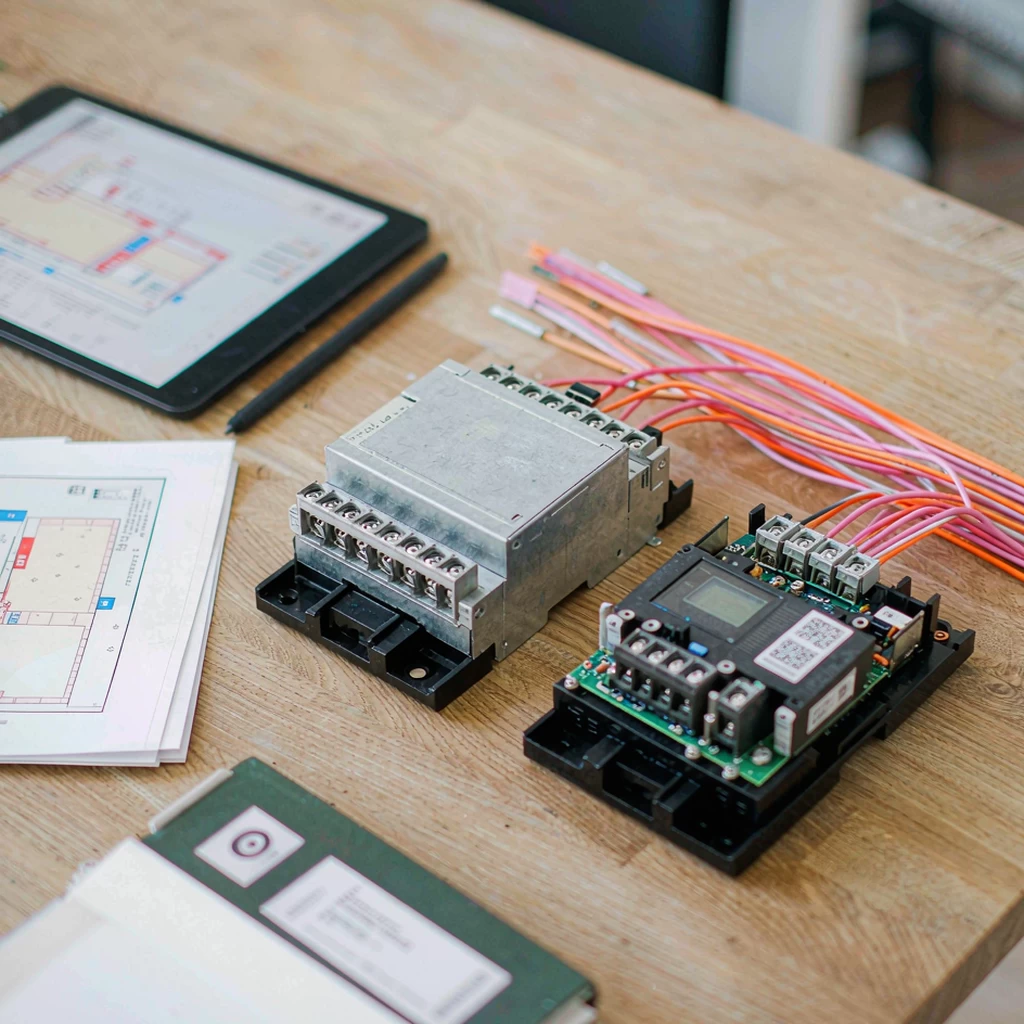
LED dimming protocols decide how an installation behaves long after handover — how smoothly it dims, how finely it can be zoned, whether anyone is told when a driver fails, and how much the controls package adds to the budget. For most B2B buyers the choice narrows to two options found on commercial LED driver datasheets everywhere: 0-10V and DALI. Both are mature, both are widely supported, and they are not interchangeable.
The protocol is locked in when drivers are ordered; changing it later usually means new control gear, rewiring, or both. This guide compares 0-10V vs DALI across wiring, zoning, dimming range, fault feedback, commissioning and cost, and closes with an RFQ checklist. Verify every figure against the datasheet and test report of the driver actually supplied.
What the two protocols are
0-10V: an analogue signal inherited from fluorescent ballasts
0-10V is analogue. Alongside the mains conductors, the luminaire carries an extra low-voltage pair: the driver sources a small DC current, the control device — dimmer, sensor or controller — sinks it. Ten volts means full output, zero volts minimum. The interface began as an annex to the fluorescent ballast standard IEC 60929 and carried into LED drivers largely unchanged, which is why it is cheap and ubiquitous. Note the 1-10V variant, where 1 V is the minimum and the fitting is switched off by removing mains, not by the signal.
Three consequences follow: the signal is a voltage, so long runs and voltage drop shift the dimmed level; the pair is polarity-sensitive, so wiring errors show up as fixtures that will not dim; and there is no addressing, so every driver on one loop dims together.
DALI: a digital bus with addresses
DALI (Digital Addressable Lighting Interface) is defined by the IEC 62386 series; DALI-2 is the current generation, with certification and trademark licensing run by the DALI Alliance. A controller sends digital commands over a two-wire bus — go to this level, recall this scene, report your status — and each driver holds a short address. Widely quoted figures for one bus are up to 64 addresses, 16 groups and 16 scenes, around 300 m at 1.5 mm² conductor size, with a bus power supply on a defined current budget; confirm these against the project standard. The bus has no polarity requirement and no topology constraint — bus, star and tree all work.
Where the two differ
Wiring and topology
0-10V adds two polarity-sensitive low-voltage conductors to every controlled fixture. DALI's two wires carry interface power and commands together, and polarity does not matter, which removes a common commissioning fault. Against that, 0-10V wiring is familiar to almost every contractor, while DALI bus layout, power supply sizing and address planning must be designed. For both, local codes govern how control conductors are classified and whether they may share a raceway with mains.
Zoning granularity
Usually the deciding factor. With 0-10V the control zone is the physical circuit: to change a zone you rewire. With DALI, zones are software groups, so a floor plate can be re-zoned after handover without touching a cable. A warehouse with fixed aisles may never need that; an office with tenant churn, or a hospital with per-bay control, probably does.
Dimming range and low-end behaviour
DALI specifies a logarithmic dimming curve with a very low defined minimum, which is why DALI drivers are quoted down to fractions of a percent. 0-10V is analogue and bottom-end performance depends on the driver: 10% is a typical quoted minimum, and below it is where mismatch, dropout and visible stepping appear. If the design relies on night modes or background levels, require measured output at those levels.
Feedback and diagnostics
0-10V is an open loop: the controller speaks, the driver listens, nothing comes back. DALI-2 supports querying devices, so a system can report lamp failure, gear failure, or a device that has stopped responding. For one small building that may be academic; for an operator maintaining hundreds of fittings, knowing which luminaire failed before anyone reports it changes the maintenance model — often where the business case for DALI is made.
Dimming curve, flicker and visual consistency
Analogue interfaces leave the mapping from voltage to light output largely to the driver designer, so two drivers from different batches can sit at visibly different brightness on the same signal — most obvious on a ceiling mixing several orders. DALI's defined curve reduces the spread. Dimming also affects flicker and, on tunable-white products, colour appearance, so require dimmed-level data: verifying flicker-free and low blue light claims, and colour consistency and binning.
Interfaces: sensors, emergency lighting and outdoor nodes
DALI-2 formalises more than control gear. Parts of the standard cover control devices such as application controllers and input devices, so sensors and switches join the bus as certified devices rather than proprietary add-ons, and a dedicated part covers emergency lighting — fittings can report test results and battery status over the same infrastructure, useful when coordinating an emergency lighting package.
Outdoor is a separate case: NEMA-style twist-lock receptacles are commonly associated with 0-10V and node control, while Zhaga-style sockets carry DALI-2 bus power and data. See Zhaga vs NEMA sockets, and settle surge protection ratings in the same package, since control electronics are part of what a surge damages.
0-10V vs DALI: side-by-side
| Dimension | 0-10V | DALI / DALI-2 |
|---|---|---|
| Signal | Analogue DC voltage; driver sources, controller sinks | Digital commands on a two-wire bus |
| Standard basis | Annex to IEC 60929, carried into LED drivers | IEC 62386 series; DALI-2 certification via DALI Alliance |
| Wiring | Two low-voltage conductors, polarity-sensitive | Two-wire bus, polarity irrelevant |
| Zoning | One zone per wired loop; re-zoning means rewiring | Software groups and scenes; re-zoning without rewiring |
| Low end | Often quoted around 10%; below that, driver-dependent | Defined logarithmic curve, much lower minimum level |
| Fault feedback | None — open loop | Device status and fault reporting available |
| Commissioning | Wiring check and end-level verification | Addressing, grouping, scenes, bus power budget |
| Best fit | Fixed, simple zoning on a tight budget | Fine zoning, reconfigurable layouts, managed maintenance |
What each option really costs
0-10V usually wins upfront: the dimming driver option is typically the cheapest variant, controls are commodity items, and there is no bus power supply or specialist commissioning day. One caveat — a control device has a finite current-sink capacity, and that rating, not the fixture count on the drawing, limits how many drivers one loop carries. Ask for it in writing.
DALI adds cost in control gear, bus infrastructure and commissioning labour. It can reduce cost elsewhere: fewer control circuits, re-zoning without a contractor visit, and fault reporting that turns reactive maintenance into planned work. Whether that trade is positive depends on how often the space changes and how the owner maintains the building.
Matching the protocol to the application
- Warehouses and industrial aisles with a stable layout: 0-10V with aisle-level occupancy sensing is often sufficient — see LED lighting for warehouses.
- Offices, education and healthcare where layouts change and daylight-responsive control is expected: DALI earns its place through re-zoning and reporting. See schools and classrooms and hospitals and clinics.
- Retail and hospitality where scenes matter: DALI scenes are set in software — see retail LED lighting specification.
- Car parks and circulation areas: either works, but verify low-end stability and flicker at the background level — see parking garage lighting.
- Road and area lighting: let the node and socket strategy decide — start from the street light buying guide.
Specification checklist for your RFQ
- Name the protocol and version — "0-10V, 0 V = minimum" or "DALI-2 to IEC 62386" — and state whether 1-10V is acceptable.
- State the dimming range in measured light output and require dimmed-level test data, not a datasheet range.
- Define the control zone — per circuit, per fixture or per group — and how many zones the project has.
- State what feedback is required: none, status query or full fault reporting, and who reads it.
- Require the driver make and model to be named in the bid so quotes compare the same control gear — see LED lighting tender and bid documents.
- Ask for a wiring topology drawing, plus a bus power budget for DALI or a current-sink calculation for 0-10V.
- Put commissioning in scope: who addresses, who sets scenes, who signs off. A site acceptance checklist is the practical tool.
- Confirm dimming components carry the same warranty terms as the luminaire, and settle the control strategy against the applicable code first — see lighting power density and energy codes and EU ecodesign compliance.
Common specification mistakes
- Specifying "dimmable" without naming the interface. A dimmable driver is not a control system; bids will arrive with three protocols and will not be comparable.
- Assuming the signal switches the fitting off. With 1-10V it may not; in DALI, dimming to zero and switching off are different commands with different energy implications.
- Ignoring the driver. It implements the protocol and is usually the first component to fail. See choosing LED drivers and thermal management and driver lifetime.
- Forgetting everything but the signal. Inrush current, power factor and harmonics still have to fit the circuits — see load calculation, PF, THD and inrush and how many fixtures a space needs.
Frequently asked questions
Is DALI always better than 0-10V?
No. DALI gives finer zoning, lower dimming levels and fault reporting, and costs more to buy and commission. Where zones are fixed and the budget is tight, 0-10V remains sound. The real question is what the building needs to do after handover.
Can 0-10V and DALI be mixed in one project?
Yes, and it is common — DALI on floors that need re-zoning, 0-10V in back-of-house. The cost is an interface between the two systems at the head end; decide where that boundary sits during design, not during commissioning.
Should I specify DALI-2 rather than DALI?
For new projects, yes: DALI-2 carries a certification programme covering control gear and control devices, which is what makes multi-vendor systems behave predictably. For extensions to an existing DALI installation, compatibility with what is already installed governs.
What should a supplier prove about dimming?
Measured output and flicker at the dimmed levels you will use, how zones are created, the wiring topology and cable budget, who commissions, and which driver the quote is based on. A claim that cannot be tied to a test report or datasheet is unverified — see how to source LED lighting from China.
Does dimming shorten fixture life?
Dimming generally reduces thermal load, and heat drives LED and driver ageing — but control electronics run continuously, and very low dimming has its own profile. Ask for lifetime projections at your intended operating point. Background: L70 and lumen maintenance.
Where Solarix fits
Some of our industrial and road ranges list both options on their product pages: the V-Series and U-Series UFO high bays state 0-10V and DALI dimming support, and the N-Series and P-Series street lights list 0-10V DIM and DALI DIM among their control options. Treat these as options to confirm on the variant quoted, not as a project guarantee — dimming behaviour depends on the driver fitted to that order. The wider range sits under industrial lighting, outdoor lighting and commercial and indoor lighting.
Next step
Send us the protocol, dimming range, zone schedule and commissioning scope you have settled on, and we will quote against it with the driver make and model named. If you are still deciding, the lighting knowledge library covers optics, glare, colour quality, lifetime and compliance at the same depth, and you can start from the full catalogue and work back to the control requirement.