
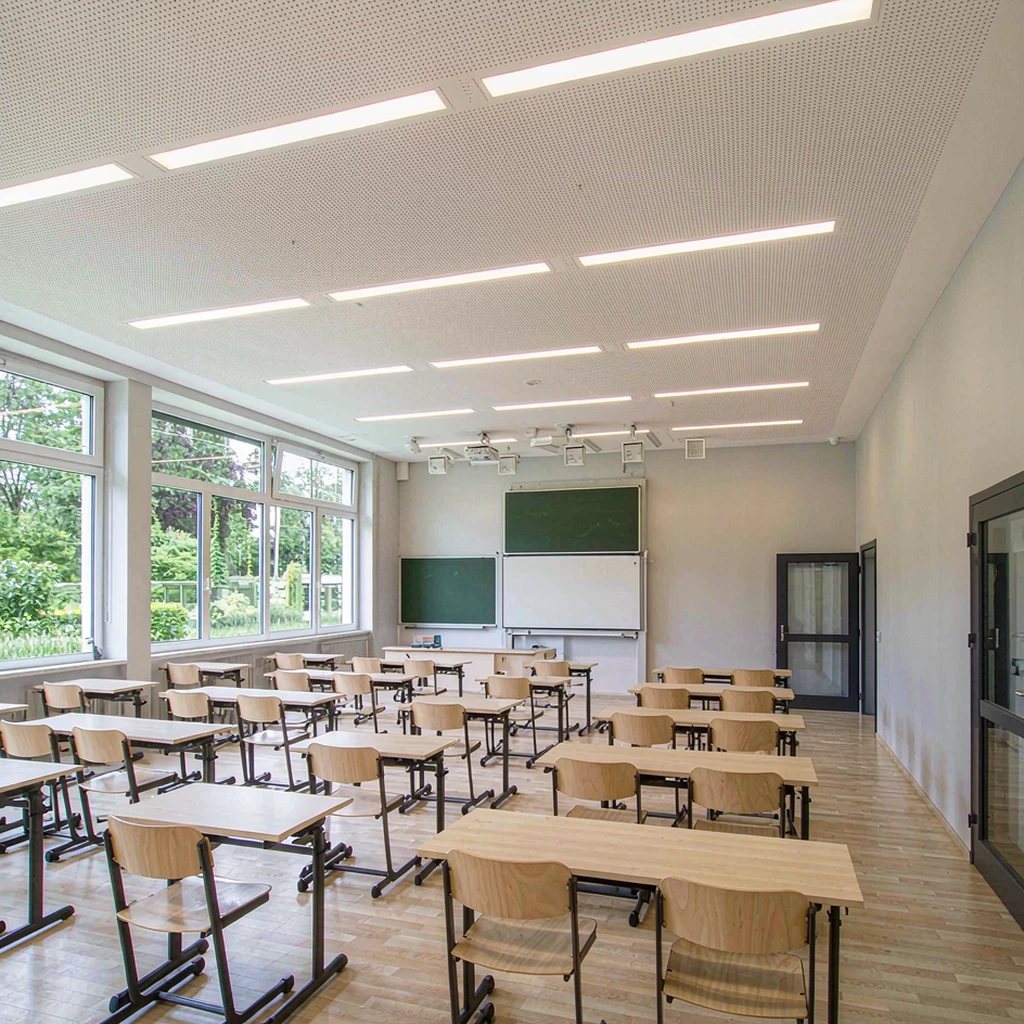
When a school district, education contractor, or private school group issues an inquiry for classroom lighting, the questions that decide the award rarely revolve around price alone. They revolve around illuminance targets, glare limits, vertical illuminance on the teaching wall, flicker performance, and how the installation will be phased around the school calendar. In other words, LED lighting for schools and classrooms is a specification exercise first and a procurement exercise second.
This guide is written for B2B buyers — procurement managers, MEP consultants, and contractors — who need to translate education lighting requirements into a fixture schedule and an RFQ that suppliers can quote accurately. Each section links to deeper technical resources on this site so you can verify claims before they reach your tender documents.
Why Classroom Lighting Is Different from Generic Commercial Lighting
A classroom is a demanding visual environment disguised as a simple rectangular room. Students perform two opposite visual tasks for hours at a time: reading high-contrast print at desk level, and looking up at a screen or whiteboard where glare and reflections cause real discomfort. Unlike a warehouse (where the priority is uniform horizontal light) or a retail floor (where the priority is drama), a classroom needs consistent horizontal illuminance across every desk, strictly controlled glare, deliberate vertical illuminance on the teaching wall, colour rendering good enough for wall displays and screens, and quiet, flicker-free operation.
The Key Metrics in a Classroom Lighting Specification
Desk-Plane Illuminance and Uniformity
Most international education lighting guidance converges on a maintained illuminance of roughly 300–500 lux on the desk plane, with higher targets for detailed tasks such as technical drawing, laboratories, and libraries. Just as important is uniformity — the ratio between minimum and average illuminance. A classroom that averages 400 lux but leaves the back corners at 150 lux creates unequal learning conditions across the room.
When you receive a supplier's lighting layout, ask for the calculation grid: the number of calculation points, the working plane height (typically 0.75–0.85 m for desks), and whether the results are maintained illuminance (including a maintenance factor) or initial values. Our guide to lumens, lux and watts explains how to check whether a fixture count is realistic, and our load calculation guide covers the electrical side of the same layout.
Glare: UGR Is the Number That Matters
Unified Glare Rating (UGR) is the standard metric for discomfort glare in interior spaces. Education guidance commonly targets UGR ≤ 19 for classrooms and stricter values for rooms with screens. The practical lever is not the UGR figure itself but the fixture construction: diffuser quality, luminous surface size, and how the luminaire is positioned relative to sightlines.
Our plain-language explainer on what UGR means and how it is calculated shows why two panels with identical lumen output can differ enormously in perceived glare — and why UGR should always be requested as a calculated value for the actual room, not quoted from a datasheet table.
Vertical Illuminance on the Teaching Wall
Boards and interactive displays need their own light. A ceiling grid that produces 400 lux on desks can still leave the teaching wall under-lit, forcing contrast between a bright screen and a dim wall. Education projects typically add asymmetric board luminaires or dedicated wallwashers so the teaching surface receives meaningful vertical illuminance on its own switching or dimming circuit. This is a frequent gap in first-round quotations: bidders quote a symmetric panel grid and ignore the board. If board lighting is required, state the board dimensions, mounting height, and target vertical illuminance explicitly in the RFQ.
Colour Temperature and Colour Rendering for Learning Spaces
Colour choices in schools are project-specific, and both ends of the common range are defensible:
- 3000K (warm white) suits early-years and reading-focused rooms, and many designers prefer it in smaller learning spaces.
- 4000K (neutral white) is the most common default for general classrooms, offering a bright, neutral appearance that photographs and renders screens well.
Our detailed comparison of 3000K vs 4000K in commercial workspaces and our broader colour temperature application guide apply directly to education spaces. For multi-room school programmes, a practical approach is 4000K in general classrooms with warmer temperatures in kindergartens, counselling rooms, and libraries.
Colour rendering matters just as much. A CRI of 80 is the usual commercial floor; CRI 90+ with good R9 noticeably improves how artwork, wall displays, and skin tones appear. Our guide to CRI, R9 and TM-30 colour quality metrics explains what to request in test reports — because "CRI 90" printed on a quotation is not evidence until a report backs it.
Flicker: A Small Line Item with Large Consequences
Flicker in LED lighting comes mostly from driver behaviour, and its effects — eye strain, headaches, and stroboscopic artifacts on camera — are disproportionately reported in classrooms, where students spend many hours under the same fittings and laptop cameras are everywhere. Because flicker is invisible in most cases, it must be handled through documentation: ask bidders for flicker percentage and flicker index data at your operating conditions, referencing recognised measurement practice rather than marketing claims. Our guide to verifying flicker-free and healthy-lighting claims sets out which figures to request and how to read them. This article makes no health or learning-outcome claims for any lighting product — it simply describes the documentation that lets a buyer compare bidders on measurable terms.
Fixture Types That Work in Classrooms
LED Panel Lights
Recessed LED panels remain the default in classrooms with suspended or grid ceilings, because their large luminous surface naturally keeps UGR low and delivers even desk-plane light. For a working comparison of the two panel constructions, see our guide to backlit vs edge-lit panel lights; for procurement-level detail, our panel light procurement guide covers sizing and specification structure that applies equally to education projects.
Relevant product references from our catalogue include the DC30-42V edge-lit low-UGR LED panel light (36W/50W) and the DC30-42V backlit low-UGR panel light (36W/50W), both specified for recessed commercial ceilings.
Linear and Suspended Luminaires
In renovated buildings with exposed soffits or higher ceilings, suspended linear luminaires distribute light more evenly across a wider room and look intentional in modern learning environments. Our LED linear light guide covers suspended, recessed and continuous-run options. A catalogued example is the 900/1200 mm suspended edge-lit linear panel.
Downlights and Supplementary Lighting
Downlights play a supporting role in schools: corridors, circulation spaces, staff areas, and accent or fill lighting in multi-use halls. Anti-glare construction matters even more in these transitional spaces, where occupants look across the room rather than down at a desk. See our commercial downlight buying guide and the anti-glare MZD cylinder COB downlight series as a reference. For corridors and service areas, durability and emergency-lighting integration dominate — our emergency lighting procurement guide covers what to verify before you award that part of the package.
Controls, Daylight and Zoning
Classrooms rarely need lights at full output all day. The highest-value control strategies in education projects are daylight-responsive dimming near windows, occupancy sensing in low-traffic rooms and storerooms, and zoned switching so the window rows, the centre grid, and the board circuit operate independently.
Specify the control protocol up front (for example, whether your project requires DALI, 0-10V, or simple switched circuits) so that bidders quote drivers compatible with your controls rather than discovering the mismatch at installation. If your scope includes certification or energy-code documentation, our guide to on-site commissioning and acceptance checks helps you verify installed performance before sign-off.
Building the RFQ: What Suppliers Need to Quote Accurately
A classroom lighting RFQ that gets comparable bids includes, at minimum:
- Room schedule: dimensions, ceiling type and height, window orientation, and board/display dimensions
- Performance targets: maintained illuminance and uniformity per room type, UGR limit, CRI, colour temperature, flicker documentation requirements
- Electrical constraints: supply voltage, circuit counts, control protocol, and any emergency-lighting integration
- Documentation requirements: photometric files, driver and LED brand disclosure, test reports, and warranty terms
- Commercial logistics: Incoterms, delivery windows phased around the school calendar, packaging, and spare-part policy
If you are sourcing from manufacturers directly, our end-to-end guide to sourcing LED lighting from China covers sampling, factory audits and inspection, and our retrofit ROI framework helps you build the energy-savings case for capital approval. Fixture-lifetime claims deserve the same scrutiny — our L70 explainer on lumen maintenance and lifetime data shows which numbers are verifiable and which are decoration.
Phasing the Installation Around the School Calendar
Education projects are logistics projects. Most schools can only release rooms during holidays and short half-term windows, so the practical differentiator between bidders is often delivery reliability, not unit price. Buyers should therefore break the delivery schedule into room batches aligned with available installation windows, require packaging and palletisation that survives multi-stage site handling, agree a sample-and-approval fixture for each fixture type before the main production run, and confirm spare-unit quantities and storage arrangements for future maintenance.
These items belong in the contract, not in friendly emails. Suppliers who can document their packaging, inspection, and delivery process may price slightly higher — and still be the better commercial choice once rework and delay risk is counted.
Frequently Asked Questions
What illuminance should a standard classroom target?
International education lighting guidance commonly falls in the 300–500 lux maintained range on the desk plane, with higher targets for specialist rooms such as laboratories, art studios, and libraries. Always confirm the applicable national or project standard with your consultant, since requirements differ by market.
What UGR should classroom lighting achieve?
UGR ≤ 19 is the widely referenced target for classrooms, with stricter values typically applied to rooms with screens. Request a room-specific UGR calculation, not a datasheet value.
Do classrooms need special "education" fixtures?
Not necessarily. The same low-UGR, appropriately documented panel and linear luminaires used in quality office projects typically meet classroom requirements when combined with correct layout and board lighting. What changes is the verification discipline: uniformity, vertical illuminance, flicker documentation, and delivery phasing.
Is 3000K or 4000K better for classrooms?
Both are used. 4000K is the common default for general classrooms; 3000K is often preferred for early-years, reading, and counselling spaces. Consistency within each room type matters more than the absolute choice.
How do we verify flicker claims before awarding?
Request flicker percentage and flicker index data measured under representative conditions, plus driver documentation. Our verification guide lists the specific figures and what they mean.
What should a classroom lighting warranty cover?
At minimum: fixture lumen maintenance terms, driver replacement terms, and the process for warranty claims on multi-year school programmes. Our sourcing checklist explains what to put in writing before the purchase order.
Plan Your Next School Lighting Project
Classroom lighting rewards buyers who convert requirements into measurable specification lines and hold every bidder to them. Solarix Lighting (Guangzhou Xuyuan Lighting Technology Co., Ltd.) manufactures low-UGR LED panel lights, linear luminaires and downlights for commercial and public interiors, and supports project buyers with photometric documentation, samples, and delivery schedules phased around installation windows.
Send us your room schedule and performance targets — our team will respond with a fixture proposal and supporting documentation for your tender. Explore our commercial indoor lighting collection and LED panel light collection to see the product families used in projects across commercial, education, and transport infrastructure environments, or browse more guides in the Lighting Knowledge blog collection.