
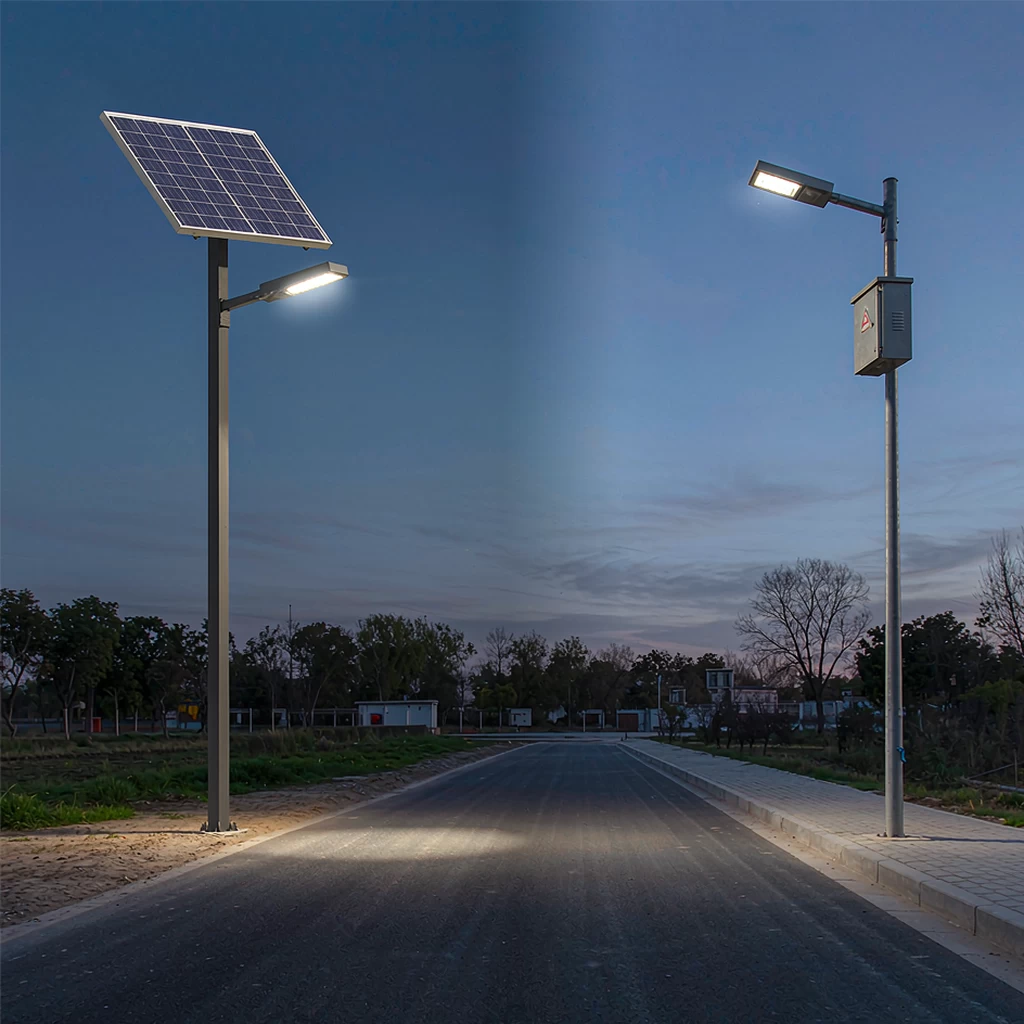
Choosing between a solar street light and a grid-connected street light shapes an entire road lighting project, and it is easy to get wrong. Teams often compare unit prices, then discover during installation that civil works, the maintenance model or the local solar resource has moved the total cost the other way. This guide gives B2B buyers a structured way to compare solar street light vs grid street light options before an RFQ goes out: the variables that decide the outcome, the failure modes that appear after handover, and a data pack every supplier can be asked to complete.
What the Two Options Mean in a Specification
Confusion starts with terminology, because "solar" and "grid" describe the power source, not the lighting performance. Both still have to deliver the same maintained illuminance, uniformity and glare control on the road surface.
Grid-connected (mains) road luminaires
A grid street light is fed from the utility network through a distribution board, with cabling, protection devices and usually central switching. The luminaire is simple; the complexity sits in the infrastructure around it. Where a network and spare capacity exist, that is largely sunk cost and adding luminaires is cheap. Where it does not, trenching, feeder pillars and utility approvals can dominate budget and schedule.
Off-grid solar road luminaires
A solar street light generates and stores its own energy: PV module, charge controller, battery and luminaire on one pole or as separate assemblies. Integrated units combine everything in one housing; split systems separate panel and battery from the luminaire head, allowing independent panel orientation and easier battery replacement. We covered that trade-off in our guide to choosing a split solar LED street light. Each pole is an independent power system, so solar scales linearly.
Six Variables That Decide the Outcome
Evaluate these on your site rather than comparing catalogue prices.
1. Grid availability and distance to connection
Measure to the first pole, not the site boundary. Where the nearest feeder is hundreds of metres away, or the route crosses a watercourse or railway, civil cost alone can exceed the cost of solar poles.
2. Electricity tariff and metering
Grid lighting is an ongoing operating expense, and the structure matters as much as the rate: standing charges, time-of-use bands, and who holds the account after handover.
3. Solar resource and the seasonal worst case
Solar must be designed for the worst month, not the annual average. Peak sun hours, seasonal cloud cover, panel tilt and shading all change what is harvested, so ask suppliers to state the design basis.
4. Required autonomy in low-light days
Autonomy is the number of consecutive nights the luminaire must run on stored energy — a design input you provide, not a specification to be guessed. A footpath tolerates reduced output; a security perimeter may not.
5. Pole, foundation and civil works
A solar pole carries more wind load because of the panel area, and the battery adds mass and access requirements, so foundations are usually larger. On the grid side trenching and reinstatement carry their own permits.
6. Maintenance model and battery replacement
Grid failures are localised and cheap to fix. Solar adds a consumable: the battery, whose life depends on chemistry, depth of discharge and above all temperature. Plan a replacement cycle and require an enclosure serviceable without removing the luminaire. Where theft risk is material, specify tamper-resistant fasteners and lock the battery inside the pole or in an enclosure at height.
Side-by-Side Comparison for B2B Evaluation
| Factor | Grid street light | Solar street light |
|---|---|---|
| Upfront cost | Luminaire plus cabling, trenching, connection charges | Luminaire plus PV module, battery, controller per pole |
| Ongoing cost | Metered energy, standing charges | No energy bill; battery replacement, panel cleaning |
| Scaling | Feeder capacity check, more cabling | Linear, each pole self-contained |
| Failure modes | Driver failure, cable faults, surge damage | Battery degradation, soiling, theft |
| Best fit | Arterial roads, existing capacity | Rural roads, perimeters, parks, campuses |
Where a Solar Street Light Usually Wins
Rural roads, parks and campuses
Low traffic density and no nearby network are exactly the conditions where trenching costs more than the energy system, and dimming further reduces what the battery must store. Sensitive or heritage surfaces are expensive to trench, so independent poles avoid reinstatement obligations, and phased sites can be lit as each phase completes. Our outdoor lighting range covers both off-grid solar and mains road luminaires, which helps when one site needs a mixed specification.
Remote parking and temporary access roads
Perimeter car parks and logistics yards often sit far from the nearest board, and solar avoids both trenching and metering administration. Where lighting is needed for a defined period and will be relocated, the absence of buried infrastructure is decisive. For covered or structured parking the calculation changes entirely — see our guide to LED lighting for parking garages.
Where a Grid Street Light Remains the Better Specification
High-mounting arterial roads and demanding environments
Greater mounting heights, tighter uniformity and long burning hours raise nightly energy demand, growing panel and battery size non-linearly, so grid is usually more robust where distribution already runs along the corridor. Short winter days, persistent cloud, shading or dust and salt deposits on panels all reduce harvest; solar can still work, but the design basis must be conservative and maintenance must include cleaning intervals.
Sites with an established maintenance system
Where the owner already runs a lighting management system with crews, spares and procedures, adding a second technology with a different failure profile and consumable adds complexity, and standardisation has real value that rarely appears in a spreadsheet. Equally, if a dim night is unacceptable and no mains backup exists, variability must be designed out rather than accepted, which usually means oversizing.
The Photometric Requirement Does Not Change
The most common specification error is relaxing the lighting requirement because the power source changed. Maintained illuminance, uniformity, threshold increment and glare control are set by the road and its users, not by how the luminaire is powered.
Specify light distribution, not just lumens
Request the photometric file and check the distribution against road geometry: pole height, spacing, carriageway width, overhang and lanes. Our guide to roadway distribution types and pole spacing explains how classification maps to layout, and how to read an IES or LDT file covers what to verify.
Dimming, ingress, surge and thermal design
On the solar side, dimming is an energy management tool: scheduled output reduction in low-traffic hours is what makes a realistic battery size viable for a given autonomy target; on the grid side it is mainly a cost and compliance tool. Require the profile in writing. Both options need an ingress rating matched to exposure — our IP rating guide explains how to read the code — and grid luminaires need coordination with the installation's surge protection devices. Solar adds a thermal consideration: in hot climates the battery compartment needs ventilation and separation from the heat of the module and panel.
Building an Honest Lifecycle Comparison
Put both options on the same horizon and scope: a model that includes battery replacement for solar but ignores reinstatement and traffic management for grid trenching is not a comparison.
- Grid-side: poles and foundations; cabling, ducting and feeder pillars; trenching, reinstatement, permits and traffic management; connection charges and metering; metered energy over the horizon
- Solar-side: luminaire, panel, battery, controller, pole and foundation sized for the worst month; battery replacement with access equipment; panel cleaning and vegetation management; security measures
Request itemised quotations: for solar, separate panel wattage, battery capacity and chemistry, controller type, autonomy basis and dimming profile; for grid, separate luminaire, pole and electrical infrastructure. Line items let you re-price quickly when the layout changes. The RFQ, sample, audit and inspection checklist sets out what to request up front, and our article on calculating retrofit payback covers handling replacement cycles without optimistic assumptions. Any result depends on your tariffs, solar resource and civil conditions, so treat the model as a decision aid, not a guarantee.
Battery Chemistry and Replacement Planning
Most off-grid solar road luminaires use a lithium iron phosphate chemistry, chosen for cycle life and thermal stability. Rather than comparing chemistry names, ask for permitted depth of discharge, the temperature range the battery will experience in its enclosure, and the warranted end-of-life criterion. Battery life is the largest uncertainty in any solar street light business case and the item most often omitted from quotations.
An RFQ Data Pack for Either Option
- Layout: road classification, carriageway width, lanes, pole height, spacing, overhang
- Photometric target: maintained illuminance, uniformity, glare limits, design calculation required
- Operating profile: nightly burning hours and dimming schedule
- Grid data: voltage and phases, distance to connection, spare capacity, tariff, metering
- Solar data: coordinates, design month, tilt and orientation limits, shading, autonomy
- Environment: ambient temperature range, wind load, coastal or industrial exposure, dust
- Security and maintenance: anti-theft provisions, responsible party, response time, spares
- Verification: pre-shipment inspection scope and witnessed commissioning tests
If you are shortlisting hardware, our LED street light buying guide covers luminaire-level specification and the L70 guide explains how to verify lifetime claims. To quote both options side by side, see the Y-Series and X-Series split solar street lights (30W/60W), the N-Series and P-Series mains road luminaires, or the full product catalogue.
Frequently Asked Questions
Is a solar street light always cheaper than a grid street light?
No. Solar usually wins where trenching, reinstatement or connection costs are high, or where no network exists; grid wins where capacity is already in place. Compare civil works against battery replacement over the same horizon.
How many consecutive cloudy days should the design cover?
That is a project input, not a standard value. Set it from the consequence of a reduced-output night: footpaths tolerate more, security perimeters less. Since autonomy drives panel and battery size, stating it precisely prevents under-performing and over-priced installations alike.
Do solar street lights need less maintenance?
Different maintenance, not less. Grid involves cable faults, driver replacement and surge damage; solar adds battery replacement, panel cleaning and vegetation control to protect the shading assumptions used in the design.
Can a solar street light meet the same road lighting standards?
The standard applies to the light on the road, not the power source. A solar luminaire can meet the same maintained illuminance, uniformity and glare limits if the photometric design is done properly and the dimming profile is reflected in the maintained value. Verify with a photometric file and calculation, not a lumen figure.
Can one project mix the two?
Yes, and it is often the most practical outcome: mains along corridors where distribution exists, off-grid solar on spurs and perimeters, with matched photometric performance so the road reads consistently at night.
Next Steps
Document the six decision variables for your site, then issue one RFQ covering both options with the data pack above: comparing complete, line-item quotations on a common horizon is what turns a technology preference into a defensible procurement decision. Solarix Lighting supplies both off-grid solar and mains-powered road luminaires for B2B and municipal projects and can quote either configuration against the same photometric target — share your road classification, layout, grid conditions and autonomy requirement, or browse the outdoor lighting collection and send us your project brief.