
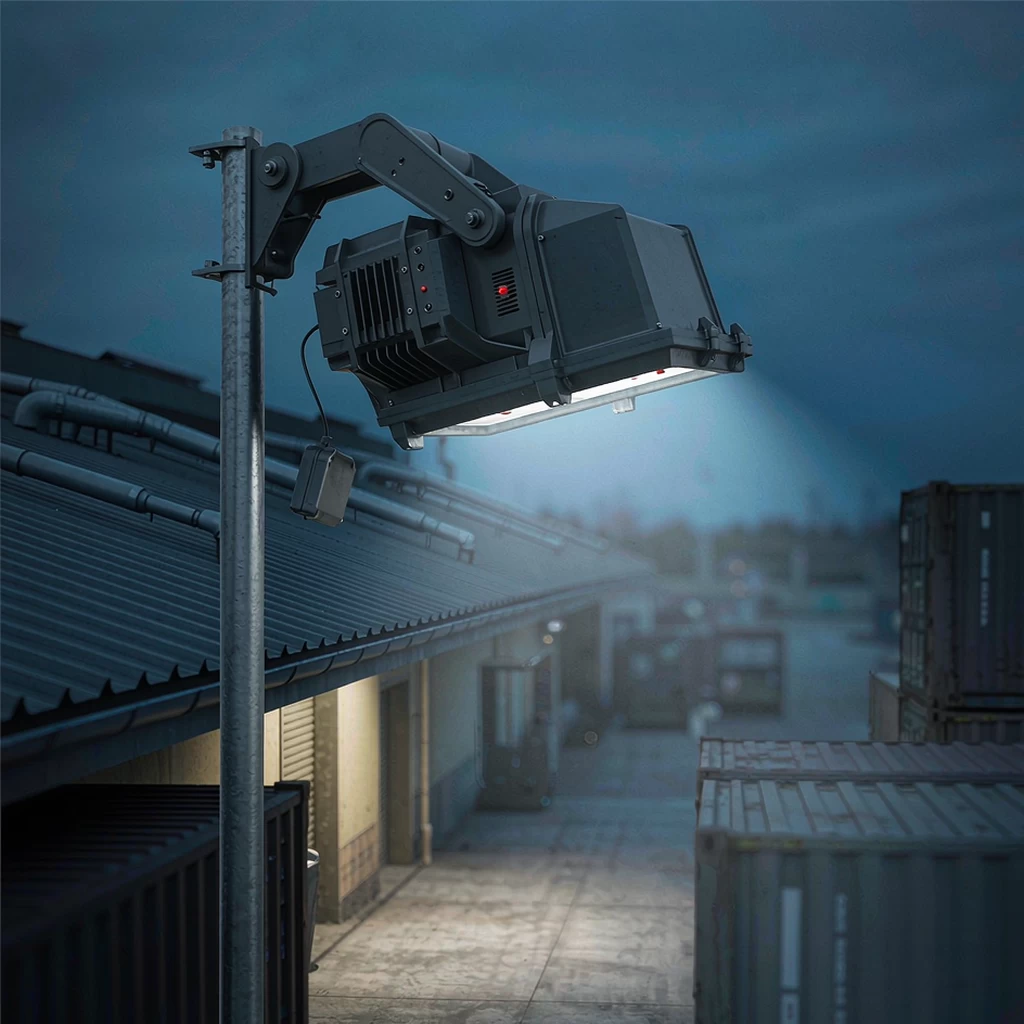
1. What an LED flood light is — and what it is not
An LED flood light throws a wide beam from a fixed point to light an area rather than a road. Buyers often ask for “a 200W flood light” when what they need is a defined illuminance over a defined area, delivered without glare into neighbouring windows.
Three families are regularly confused with it. A roadway luminaire lights a long narrow strip of asphalt with controlled cut-off and assumes a pole over the road; an area light is the pole-top version of the same idea. A high bay is an interior fitting aimed down from height, and it is usually a poor choice outdoors because its sealing and bracket were not designed for weather. Our LED street light buying guide and high bay lighting guide cover those cases.
1.1 Where a flood light is the right tool
Flood lights earn their place when the lit area is broad and irregular and the mounting point sits on the perimeter rather than over the middle: facades, loading yards, container stacks, car park perimeters and signage. On a long road or a repetitive grid, a pole-top luminaire usually gives better uniformity at lower connected load.
2. Start from the task, not from the wattage
Wattage is an input, not an output. Two LED flood lights of equal wattage can perform very differently, because the lumens produced and their distribution both differ. Begin with what has to be seen, from where it is lit, and how uniform it must be — then sketch the area and mark every mounting position, because the distance to the far corner drives every choice that follows.
2.1 Target illuminance and uniformity
The ranges below are starting points for discussion with your designer or supplier, not a substitute for the standard that applies in your jurisdiction.
| Application | Commonly discussed range | What governs the result |
|---|---|---|
| Perimeter security, general yard | Often 20–50 lux | Uniformity, camera compatibility |
| Loading docks, active yard | Commonly 50–150 lux | Vertical surfaces, signage colour |
| Car park surface | Commonly 20–75 lux | Uniformity ratio, layout |
| Facade and architectural accent | Set by design intent | Grazing angle, beam precision |
| Training-level sports | Commonly 200 lux and up | Vertical illuminance, glare |
An average lux figure can be met by bright pools and dark gaps, so ask for the uniformity ratio too and state the plane you are measuring. The method in our article on lumens, lux and watts applies outdoors as well.
3. Beam angle: the specification that decides the result
3.1 Narrow, wide and asymmetric optics
A narrow beam throws further and suits facade grazing or a mast lighting a distant corner; a wide beam covers a broad near field but loses intensity quickly, so it suits a wall-mounted fitting lighting the ground below it. Asymmetric optics push light forward and down rather than symmetrically around the axis — often the right answer on a building edge, where half a symmetric beam would land on the wall behind.
3.2 Match the beam to the geometry
The spread needs to cover the area at the mounting distance, with overlap between adjacent fittings. Where throw distance is large relative to mounting height, a narrow beam is usually right; where the fitting sits directly above the area, a wide one is. Uniformity comes from that overlap rather than from adding lumens, so a lower-wattage fitting with the correct optic often beats a higher-wattage one with the wrong optic.
3.3 Cut-off, glare and light trespass
Outdoor glare generates complaints: it annoys neighbours, blinds drivers and security staff, and in many jurisdictions it is regulated. Ask about louvre, visor and shield options and for a calculation showing spill at the boundary. A shielded optic that keeps light below the horizontal is often a planning requirement, and far cheaper to specify at purchase than to retrofit after a complaint.
4. Output, efficacy and the datasheet details that matter
4.1 Lumens, efficacy and light loss
Compare delivered lumens rather than wattage, and check whether the quoted figure is for the LED package or the whole luminaire — luminaire lumens are the honest number because they include optical and thermal losses. Efficacy in lm/W then tells you what you pay for in electricity. Initial lumens fall over time, so design to the maintenance figure in our guide to L70 and lumen maintenance, not to the day-one value.
4.2 Colour temperature and rendering outdoors
Neutral white around 4000K is a common working-yard default because it reads clean and supports camera imaging; 3000K is increasingly specified near housing or under dark-sky rules. Cooler 5000K–5700K reads brighter per watt but draws more complaints and scatters more in fog. Rendering matters when the task involves reading container numbers or safety colours — see our colour temperature guide.
4.3 Driver, surge protection and control
Outdoor fittings fail because of the electrical environment as often as because of the weather. Ask which driver series is used, its rated case temperature and lifetime, and what surge protection is fitted, usually quoted as a kA rating and protection mode. Decide early whether you need simple on/off, 0–10V or DALI dimming, a photocell or a motion scheme, because adding control later costs disproportionately more. Circuit loading is covered in our LED load calculation article.
5. Weather, impact and heat
5.1 IP and IK are two different questions
Ingress protection describes dust and water; the impact rating describes mechanical resistance. A flood light at ground or low-wall level must address both — vehicle contact, vandalism and pressure washing are mechanical events, not weather events. IP65 is the usual baseline for exposed exteriors, moving to IP66 for jetting or driving rain. The reasoning is set out in our IP rating guide.
5.2 Finish and thermal management
Ask how the housing is finished: coated die-cast aluminium behaves very differently from thinly coated metal in coastal air. A sealed housing also traps heat, and heat is what shortens LED and driver life — look for a real heatsink path and, where the design uses one, a vent that blocks water while letting pressure balance. Specify a locking bracket with the tilt range you need and a graduated scale, so the fitting does not creep out of aim after a season of wind, and confirm the fixing pattern before ordering: brackets are a common reason a delivery cannot be installed on day one.
6. Documentation, compliance and photometric evidence
6.1 Ask for the IES or LDT file and a calculation
A supplier who cannot provide a photometric file for the exact optic you are buying cannot demonstrate that the design will meet target. With the file, your designer can produce a calculation showing average and minimum illuminance, uniformity and boundary spill. Ask for it with the quotation.
6.2 Certificates, dark-sky rules and local requirements
Request the reports behind the claims: ingress protection, impact rating, surge, photometric and safety certification appropriate to the destination market, each naming the model you are buying. Many municipalities now also regulate upward light, colour temperature and curfew dimming. A fitting with good cut-off, a warm CCT option and dimming capability stays compliant as rules tighten; one without them can be compliant at handover and non-compliant two years later.
7. A specification template you can copy into an RFQ
Quotations are only comparable when every supplier prices the same thing. State at least:
- Application and area — dimensions, mounting positions and heights, what is being lit.
- Performance — target average and minimum lux on the stated plane, plus the uniformity ratio.
- Optics — symmetric or asymmetric distribution, cut-off or shielding, louvre or visor.
- Output — minimum delivered lumens, minimum efficacy in lm/W, and the maintenance basis.
- Light quality — CCT and tolerance, minimum CRI, flicker limits if cameras are involved.
- Construction — housing material and finish, IP and IK ratings, operating temperature range.
- Electrical — voltage and frequency, driver brand or equivalent, surge rating, power factor, dimming protocol.
- Documentation — IES or LDT file, photometric calculation, IP/IK and safety reports, warranty in writing.
Our checklist for sourcing LED lighting, RFQ, sampling and inspection expands on each point, and the commissioning checklist covers what to verify before sign-off.
8. Total cost, and when retrofit makes sense
Compare quotations on installed cost per delivered lux over the maintenance life rather than unit price: a cheaper fitting that needs two extra poles, or that loses much of its output in three years, is not cheaper. Where an installation is being replaced, check whether poles, brackets and cabling can be reused — that often shapes the business case more than the luminaire price. The payback method in our retrofit ROI guide applies outdoors too.
9. Frequently asked questions
What wattage LED flood light do I need?
Wattage follows the design, not the other way round. Once area, mounting height and target lux are fixed, a photometric calculation returns the lumens required, and wattage is whatever an efficient fitting needs to produce them. Asking for “200W” before that step is why so many yards end up both over-lit and patchy.
Which beam angle should I choose?
Wide for a fitting mounted directly over a near area, narrow for long throw from a perimeter position, asymmetric where the mounting point is on a building edge and half the beam would otherwise be wasted. Ask the supplier to model two options with the photometric file.
Is IP65 enough outdoors?
For most exposed positions IP65 is the accepted baseline, moving to IP66 for driving rain, jet washing or coastal exposure, backed by a test report naming the model. Add an impact rating where the fitting is within reach of vehicles, machinery or the public.
Can a flood light replace a street light?
Sometimes, but not by default. Roadway optics give uniform coverage along a road with controlled cut-off, while a general flood light tends to produce a bright pool under the pole and glare for approaching drivers — see the IESNA distribution types guide.
Do I need dimming or controls?
If the site has a curfew, a security-only night mode or neighbours affected by spill, yes — and it must be specified at purchase, because adding control later usually means changing drivers or fittings.
10. Putting it together
A well-specified LED flood light project is unglamorous: an area sketch, a target lux on the right plane, an optic chosen for the geometry, IP and IK matched to the site, and a photometric calculation before anyone signs. Get those five right and unit price matters much less.
Solarix Lighting works with contractors, distributors and project buyers on commercial, industrial and outdoor lighting. Send us your area drawing, mounting heights and target levels, and we will turn them into a specification that can be quoted like for like. Browse the outdoor lighting and industrial lighting ranges, or read our guide to reading a lighting case study before weighing a supplier's references.