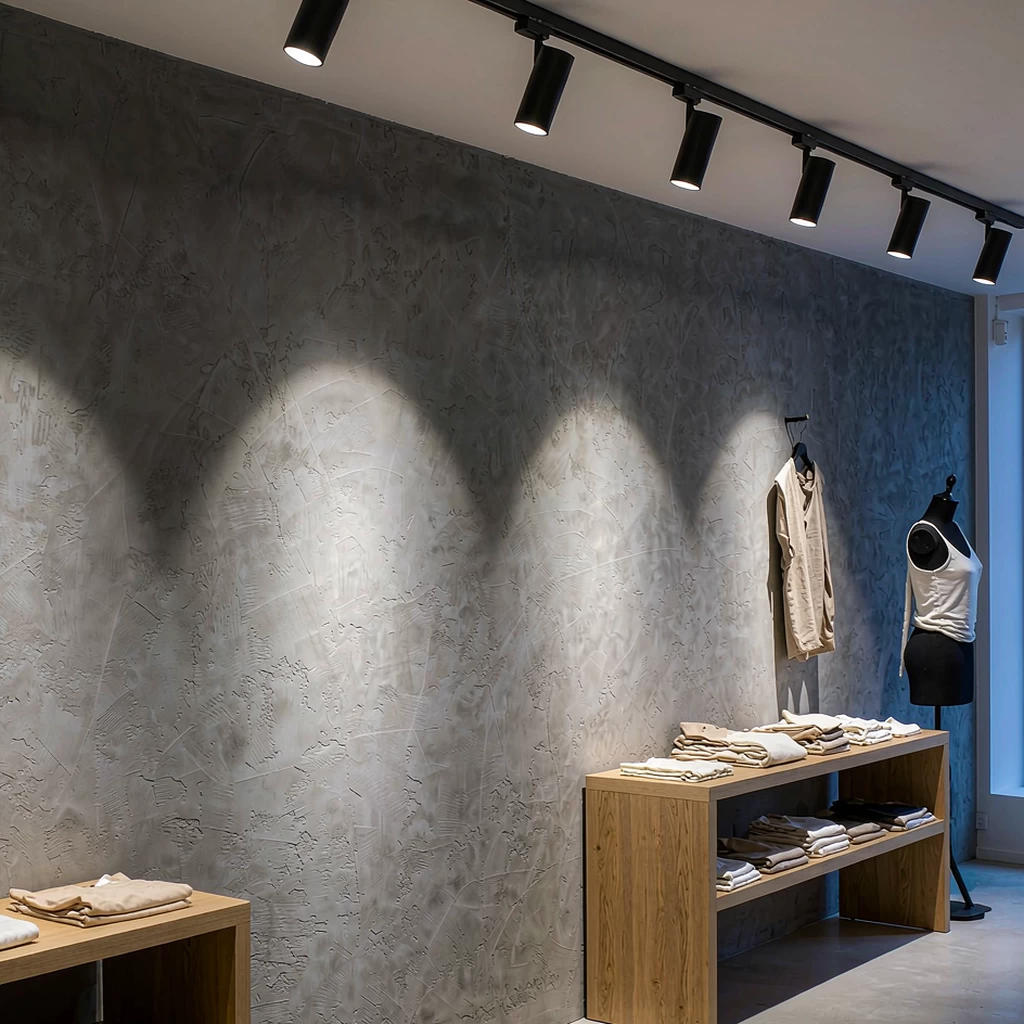
Walk into a well-lit fashion store, a showroom or a gallery and you are almost certainly looking at the work of a track system: a slim ceiling rail, a row of adjustable heads, and pools of light that land exactly where the merchandise is. For B2B buyers, however, an LED track light is easy to get wrong, because you are not buying a lamp — you are buying a system of rail, adapters, luminaires and electrics that has to work together for years. This guide explains how to specify track lighting for retail and commercial accent applications, and what to put in the RFQ so quotations are comparable.
What "LED Track Light" Actually Means: A System, Not a Single Fixture
The first specification mistake is treating a track light as a standalone product. In practice, four components have to match:
The Four Parts of a Track System
- The rail (track). The aluminium extrusion that carries both the mechanical fixing and the electrical conductors. Rails come in 0.5 m to 3 m sections that join into runs, with corner, L/T/X and flexible connectors and end caps.
- The adapter. The part of each head that clicks into the rail, twists to lock, and picks up power. The adapter defines which track standard the head is compatible with.
- The luminaire head. The actual LED track light: housing, COB or SMD engine, driver, reflector or lens, and the tilt/rotation mechanism (typically 350° rotation, up to 90° tilt).
- The feed. How power enters the run: end feed, centre feed, floating feed or canopy feed, plus the circuit configuration (see the electrical section below).
Track Standards and Adapter Compatibility
Track is not fully standardised. Global HV track (the common 3-wire and 4-wire formats) is broadly interchangeable between brands, but low-voltage magnetic track and several proprietary systems are not. Before ordering heads and rail from different suppliers, get written confirmation that adapter, rail and circuit wiring are compatible — ideally test one head on the actual rail. This single check prevents the most common delivery-stage dispute in track projects.
Mounting Options: Surface, Suspended and Recessed
Surface-mounted track fixes directly to the slab and is the default for concrete ceilings. Suspended track hangs on cables or rods from higher ceilings — common in showrooms and double-height retail. Recessed (trimless) track integrates flush into a gypsum ceiling for a minimalist look, at the cost of more drywall coordination. Your ceiling construction decides the mounting method long before aesthetics do.
Where Track Lighting Earns Its Keep
Retail: Accent Lighting That Follows the Merchandise
Retail is the natural home of the LED track light because merchandise layouts change. When the planogram moves, you re-aim heads in minutes instead of re-wiring the ceiling. For the ambient layer, most stores combine track accents with recessed downlights or panel light — our guides on retail and supermarket LED lighting and panel lights for commercial spaces cover that layer in detail.
Showrooms, Galleries and Hospitality
Car showrooms, galleries and hotel lobbies share the same requirement: flexibility plus a clean ceiling. Track delivers both, and mixed runs — accent heads alternating with wall-washers — let one rail serve several roles. In transport hubs, track appears mainly in retail and concession zones; see our subway station lighting guide for how concourses layer fixed and accent lighting.
When Track Is the Wrong Tool
Track is a poor choice when the layout will never change, when maintenance access is difficult (each head has a mechanical adapter that can loosen over years), or when the budget cannot absorb rail and accessory cost for a purely ambient job. For uniform general lighting, fixed luminaires are cheaper and simpler — compare the trade-offs in our downlights vs panel lights guide before committing the whole ceiling to track.
Specifying the Optical Job: Layers, Beam Angles and Aiming
Layer Ambient and Accent Light Separately
Decide first what the track is responsible for. In a typical store, the ambient layer brings the floor to roughly 300–500 lux, and the track heads add accent light on displays — commonly two to five times the ambient level on the merchandise. State this split explicitly in the specification; "500 lux average" alone tells a supplier nothing about the accent layer.
Beam Angle: Narrow, Medium and Wide
| Beam angle | Typical range | Best use |
|---|---|---|
| Narrow spot / spot | 10°–24° | High ceilings, small high-value items, jewellery, tight pools of light |
| Medium flood | 24°–38° | General accent on shelving, mannequins, medium displays |
| Wide flood / wall-wash | 38°–60°+ | Wall-washing, large backdrops, soft general accent |
A practical retail rail usually mixes two or three beam angles rather than standardising on one. Ask suppliers for IES or LDT files per beam angle and check them yourself — our guide to reading IES and LDT photometric files walks through the process, and the lumens vs lux vs watts explainer converts file data into delivered illuminance on the target.
Aiming, Angles and Glare Control
Accent quality depends on geometry: the further a head is aimed off-axis, the more the beam spreads and the faster illuminance on the target drops. Keep aiming angles within about 30–35° of vertical for merchandise walls, and control glare with accessories (snoots, honeycomb louvres, cross baffles) rather than the reflector alone. Because track heads sit below the ceiling line and are visible from most angles, source brightness and cut-off matter more here than the UGR metric — see the UGR explained guide for why.
Colour Quality: Choose Deliberately, Briefly
For merchandise presentation, colour quality is a sales variable, not a nice-to-have. Specify CRI together with R9 (saturated red) rather than CRI alone, and check flicker if the space will be filmed or photographed. The full metric set is covered in the high-CRI metrics guide and the market context in the full-spectrum healthy lighting overview; the practical step here is to put CRI, R9 and flicker requirements in the RFQ and verify them on the sample with a spectrometer, not the datasheet alone.
On colour temperature, 3000K dominates fashion and hospitality retail, while 3500K–4000K suits fresh food, electronics and industrial-styled stores. The key is consistency across the interior — the indoor colour temperature guide explains how to hold one CCT across mixed fixture types.
Electrical Limits: Circuit Load, Inrush and Control
Circuit Load and Breaker Sizing
A track run is a shared circuit, so electrical design matters as much as optics. Sum the wattage of all heads on the run, then add headroom for driver inrush current, which can briefly reach many times the rated current at switch-on — our load calculation guide gives the sizing method including power factor, THD and breaker coordination. Keep the connected load at 80% or less of the circuit rating, and confirm how many heads the drivers allow per 10 A circuit.
Three-Circuit Track and Control Options
Global HV track commonly comes in 3-circuit format: three live conductors share one neutral, so one rail can carry three independently switched groups. This is the cheapest "control system" available — day zone, night zone and window display switch separately with no dimmers at all. If the project needs scene control or daylight response, add DALI or 1-10V dimmable drivers in the heads. Dim-to-warm and tunable heads exist but complicate the supply chain; use them only where the design genuinely needs them. Driver failure modes are covered in our LED driver selection guide.
Compliance and Documentation to Demand
- Safety and EMC certification appropriate to the destination market (CE/UKCA for Europe, and equivalents elsewhere). Ask for the certificate number, not just the logo.
- Photometric files (IES/LDT) for every head and beam angle on the bill of materials.
- Thermal design data. Track heads are compact and run hot; ask for the temperature rise at the driver and the LED junction behind the L70 claim — see the L70 and lumen maintenance guide for reading lifetime claims critically.
- Mechanical data. Rail cross-section and load rating (kg per point and per metre), adapter locking torque, and suspension kit ratings for suspended runs.
- IP rating where relevant. Dry interior retail normally needs no ingress protection, but semi-outdoor arcades and shopfronts under canopies do — the IP rating guide explains what IP65 and IP66 actually certify.
Procurement: Samples, Batch Consistency and the RFQ Pack
Track projects fail at the batch level more often than the sample level. A single head on a rail in the showroom always looks fine; 120 heads across three rails must match in colour, beam and finish. Build the RFQ around that reality:
- Order a mixed sample set: one rail section, connectors, one head per beam angle and CCT, and one dimmable head if the design uses dimming.
- Define the binning requirement in writing: SDCM tolerance (3-step or tighter) across the whole order, with a reference sample retained by both sides — the method is described in our sourcing and inspection checklist.
- Ask for the accessory list explicitly: corner, T, X and flexible connectors, end caps, feeds, suspension kits and joiners per run. Accessory omission is the most frequent cause of delayed installation.
- Agree the spare-part position: which drivers and LED modules are serviceable, and how long the supplier commits to supplying matching heads for future rail extensions.
If the business case for a refit is being built, the payback method in the retrofit ROI guide applies to track upgrades the same way it applies to ambient relighting.
Installation and Commissioning Notes
Three checks turn a good specification into a good installation. Verify the rail is level and the joints are seated — a twisted joint is the classic cause of intermittent contact and flickering heads. Check the aiming pattern from the customer's eye height, not a ladder; angles that look precise from the ceiling rarely look right from 1.6 m. And run a structured handover: our commissioning and acceptance checklist covers the verification points that protect buyer and contractor at project close.
Frequently Asked Questions
Can I mix track heads from different brands on the same rail?
Sometimes, but never by assumption. Global 3-wire HV track formats are often cross-compatible, yet adapter geometry and circuit wiring differ enough between brands that the only reliable answer is a physical test: click the head onto the actual rail, rotate to lock, and confirm power on all three circuits before ordering mixed brands.
How many LED track lights can I run on one circuit?
Work from wattage, not head count. Add the rated power of every head, keep the total at or below 80% of the circuit rating, and derate for driver inrush at switch-on. A 10 A / 230 V circuit typically carries around 1,200–1,500 W of LED track load, but the breaker type and driver data decide — calculate rather than guess.
What beam angle should I use for retail shelving and displays?
Use medium floods (24°–38°) for shelf runs at normal 2.7–4 m ceilings, narrow spots only where the ceiling is high or the product is small and high-value, and wall-wash optics for uniform background walls. Most retail rails mix two or three angles instead of standardising on one.
How far from the wall should track heads be for wall-washing?
A common starting point is one quarter to one third of the wall height: for a 3 m wall, mount the rail roughly 0.75–1 m off the wall with dedicated wall-wash heads, then confirm the offset against the supplier's wall-wash photometry.
Can LED track heads be dimmed, and does dimming change the colour?
Most quality heads dim smoothly with DALI, 1-10V or phase-cut drivers if the driver is specified for it — dimming is a driver attribute, so it must be in the order, not an upgrade later. Standard dimming does not significantly shift colour; dim-to-warm heads deliberately do, which is a design choice, not a defect.
Plan the System, Then Order the Heads
The LED track light is the most adjustable tool in commercial accent lighting, and that flexibility is why the buying decision is systemic: rail standard, adapter compatibility, circuit design, beam angles, colour quality and batch consistency all have to line up. Write the RFQ around the whole system, test samples on the actual rail, and bin-match the production order — the light will then follow your merchandise wherever it moves next.
If your project pairs track accents with a fixed ambient layer, browse the commercial and indoor lighting collection — COB downlight and surface spotlight families such as the MZD anti-glare COB downlight series and the LD ultra-thin recessed COB series are specified to the same colour-consistency discipline described above. Solarix Lighting supplies commercial interior luminaires for retail, office and public-space projects across Asia, Europe and the Middle East — send us your layout and accent requirements, and our engineering team will help you build an ambient-plus-accent scheme that is practical to install and easy to re-aim for years to come.