
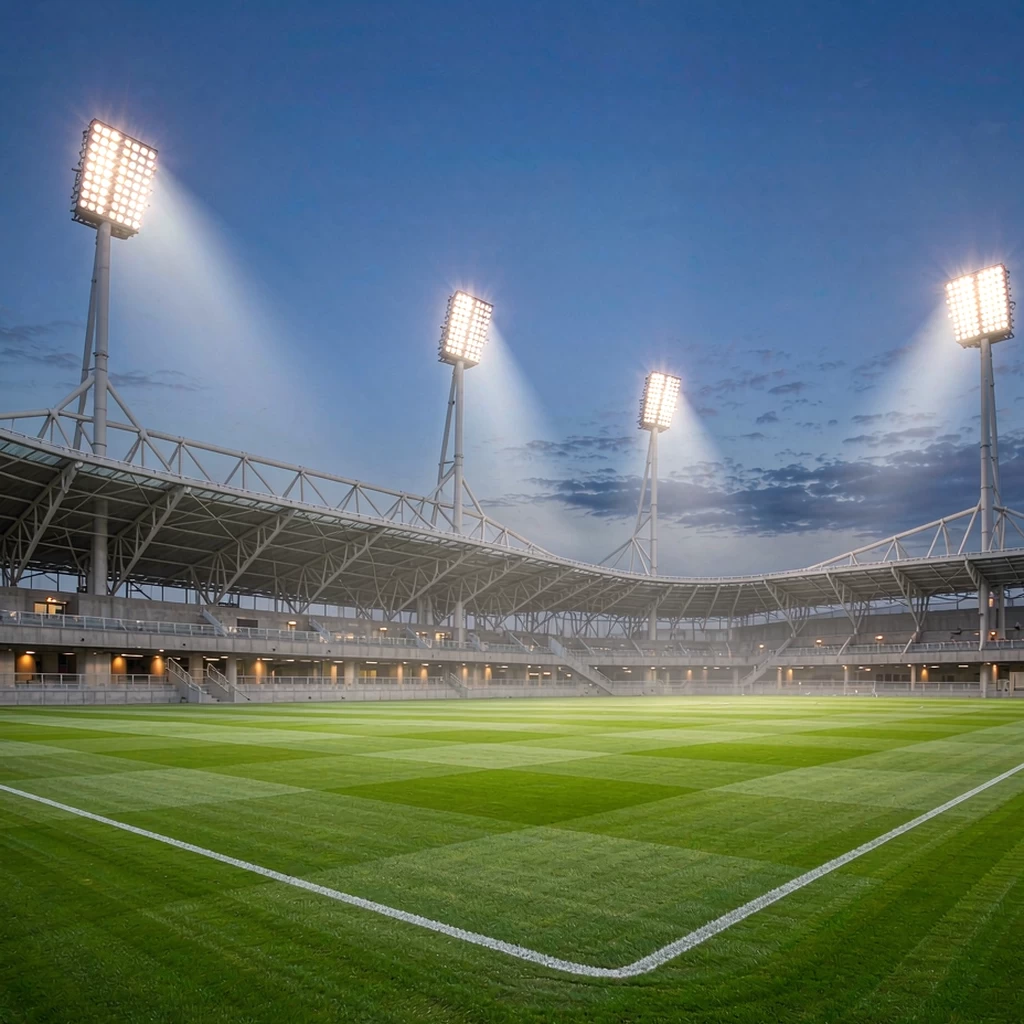
LED lighting for sports and stadiums is often bought as a luminaire count and later discovered to be a compliance exercise. Four masts get priced, installed, and then the league, the broadcaster or the local authority asks for a different class of play. The fixtures were rarely the problem. The missing piece was the requirement.
This guide is for B2B buyers, specifiers and contractors sourcing for pitches, halls, courts and stadium bowls in Europe, North America and Asia. It covers venue class, lighting zones, the documents that define acceptance and what to put in the RFQ, without stating illuminance targets or savings figures, which belong to the governing body, designer and approving authority.
1. Start With the Venue Class, Not the Luminaire
Competition level decides the document set
Training, domestic competition, elite competition and televised competition are four different problems. Each brings its own governing document: a regional sports lighting standard, a federation rulebook, a league regulation or a broadcaster specification. Identify which applies before the first quote, and record it in the tender pack. A supplier cannot choose the class for you.
Indoor hall, outdoor pitch and multi-use court diverge early
A hall is bounded by its roof, so mounting height, access and reflections are fixed by the building. A pitch depends on masts, ground conditions and wind. A community court may serve five sports. These are separate briefs; bundling them into one line item produces a compromise aimed at none.
Three parties own the requirement
The venue owner funds it, the federation validates playing conditions, and the local authority handles planning, electrical inspection and structural approval. Broadcast adds a fourth party. Name them in the project file, because after installation the question is always who accepted which criterion.
Where this guide stops
Mast geometry belongs to the high-mast guide, beam angle and ingress to the flood light guide. Approach roads follow pole height and spacing and parking garage practice.
2. Map the Venue Into Lighting Zones
A stadium is not one lighting condition but a set of zones with different tasks and owners. Splitting the package by zone makes bids comparable.
The playing surface and its run-off
The field of play plus run-off carries the competition requirement, and is usually the only zone where the governing document defines a measurable grid. Include the run-off in that calculation: athletes decelerating out of bounds still need to see the ground.
Spectator bowl, concourse and circulation
Seating areas serve safe movement, wayfinding and a clear view without glare in the eye. Concourses, ramps and vomitories behave like stairwell and corridor lighting and should be priced separately from sports floodlighting.
Perimeter, egress and back of house
Service yards, plant rooms and player tunnels get improvised at the end of the programme if they are left out. Emergency and escape lighting is its own compliance stream: see the emergency lighting guide and confirm all life-safety requirements with the local authority.
| Zone | What is decided here | Who signs off |
|---|---|---|
| Field of play and run-off | Competition class, aiming, measurement grid | Federation, venue owner |
| Spectator bowl | Visibility, glare to spectators, access | Venue operator, designer |
| Concourse and circulation | Safe movement, wayfinding, escape routes | Authority having jurisdiction |
| Perimeter and service areas | Security, vehicles, maintenance access | Venue operator |
| Broadcast positions | Camera sightlines, background contrast | Host broadcaster |
3. Read a Sports Lighting Specification Without Guessing
Maintained illuminance on a reference grid
Sports specifications rarely quote a single lumen figure. They define illuminance maintained over life, evaluated on a measurement grid across the playing area. Grid spacing, mounting height and maintenance factor are part of that definition, so a bid quoting bare output cannot be compared with one quoting a grid result.
Uniformity is two numbers, not one
Uniformity usually appears as minimum-to-average and minimum-to-maximum. The first describes how flat the lighting feels; the second catches dark patches a player or camera will notice. Ask which definition a bidder used: one layout can look compliant under one ratio and marginal under the other.
Glare belongs to the athlete's line of sight
Stadium glare is not office discomfort glare. It depends on where the luminaire sits relative to a player looking up, sideways or down the pitch, and on the brightness behind it. The UGR explainer covers the metric family; sports glare is judged from defined viewing directions.
Colour, flicker and camera-facing behaviour
Adjacent floodlights appear in the same frame, so colour consistency matters more than in interior work; see the colour consistency guide. Where slow-motion capture is planned, flicker becomes a procurement question — the flicker verification guide explains which documents to request.
Photometric files are the contract
A layout is only as good as the file behind it. Request the IES or LDT file for the exact luminaire and optic proposed, and confirm it matches the delivered model. The IES and LDT guide shows what to inspect; distribution types show whether a beam suits the mast position.
4. Indoor Versus Outdoor: What Changes in Procurement
Structure, access and maintenance
Indoor fittings hang from roof steel or catwalks, and a driver replacement may need a lift or a court closure. Outdoors, the constraint is mast access and weather windows. Both reward serviceable luminaire design, because maintenance cost follows access, not the fixture.
Impact, ingress and corrosion
Balls, equipment and cleaning hit indoor fittings; rain, dust, salt and ultraviolet attack outdoor ones. Specify impact and ingress protection by position rather than for the whole project, and read the IP rating guide before accepting a headline number.
Daylight and surface reflection
Roof glazing and light-coloured surfaces change how a hall reads in daylight, and polished floors add reflected glare no photometric file predicts. Raise both at design stage. Outdoors, low sun angles can matter as much as the floodlights during late-afternoon fixtures.
5. Multi-Use Venues and Reconfigurable Presets
The second-sport problem
A court used for basketball, badminton and volleyball has three ideal aiming patterns and three glare sensitivities. One fixed aim will favour one sport. Decide at procurement whether the venue accepts that compromise or pays for re-aiming, extra circuits or adjustable brackets, and record the decision.
Scene control and the operator
Competition, training, cleaning and event modes are delivered as scenes, and who operates them is a procurement question: a scene needing a technician every Saturday is a different product from one recalled from a panel. See the smart control guide and dimming protocols.
6. Retrofit, Temporary and Phased Programmes
Reusing existing structures
Many upgrades keep the masts and replace only the luminaires. That saves capital and transfers risk: new fittings may be heavier or aimed differently, and the structure may never have been assessed for that load or wind area. Require a structural check before the order.
Working around the season
Installation windows are short and fixed by the fixture calendar, so lead time, phased delivery and aiming visits are commercial terms, not afterthoughts. Where a venue cannot close, plan zone-by-zone changeover and agree how partial installations are assessed.
7. Acceptance: Aiming, Measurement and Handover
The aiming report
Aiming is where a compliant design becomes a compliant installation. Require a record listing each luminaire, its circuit, aim point and adjustment date, kept as an as-built document. Without it, every later fault becomes an argument about who moved what.
Measuring after installation
Acceptance should be measured on the grid defined by the governing document, under the conditions it specifies, with calibrated instruments. The commissioning and site acceptance checklist structures the walk-through and sign-off. Agree in advance what happens if a reading falls outside tolerance.
Handover package and spares
The handover set should include as-built drawings, circuit schedules, control sequences, installed photometric files, aiming records, test certificates and a spare-parts list. Warranty terms are a separate review: see the warranty guide. Confirm whether spare drivers and modules are held locally.
8. Procurement Pitfalls to Catch Early
- A bid priced on luminaire count with no measurement grid.
- Uniformity quoted without stating which ratio definition was used.
- No named owner for aiming, re-aiming or seasonal adjustment.
- Life-safety and egress lighting left out of the sports package.
- Acceptance criteria agreed verbally after installation.
9. What to Put in the Sports Lighting RFQ
- Venue type, dimensions, run-off and the sports to be served.
- The governing document and competition class, named and dated.
- Documentation required: photometric files, layout, aiming plan, test reports.
- Mounting positions and whether existing structures are reused.
- Circuit and control architecture, and who supplies the control system.
- Ingress, impact and corrosion requirements by zone.
- Maintenance access method and expected spare-parts holding.
- Delivery phases and available installation windows.
- Acceptance method, instrument responsibility and tolerance handling.
- Warranty scope, start date and claim process.
Buyers who align these fields before issuing the enquiry get bids comparable line by line — the discipline described in the tender and bid documents guide.
Frequently Asked Questions
Does LED lighting for sports and stadiums always require a lighting designer?
For competition or broadcast venues, usually yes: the governing document defines grids and viewing directions that must be modelled. For training pitches and community courts, a supplier-prepared layout may suffice if the class is confirmed.
Can existing metal halide installations be converted to LED?
Often yes, but it is not a lamp swap. Output, beam distribution, weight, control gear and aiming all change, so layout, electrical load and structure need review. Confirm in writing which parts are reused.
How many spare luminaires should a venue keep?
No universal figure exists; it depends on fixture count, access difficulty, lead time and how often the venue must stay operational. Ask the supplier for a recommendation based on your maintenance arrangements.
Does a higher IP rating make a sports luminaire better?
Not by itself. The right rating depends on position, exposure and cleaning regime, and a higher number can add cost without benefit indoors. Match the rating to the zone and confirm how it is verified, as the IP rating guide describes.
What happens if measured results miss the target?
Settle that before installation. A workable contract defines measurement conditions, permitted tolerance, re-aiming or replacement process and time to correct. Without those clauses, a marginal reading becomes a dispute.
Next Step
If you are scoping a pitch, hall, court or stadium bowl, start by writing down the class, the zones and the documents the venue must satisfy. That short brief turns a luminaire enquiry into a comparable package.
Solarix Lighting supplies LED luminaires for outdoor, industrial and commercial interior applications, with specification data and photometric files. Browse the outdoor lighting collection, the industrial lighting collection or the full product range, and send your venue brief with the governing class so our team can respond against the same criteria. More guidance is in All Blogs and Lighting Knowledge.