
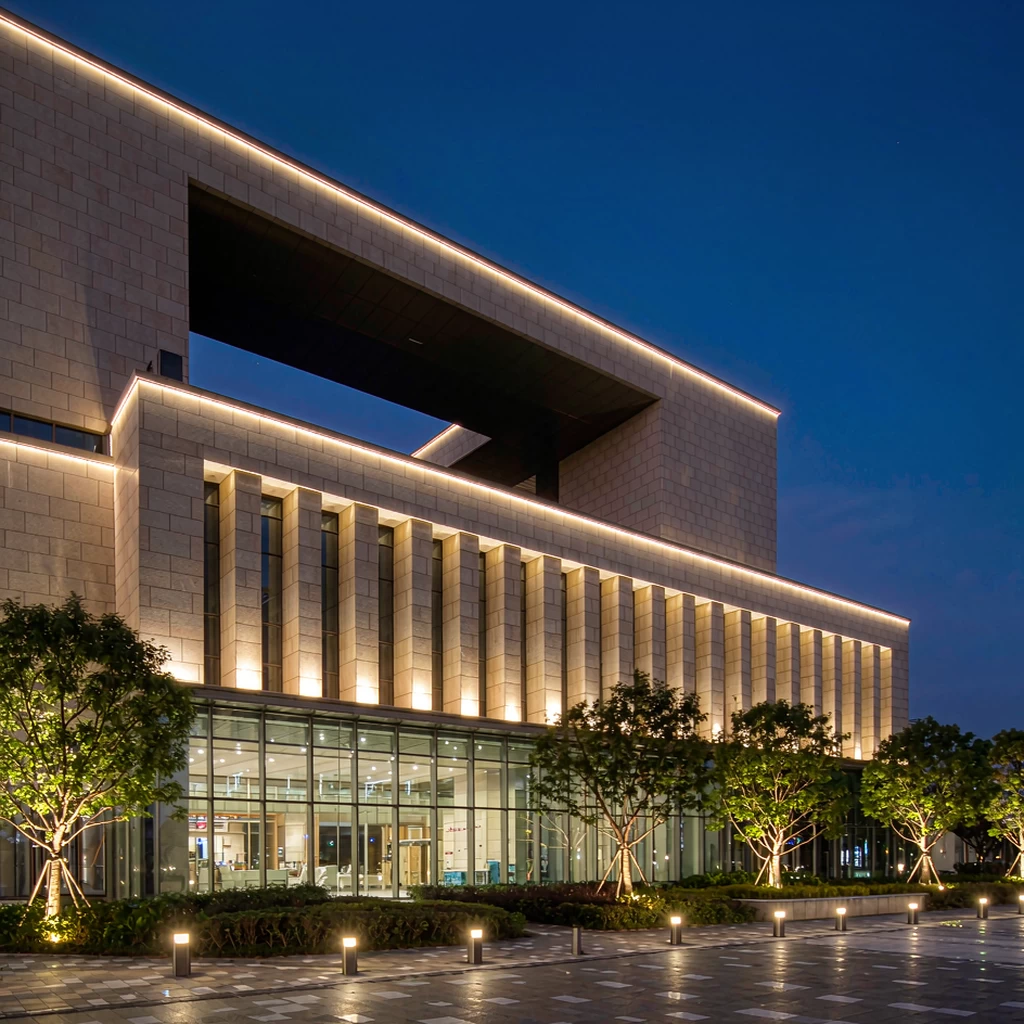
LED lighting for landscape and facade projects fail less often because a luminaire is wrong than because the scope was never written down. A render is not a specification, and a "warm wash on the elevation" can be quoted five different ways. For B2B buyers, specifiers and contractors across Europe, North America and Asia, the question is which effects, interfaces and responsibilities become verifiable before an order is placed.
This guide treats LED lighting for landscape and facade as its own procurement category: scope boundaries, documents in place of renders, mounting responsibility, outdoor exposure, circuit zoning and acceptance. It deliberately avoids illuminance targets, savings figures and performance claims, which belong to the project's lighting designer and local approvals.
1. Define the Scope Before the RFQ
Facade and landscape are two different scopes
Facade lighting is fixed to a building: grazing, wall washing, silhouetting, revealing structure or outlining edges. Landscape lighting sits in the ground plane: paths, planting, steps, bollards, water features and trees. They share a night-time appearance but use different mountings, cable routes and maintenance access. Listing them as one line item invites a single generic quote, so separate the elevation schedule from the landscape schedule and price them independently.
Where this scope ends
Roadway luminaires, pole geometry and spacing, high-mast area lighting, tunnel lighting and sports floodlighting are separate disciplines with their own photometric and structural logic. Our flood light specification guide, high-mast guide, pole height and spacing guide and tunnel lighting guide cover those categories. Keep their criteria out of the elevation package.
Put the boundary in the tender pack
State which drawings govern, which trades supply brackets, and where each circuit terminates. A scope matrix closes the common gap where nobody owns the cable between the facade bracket and the nearest junction box; align the wording with the tender and bid document structure so every bidder prices the same interfaces.
2. Turn Nightscape Intent Into Verifiable Requirements
Specify the effect, not the fitting
"Graze the stone fins from 200 mm offset" is testable; "make it look like the render" is not. Describe the surface, the setback, the direction of light, the intended brightness relationship between elements and any surfaces that must stay dark. Avoid naming wattage as a proxy for effect. The lumens, lux and watts explainer sets out the vocabulary; it does not replace a designer's calculation.
Photometric files as the anchor
Ask for an IES or LDT file for every optic offered, plus the beam and field angles and the aiming geometry used in the mock-up. Our guide to reading photometric files explains what they contain, and the distribution type overview shows why a facade optic and a roadway optic are not interchangeable. Files, not catalogue phrases, are what a reviewer can check.
Mock-ups before bulk release
Agree a sample or on-site mock-up as a contractual milestone: which elevation bay, which tree, which hours, who attends and what gets recorded. Approve aiming angle, shielding and apparent colour on the actual substrate, not a white board. Align this with the sample and pre-shipment inspection process so the approved unit becomes the batch reference.
Colour consistency across batches
Facades make variation obvious: adjacent luminaires on one plane are compared instantly. Require the same CCT, binning declaration and driver family across an elevation, and state how replacements will be matched. The colour consistency and binning guide lists the fields to request without asserting a tolerance.
3. Glare, Spill Light and the Compliance Boundary
Aiming and shielding as line items
Every exterior luminaire needs a defined aim point, a shielding or baffle requirement and a stated limit on light leaving the intended surface; record these as schedule columns, not prose. For the vocabulary, the plain-language UGR guide is useful background, though exteriors are assessed under local criteria.
Who owns compliance
Spill light, curfews, dark-sky expectations, heritage facades, aviation constraints and neighbour impacts are jurisdiction-specific. This guide states no limit values and certifies nothing. Confirm the ordinance, the authority having jurisdiction and required submittals with the designer and approval body before tender; our energy code compliance workflow and EU product compliance guide cover documentation practice in adjacent areas.
4. Mounting Positions and Structural Responsibility
Brackets, penetrations and anchorage
Decide who supplies brackets, who drills the cladding and who certifies the fixing into the substrate. A facade fixing is a structural and weatherproofing interface, not a lighting accessory; require shop drawings of bracket, fastener, load path and sealing, with the cladding trade as a named approver.
Coordinating with cladding and curtain-wall trades
Luminaires on a rainscreen, stone panel or curtain wall must not compromise the cavity, drainage plane or that assembly's warranty; agree the fixing sequence and field-adjustment tolerance. Where linear runs follow an elevation, the coordination questions in our linear light guide still apply.
Cable routes and access for replacement
Concealed cables, junction boxes and driver locations should be drawn, not assumed; confirm a failed unit can be reached without scaffolding or removing finished landscaping, and record the access method. The serviceable fixtures guide lists the questions on field-replaceable components.
5. Ingress Protection and the Outdoor Environment
Read IP and IK as documents, not adjectives
"Weatherproof" is not a specification. Ask for declared IP and IK ratings, the test report reference and the installation orientation, since a rating can depend on mounting. Our IP rating guide explains what the digits cover and, just as importantly, what they do not.
Coastal, salt and poolside exposure
De-icing salts, marine aerosol, chlorinated water and fertiliser-rich planting all change the material question; specify housing finish, fastener material and gasket compound as schedule items, and ask the supplier to state the assumed exposure class in writing. Do not accept a general "outdoor" label in aggressive environments.
Drainage, condensation and in-grade fittings
Ground-recessed uplights and step lights sit in water; require drainage, a condensation path and a defined lens-cleaning interval, and confirm the fixture is rated for the intended load in trafficked surfaces. Heat and driver access interact with all of this; the thermal management guide and lumen maintenance explainer show how to read lifetime claims without treating them as guarantees.
6. Power, Circuits and Scene Control
Zone by scene, not by convenience
Group circuits by what must dim or switch together: elevation planes, tree uplights, path bollards, signage and curfew-limited layers. A circuit list that mirrors the electrical drawing rather than the scene plan makes commissioning guesswork; include the zoning in the control strategy from the outset.
Load, voltage drop and surge
Long external runs make load calculation and voltage-drop checks a real design task, not a formality; confirm driver location, cable size, inrush and protective device coordination, and treat surge exposure as a separate line item. The load calculation guide and surge protection guide cover the documents to request.
Interfaces, schedules and failure state
State the control interface in the schedule, keeping protocol discussion out of the aesthetic brief — the 0-10V vs DALI comparison covers that. Define time-based scenes, manual override, maintenance isolation and each circuit's behaviour on loss of signal. Where exteriors meet egress routes, keep emergency lighting and circulation space responsibilities clearly separate.
7. Documentation and Site Acceptance
The submittal package
Require one indexed pack: fixture schedule, photometric files, IP/IK declarations, finish and material schedule, mounting shop drawings, wiring and zoning diagrams, control interface, sample approval record and spare-parts list. Field-by-field quotation comparison is easier when every supplier uses the same structure.
Aiming and commissioning record
Night-time aiming is where a facade scheme is won or lost; agree who sets each aim point, who witnesses it and how as-built angles are recorded. A short commissioning checklist with dated photographs and a signed aiming schedule beats a verbal sign-off.
Defining acceptance in the contract
Separate "delivered", "installed", "aimed" and "accepted"; tie acceptance to the approved mock-up and documented submittal pack, not a subjective impression on the night. Clarify how the warranty terms apply to exterior fixtures and who owns replacement labour at height.
8. RFQ Field Checklist for LED Lighting for Landscape and Facade
Use this as a completeness check before issuing an enquiry; the values themselves come from the project designer.
- Scope split: elevation schedule versus landscape schedule
- Effect description, surface, setback and aim point per luminaire type
- IES or LDT file, beam and field angle per optic
- CCT, binning declaration and replacement-matching rule
- Shielding, baffle and spill-light constraint notes
- Mounting detail, bracket ownership and cladding approval
- IP/IK declarations, finish, fastener and gasket specification
- Circuit zoning, control interface, time scenes and failure state
- Mock-up, sample approval and commissioning milestones
- Submittal index, as-built format and spare-parts list
9. Frequently Asked Questions
Should facade and landscape lighting go in one RFQ?
They can share one tender, but keep separate priced schedules. The mountings, cable routes, access methods and approval trades differ, and a combined line item hides those differences until installation.
Can we specify a luminaire by wattage alone?
No. Wattage says nothing about distribution, aiming or the surface being lit. Anchor the specification to a photometric file, a described effect and an approved mock-up instead.
Who decides the spill-light and curfew limits?
The local authority, the applicable ordinance and the project's lighting designer. We state no values here; treat compliance as a documented approval step owned by the project, not by a product datasheet.
How do we control colour variation across a long elevation?
Require one declared binning basis for the whole elevation, keep the same driver family, and record how future replacements will be matched. Approve the assembled run in the mock-up, not as isolated samples.
What should a handover contain?
An indexed as-built pack: the aiming schedule, circuit and zoning diagrams, approved submittals, sample record, commissioning photographs and the spare-parts and access plan. It is the reference for later maintenance and for any sourcing and inspection discussion.
10. Next Steps
Start with the scope matrix and effect schedule, then ask suppliers to respond against the checklist above. Our outdoor lighting collection and full product range cover adjacent commercial and industrial categories; the Lighting Knowledge collection and All Blogs hold the wider technical library, with sourcing context in the China sourcing checklist and packaging guide. Nothing here guarantees any approval, performance or commercial outcome — confirm every requirement with your designer, contractor and the relevant authority. Solarix Lighting — Guangzhou Xuyuan Lighting.