
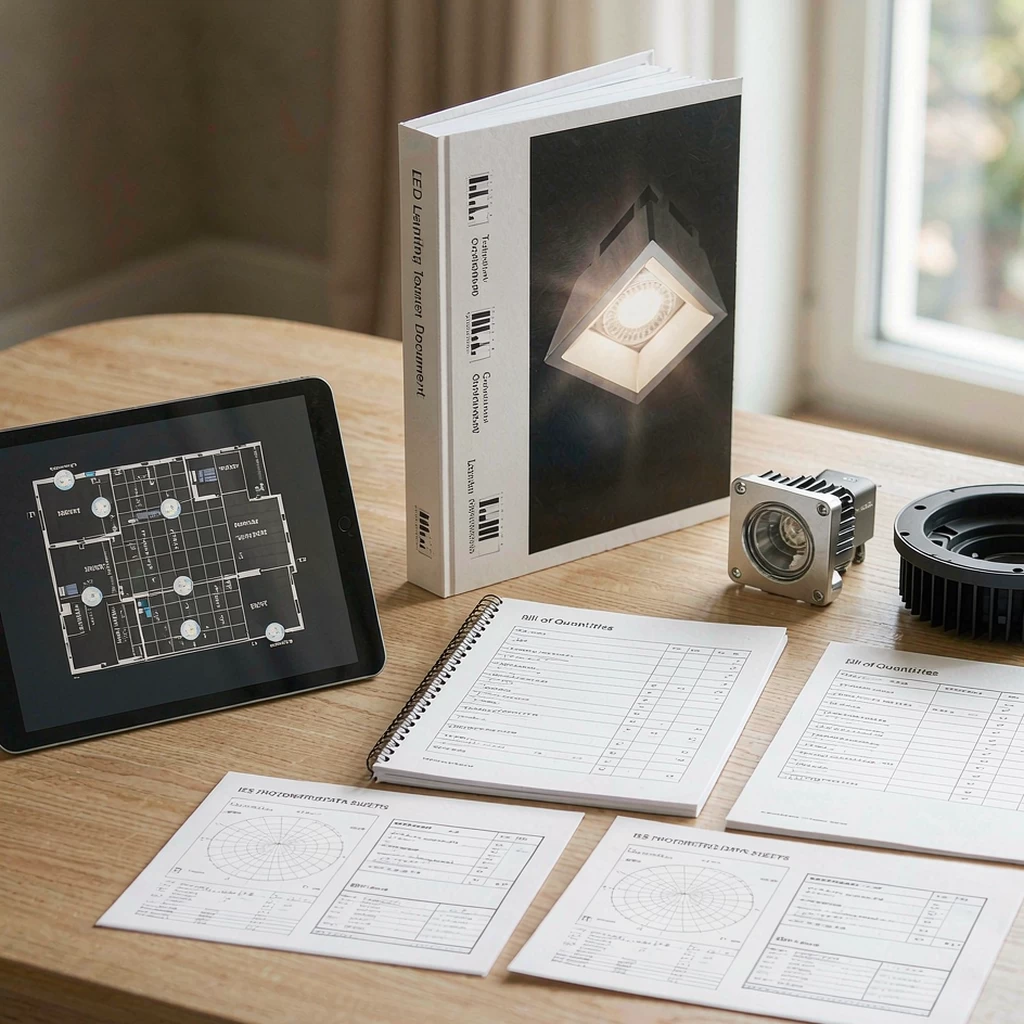
Most LED lighting tenders are not lost on price. They are lost in the document set — a missing photometric file, an unqualified "compliant" against a mandatory clause, a warranty that quietly excludes the driver, or a delivery term the bidder never priced.
This guide is for procurement managers and project buyers who assemble, issue or evaluate LED lighting tender and bid documents: what a bid package should contain, which technical evidence to require, how to build an evaluation model that discriminates between genuinely different offers, and the defects that disqualify capable suppliers. Requirements vary by country, utility and funding body, so treat it as a checklist to adapt rather than a template to copy.
Why Lighting Tenders Fail Before Price Is Opened
Lighting is deceptively easy to specify and surprisingly hard to compare. Two fixtures can carry the same wattage, the same nominal lumen output and the same "50,000 hours" claim while differing substantially in optical distribution, driver quality, colour consistency, ingress protection and the practical meaning of their warranty. When the tender document does not force those differences into the open, evaluation collapses into a spreadsheet of unit prices, and the cheapest line wins on information the buyer never verified.
A well-structured LED lighting tender document does three jobs: it tells bidders exactly what evidence to submit, it gives the panel a defensible scoring method, and it converts the contract into something checkable on site. Any clause doing none of those is noise — and noise is expensive, because every ambiguous line generates clarifications, addenda and later claims.
What an LED Lighting Bid Package Should Contain
Tender packages are named differently by market — ITT, ITB, RFT, RFP, or a two-envelope public process — but the functional parts are consistent across Europe, North America, the Middle East and Asia.
Instructions to Bidders
This governs the process: deadline and submission method, single or two-envelope, bid validity period, currency and Incoterms, whether alternatives are permitted, the clarification window, accepted formats and languages, and the right to reject non-conforming bids. It pre-empts the two most common disputes — a bidder claiming their alternative was ignored, and a buyer trying to clarify what should have been declared as a deviation.
Technical Specification and Bill of Quantities
The specification describes performance and construction; the BOQ turns it into countable line items. Keep them linked with shared item codes — a recurring fault is a line reading "LED high bay, 150W, IP65" with no reference to the performance clause it must satisfy, which makes consistent scoring impossible. For how quantities are derived before reaching a BOQ, see lumens, lux and watts in lighting calculations and warehouse lighting layout and procurement.
Compliance Schedule and Deviation Sheet
The most useful document in the package: every mandatory requirement gets a row, and the bidder marks "comply", "comply with deviation" or "does not comply", stating the actual value plus the page where proof sits. A bid marked "compliant" with no value is unassessable — your evaluation rules should say so explicitly.
Commercial Forms and Contract Conditions
Price schedule, payment terms, delivery schedule, liquidated damages, warranty document, spares pricing and any performance bond. Insist the warranty is submitted as a document, not a sentence in the offer letter: our article on L70 and lumen maintenance claims shows why a lifetime number without its test basis is not a warranty.
The Technical Submission: Evidence Worth Requiring
The temptation is to ask for everything. That backfires: bidders submit a 400-page data dump, evaluators read the summary page, and the differentiators stay hidden. Ask instead for a small set of evidence mapped to how the product fails or disappoints in service.
Photometric Files and Calculations
Require IES or LDT files for every luminaire type, plus a calculation output for the actual room or road geometry. A spec-sheet lumen figure says nothing about whether light lands where it is needed — see our guide to reading IES and LDT photometric files and to IESNA distribution types and pole spacing.
Lifetime and Lumen Maintenance
Ask for the LED package test data, the projection method, the claimed L-value with hours, and the case temperature (Tc or Ts) at which it holds, plus the fixture's ambient rating. A claim quoted at 25 °C ambient says little about a sealed high bay running at 45 °C; where relevant, request thermal management and driver temperature data too.
Ingress, Impact and Electrical Safety
IP and IK ratings must be backed by test reports naming the standard and revision, covering the complete luminaire rather than a component. Our IP rating guide (IP65 vs IP66) and surge protection guide help when drafting outdoor clauses. Where reports must come from ISO/IEC 17025-accredited laboratories, state it in the instructions, not a footnote.
Driver, Control and Power Quality
Request driver make and model, rated case temperature and design life, dimming interface, power factor, harmonic performance and inrush current. Inrush is routinely overlooked at tender stage and discovered at energisation when protective devices trip — see load calculation, power factor, THD and inrush and our LED driver selection guide.
Optical Comfort and Colour Quality
For interior schemes, ask for UGR calculated for the actual room, CRI and R9, TM-30 data where available, colour tolerance in MacAdam steps or SDCM, and flicker metrics — the items most often omitted and most often regretted after handover. See UGR and glare, colour quality metrics and verifying flicker-free and low-blue-light claims. Where energy code compliance must be shown, require a lighting power density calculation and control narrative, naming the applicable edition rather than the standard generically.
Building a Compliance Matrix That Actually Discriminates
Separate Mandatory from Rated Criteria
Mandatory criteria are pass/fail gates: safety certification, minimum IP rating, required dimming interface, maximum wattage per area. Rated criteria are where scoring happens: photometric performance, warranty scope, spares, lead time. Mixing the two is the most common structural error — a "mandatory" requirement nobody can fully meet forces the panel either to disqualify everyone or to ignore its own rules.
Write Measurable Pass/Fail Lines
Replace adjectives with numbers. "Good colour rendering" is not assessable; "CRI ≥ 80 and R9 > 0, supported by test data" is. "Suitable for outdoor use" is not assessable; "IP66 to IEC 60529 and IK08 to IEC 62262, with accredited test reports" is.
Handle "Or Equivalent" Deliberately
"Or equivalent" protects a tender from being challenged as restrictive and simultaneously opens the door to substitutions the specifier never intended. The fix is procedural: allow equivalents, but require a clause-by-clause comparison and an explicit statement of any requirement the equivalent does not meet, so the panel assesses declared differences instead of discovering them at delivery. The same applies to vague drafting — "as per manufacturer's standard", "high quality LED", "comply with all relevant standards" transfer control to the bidder and cannot be enforced. Name the standard and edition, or delete the line.
Evaluating Bids Beyond Unit Price
Normalise Before You Score
Check that offers are comparable. Two bidders quoting 150 W fixtures may deliver very different lumen packages; a lower unit price with lower maintained lumens is not a saving. Normalise on delivered lumens at the specified L-value, on fixture count after the photometric calculation, and on control equipment included or excluded — and write that method into the evaluation rules. Where past references form part of the submission, our guide to reading a lighting project case study explains what a reference actually proves.
Weigh Whole-Life Cost Transparently
Energy, maintenance access, expected driver replacement interval and warranty scope belong in a whole-life view, especially for high-mount installations. Declare the inputs — discount rate, operating hours, tariff and labour assumptions — in the tender itself; the method is covered in our retrofit ROI and payback guide. No saving should be presented as guaranteed, since results depend on site conditions, tariffs and usage.
Score Delivery, Spares and Support
Lead time, packing standard, spares price validity and warranty response time are genuine risks. A low-priced bid with a 14-week lead time can cost more than a compliant 8-week offer once delay damages apply. Ask for a delivery schedule per BOQ line and a spares price list valid for a defined period after commissioning.
Example Weighting Model
| Criterion | Type | Typical weight | Evidence required |
|---|---|---|---|
| Safety certification | Mandatory | Pass/fail | Reports naming standard and edition |
| IP / IK rating | Mandatory | Pass/fail | Report for complete luminaire |
| Photometric performance vs target lux / uniformity | Rated | 25–35% | IES or LDT files + calculation |
| Lumen maintenance and lifetime | Rated | 10–15% | Test data, projection, Tc / ambient |
| Colour quality, glare, flicker | Rated | 10–15% | CRI / R9 / TM-30, UGR, flicker |
| Warranty scope and claims process | Rated | 10–15% | Warranty document, exclusions |
| Price and whole-life cost | Rated | 25–40% | Priced BOQ, energy and labour inputs |
| Lead time, packing, spares | Rated | 5–10% | Delivery schedule, spares list |
Weights are illustrative only. Public-sector and funded projects are often constrained by procurement rules — confirm what is permitted before publishing.
Defects That Get Compliant Bids Disqualified
Evaluation panels see the same documentation problems repeatedly, and most are avoidable if the tender states the rule up front:
- Unqualified "compliant" — no value, standard revision or page reference.
- Reports for a different model or configuration, or covering only a component.
- Lifetime claims without their basis — no test method, projection or temperature.
- Warranty excluding the driver, or with no defined failure threshold.
- Missing or mismatched photometric files for the offered wattage or optics.
- Undeclared deviations that surface only when the sample arrives.
- Incomplete price schedule, or quantities silently altered.
- Bid validity shorter than required, removing the bidder at award stage.
A Bidder's Pre-Submission Check
Read the same structure in reverse: confirm every mandatory clause has a value and a document behind it; photometric files match the offered configuration; lifetime claims carry their test basis; the warranty document is attached and covers the driver; Incoterms, currency, validity and payment terms match the instructions; and packing and shipping protection is described rather than assumed. Our RFQ, sampling, audit and inspection guide complements this pre-award, and the commissioning and site acceptance checklist covers post-award.
Where Product Evidence Fits In
Tender documents should reference product families only after the performance requirement is defined. A road scheme sets mounting height, road class, target luminance and uniformity, surge protection and pole details first — then points to candidates such as the P Series modular LED street light or the Y Series split solar LED street light within the outdoor lighting range; the municipal street light buying guide and solar vs grid comparison help when drafting those clauses. For industrial schemes see the industrial collection and the high bay spacing guide; for interiors, the commercial and indoor collection and the LED panel light procurement guide.
Frequently Asked Questions
What documents should a buyer require in an LED lighting tender?
At minimum: a completed compliance schedule, IES or LDT files with a matching calculation output, lumen maintenance evidence with its test basis, IP/IK and safety reports, driver and power quality data, a warranty document, and a priced BOQ with a delivery schedule. Anything beyond that should be justified by a specific project risk.
How long should the bid validity period be?
Long enough to cover evaluation, any mandatory standstill period, internal approval and signature — often 60 to 120 days in practice. Confirm against your own procurement rules and the expected fixture lead time; validity shorter than your approval cycle creates re-tender risk.
Should lighting tenders be single or two-envelope?
Two-envelope is generally preferable when technical quality genuinely differentiates offers, because it stops price from anchoring the technical assessment. Single-envelope suits standardised items where responsive bids are functionally equivalent.
How should "or equivalent" be handled without weakening the specification?
Allow it, but require a clause-by-clause comparison and an explicit declaration of any requirement the equivalent does not meet; silence should be treated as non-compliance.
What is the most common reason a good supplier is disqualified?
Incomplete compliance documentation — "compliant" with no supporting value, report or page reference. It is a paperwork failure rather than a product failure, and the easiest for a bidder to fix before submission.
Next Steps for Your Next Lighting Tender
Start from the decision, not the document. Write down what the panel actually needs to compare, build the compliance schedule and evidence list around it, then draft the specification clauses those rows refer to. Done in that order, the bid package gets shorter, clarifications get fewer, and the award becomes defensible.
Solarix Lighting supplies commercial, industrial, outdoor and rail transit LED luminaires to project buyers and distributors. If you are preparing a tender package and want a clause-by-clause view of what documentation a supplier should provide, share your draft specification with our team — we will say what we can evidence and where our scope ends. Browse the product catalogue, read more guidance in our lighting knowledge collection, or get in touch about your project documentation.